GAP and the Atiyah–Singer Index Theorem
\(
\def\cuberoot#1{\sqrt[3]{#1}}
\def\fourthroot#1{\sqrt[4]{#1}}
\def\abspartial#1#2#3#4{\left|\,{\partial(#1,#2)\over\partial(#3,#4)}\,\right|}
\def\absdeltal#1#2#3#4{\left|\,{\d(#1,#2)\over\d(#3,#4)}\,\right|}
\def\dispop#1#2{\disfrac{\partial #1}{\partial #2}}
\def\definedas{\equiv}
\def\bb{{\bf b}}
\def\bB{{\bf B}}
\def\bsigma{\boldsymbol{\sigma}}
\def\bx{{\bf x}}
\def\bu{{\bf u}}
\def\Re{{\rm Re\hskip1pt}}
\def\Reals{{\mathbb R\hskip1pt}}
\def\Integers{{\mathbb Z\hskip1pt}}
\def\Naturals{{\mathbb N\hskip1pt}}
\def\Im{{\rm Im\hskip1pt}}
\def\P{\mbox{P}}
\def\half{{\textstyle{1\over 2}}}
\def\third{{\textstyle{1\over3}}}
\def\fourth{{\textstyle{1\over 4}}}
\def\fifth{{\scriptstyle{1\over 5}}}
\def\sixth{{\textstyle{1\over 6}}}
\def\oA{\rlap{$A$}\kern2pt\overline{\phantom{\dis{}I}}\kern.5pt}
\def\obA{\rlap{$A$}\kern2pt\overline{\phantom{\dis{}I}}\kern.5pt}
\def\obX{\rlap{$X$}\kern2pt\overline{\phantom{\dis{}I}}\kern.5pt}
\def\obY{\rlap{$Y$}\kern2pt\overline{\phantom{\dis{}I}}\kern.5pt}
\def\obZ{\rlap{$Z$}\kern2pt\overline{\phantom{\dis{}I}}\kern.5pt}
\def\obc{\rlap{$c$}\kern2pt\overline{\phantom{\dis{}I}}\kern.5pt}
\def\obd{\rlap{$d$}\kern2pt\overline{\phantom{\dis{}I}}\kern.5pt}
\def\obk{\rlap{$k$}\kern2pt\overline{\phantom{\dis{}I}}\kern.5pt}
\def\oba{\rlap{$a$}\kern2pt\overline{\phantom{\dis{}I}}\kern.5pt}
\def\obb{\rlap{$b$}\kern1pt\overline{\phantom{\dis{}t}}\kern.5pt}
\def\obw{\rlap{$w$}\kern1pt\overline{\phantom{\dis{}t}}\kern.5pt}
\def\obz{\overline{z}}\kern.5pt}
\newcommand{\bx}{\boldsymbol{x}}
\newcommand{\by}{\boldsymbol{y}}
\newcommand{\br}{\boldsymbol{r}}
\renewcommand{\bk}{\boldsymbol{k}}
\def\cuberoot#1{\sqrt[3]{#1}}
\def\fourthroot#1{\sqrt[4]{#1}}
\def\fifthroot#1{\sqrt[5]{#1}}
\def\eighthroot#1{\sqrt[8]{#1}}
\def\twelfthroot#1{\sqrt[12]{#1}}
\def\dis{\displaystyle}
%\def\definedas{\equiv}
\def\bq{{\bf q}}
\def\bp{{\bf p}}
\def\abs#1{\left|\,#1\,\right|}
\def\disfrac#1#2{{\displaystyle #1\over\displaystyle #2}}
\def\select#1{ \langle\, #1 \,\rangle }
\def\autoselect#1{ \left\langle\, #1 \,\right\rangle }
\def\bigselect#1{ \big\langle\, #1 \,\big\rangle }
\renewcommand{\ba}{\boldsymbol{a}}
\renewcommand{\bb}{\boldsymbol{b}}
\newcommand{\bc}{\boldsymbol{c}}
\newcommand{\bh}{\boldsymbol{h}}
\newcommand{\bA}{\boldsymbol{A}}
\newcommand{\bB}{\boldsymbol{B}}
\newcommand{\bC}{\boldsymbol{C}}
\newcommand{\definedas}{\equiv}
\newcommand{\half}{\frac{1}{2}}
%\newcommand{\slfrac}[2]{\raisebox{0.5pt}{$\scriptstyle{}^{#1}\!/\!_{#2}$}}
\def\slfrac#1#2{\raise.8ex\hbox{$\scriptstyle#1$}\!/\!\lower.5ex\hbox{$\scriptstyle#2$}}
\newcommand{\bsigma}{\boldsymbol \sigma}
\newcommand{\abs}[1]{\left|\,#1\,\right|}
\newcommand{\Rectangle}{\sqsubset\!\sqsupset}
\newcommand{\rectangle}{{%
\ooalign{$\sqsubset\mkern3mu$\cr$\mkern3mu\sqsupset$\cr}%
% How to do fractions: for 1/2 use this in place: $\raise{0.8pt}{\scriptstyle{}^{1}\!/\!_{2}}$
% for n/m use this in place: $\raise{0.8pt}{\scriptstyle{}^{n}\!/\!_{m}}$
}}
\)
GAP and the Atiyah–Singer Index Theorem
Patrick Reany
20 May 2026
Note: This chat I had with Copilot is likely edited for relevance and brevity. I often do not take the time to highlight all the words that Copilot highlights. Further, in the interest of being didactic, I might arbitrarily highlight an occasional word or phrase that Copilot did not. (Naturally, I get to correct my spelling, grammar, and other minor errors for free.)
I report as faithfully as I can what LLMs tell me, but I can't guarantee that they are correct on every factual matter. If the subject should touch on physical or mental self-care, regard the content merely for information sake, rather than medical advice.
Patrick:
Can the Atiyah-Singer Index theorem be usefully examined from the GAP+Entropy perspective? If not, I'm sure you have a nearby wastebasket to throw the idea into.
Copilot:
You don’t need the wastebasket yet—Atiyah–Singer is actually a very clean GAP example, but it’s mostly “GAP without entropy”, with entropy only entering in more analytic refinements (heat kernels, determinants, eta invariants).
1. GAP recast of Atiyah–Singer
In bare-bones GAP language:
- State space:
Elliptic operators (or better: Fredholm operators) on a compact manifold \(M\), modulo compact perturbations. Call this space \(\mathcal{E}(M)\).
- Observable algebra:
Two natural choices:
- Symbol side: The commutative \(C^*\)-algebra \(C_0(T^*M)\) (or its K-theory), where the principal symbol \(\sigma(P)\) of an elliptic operator \(P\) lives as an invertible element.
- Operator side: The \(C^*\)-algebra of bounded operators modulo compacts, where a Fredholm operator defines a K-homology class.
GAP-wise, these are two different observable algebras on the same underlying “world” of PDEs.
- Projector:
The key admissible projection is:
\[
\Pi_{\text{top}}: \mathcal{E}(M) \longrightarrow K^0(T^*M)
\]
sending an elliptic operator to the K-theory class of its symbol, and
\[
\Pi_{\text{an}}: \mathcal{E}(M) \longrightarrow \mathbb{Z}
\]
sending it to its analytic index \(\mathrm{ind}_{\text{an}}(P) = \dim \ker P - \dim \mathrm{coker}\,P\).
Both are “GAP-style” projections: they forget almost all microscopic PDE data and retain only a stable, homotopy-invariant summary.
- Monotone / invariant:
The index is homotopy invariant under admissible deformations (elliptic homotopies, compact perturbations). In GAP terms, the index is a monotone that is constant along the orbits of the admissible dynamics on \(\mathcal{E}(M)\).
- Attractor:
The K-theory class of the symbol is the attractor: many different elliptic operators flow (by homotopy, stabilization, compact perturbation) to the same K-class. The analytic index is then a further projection of that attractor to \(\mathbb{Z}\).
- The theorem as a GAP statement:
Atiyah–Singer says:
\[
\mathrm{ind}_{\text{an}} = \mathrm{ind}_{\text{top}} \circ \Pi_{\text{top}}
\]
i.e. the analytic projection and the topological projection agree after passing to the correct attractor. In GAP language: two a priori different admissible projectors from the same state space land in the same scalar invariant.
So as a GAP object, Atiyah–Singer is almost tailor-made: it’s a theorem about the compatibility of two projections (analytic and topological) and the existence of a universal monotone (the index) that factors through both.
2. Where “entropy” might live here
Now, does entropy—in your GAP sense of “certificate that a projection has closed and an attractor has been reached”—play a natural role?
I’d say:
- At the coarse structural level (the basic index theorem), entropy is not essential. The story is about exact invariants, not about loss of information measured by a convex functional.
- However, in the heat kernel / analytic proofs, you do get entropy-flavored objects:
- Heat kernel flow:
Consider \(e^{-tP^*P}\) or \(e^{-tD^2}\) for a Dirac-type operator \(D\). As \(t \to 0\), you get local asymptotics; as \(t \to \infty\), you project onto the kernel. The trace \(\mathrm{Tr}(e^{-tD^2})\) behaves like a partition function; its logarithm and derivatives are free-energy/entropy-like.
- Zeta-regularized determinants:
\(\zeta_D(s) = \sum \lambda_i^{-s}\) and \(\log \det D\) (when defined) are exactly the kind of spectral functionals that, in other contexts, you’d interpret as free energies. Their variation under metric changes has a strong “thermodynamic” flavor.
- Eta invariant and spectral asymmetry:
The eta invariant \(\eta(D)\) measures spectral imbalance and appears in index formulas on manifolds with boundary. It behaves like a “signed entropy” of the spectrum, and it is a correction term ensuring that the analytic projection is well-defined and stable.
In a GAP+Entropy dialect, you could say:
- The projection from the full spectrum of \(D\) to its index is “certified” by the monotonic behavior of certain spectral functionals (heat trace, eta invariant) under admissible flows (e.g. varying \(t\), or varying the metric in a controlled way).
- These functionals play the role of entropy-like certificates that the spectral data has collapsed to a stable topological invariant.
But this is more of a reinterpretation than something built into the classical formulation.
3. A clean way to phrase it in your hierarchy
If we plug this into your two-level entropy hierarchy / RG language:
- Level 0 (microscopic):
Full PDE data: operator \(P\), metric, connection, etc.
- Level 1 (mesoscopic):
Symbol class in \(K^0(T^*M)\), K-homology class of \(P\), etc. This is the “attractor” for elliptic operators under admissible deformations.
- Level 2 (macroscopic scalar):
The integer index \(\mathbb{Z}\).
Then:
- GAP:
Gives the admissible projections \( \text{PDE} \to K\text{-theory} \to \mathbb{Z}\), and the theorem is the compatibility of analytic and topological routes.
- Entropy:
Lives in the analytic machinery (heat kernel, zeta, eta) that shows the projection is stable and local. These are the “entropy-like” functionals that monotonically encode how much of the spectral information has been discarded on the way to the index.
So: Atiyah–Singer is an excellent GAP case study, and a moderately natural GAP+Entropy case study if you lean on the heat-kernel/zeta/eta side. It’s not as entropy-native as Perelman or statistical mechanics, but it’s definitely not trash.
If you like, next step could be: pick one concrete proof (say, the heat kernel proof for a Dirac operator) and rewrite it explicitly in your GAP+Entropy vocabulary—state space, admissible flow in \(t\), monotone spectral functional, and the point where the index pops out as the “zero-temperature” or “infinite-time” limit.
Patrick:
Great. The GAP prespective has included another realm of mathematics. But, does it 1) add coherence or clarity to the subject or 2) suggest relationships to nearby fields of mathematics or 3) hint at additional lines of inquiry for mathematicians to pursue within the Atiyah-Singer Index realm?
Copilot:
Short answer: Yes — the GAP viewpoint adds conceptual clarity and useful analogies to Atiyah–Singer, and it points to concrete cross‑links (heat‑kernel “entropy” functionals, noncommutative/K‑homology extensions, spectral invariants) that are worth pursuing further. [pages.uoregon.edu](https://pages.uoregon.edu/gilkey/dirPDF/InvarianceTheory1Ed.pdf) [TIFR School of Mathematics](https://www.math.tifr.res.in/conferences/baum/baum-erp.pdf)
Comparison table: what GAP+Entropy contributes
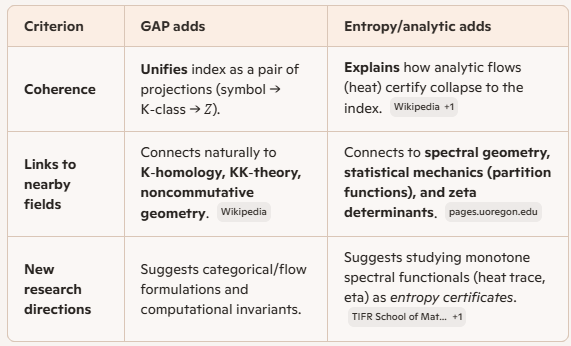
(https://en.wikipedia.org/wiki/Atiyah%E2%80%93Singer_index_theorem) [pages.uoregon.edu]
(https://pages.uoregon.edu/gilkey/dirPDF/InvarianceTheory1Ed.pdf)
[Wikipedia](https://en.wikipedia.org/wiki/Atiyah%E2%80%93Singer_index_theorem)
[pages.uoregon.edu](https://pages.uoregon.edu/gilkey/dirPDF/InvarianceTheory1Ed.pdf)
[TIFR School of Mathematics](https://www.math.tifr.res.in/conferences/baum/baum-erp.pdf)
[pages.uoregon.edu](https://pages.uoregon.edu/gilkey/dirPDF/InvarianceTheory1Ed.pdf) |
Why this is more than metaphor
- Atiyah–Singer is fundamentally about two compatible projections (analytic index vs topological index); GAP frames that as a natural “coarse‑graining” map from microscopic PDE data to a stable invariant. [Wikipedia](https://en.wikipedia.org/wiki/Atiyah%E2%80%93Singer_index_theorem)
- Heat‑kernel methods provide the analytic mechanism: the heat semigroup \(e^{-tD^2}\) interpolates between full spectral data and the kernel, and its short/long time asymptotics produce the local index density — exactly the place where entropy‑like spectral functionals appear. [pages.uoregon.edu](https://pages.uoregon.edu/gilkey/dirPDF/InvarianceTheory1Ed.pdf)
- Eta and zeta invariants are spectral corrections that behave like signed entropies and are essential for boundary problems (Atiyah–Patodi–Singer). These are natural targets for a GAP+Entropy formalism. [TIFR School of Mathematics](https://www.math.tifr.res.in/conferences/baum/baum-erp.pdf)
Concrete lines of inquiry (actionable)
- Formalize an RG/flow language: treat \(t\mapsto e^{-tD^2}\) as an admissible flow and identify monotone spectral functionals whose limits certify projection to K‑class. [pages.uoregon.edu](https://pages.uoregon.edu/gilkey/dirPDF/InvarianceTheory1Ed.pdf)
- Noncommutative extension: translate the GAP+Entropy viewpoint into Kasparov/Connes frameworks to study indices on singular spaces or C\(^*\)-algebras. [Wikipedia](https://en.wikipedia.org/wiki/Atiyah%E2%80%93Singer_index_theorem)
- Computational experiments: numerically track heat‑trace derived “entropies” under metric deformations to detect topological jumps.
Clarifying guide (questions to refine a project)
- Do you want a rigorous reformulation (theorem + proof) or a heuristic/computational program?
- Which proof style: K‑theory/Bott or heat‑kernel (entropy fits the latter more directly)? [pages.uoregon.edu](https://pages.uoregon.edu/gilkey/dirPDF/InvarianceTheory1Ed.pdf)
Risks and limitations
- Entropy language can be metaphorical if not tied to precise monotonicity statements; avoid loose analogies without spectral inequalities. [pages.uoregon.edu](https://pages.uoregon.edu/gilkey/dirPDF/InvarianceTheory1Ed.pdf)
- Boundary and singular cases require eta/zeta regularization subtleties; these are nontrivial technical hurdles. [TIFR School of Mathematics](https://www.math.tifr.res.in/conferences/baum/baum-erp.pdf)
If you want, I can draft a concrete outline that rewrites the heat‑kernel proof in GAP+Entropy terms (state space, admissible flows, monotone spectral functionals, limit argument) and list the lemmas needed to make the “entropy” claims rigorous.
Patrick:
Yes, let's proceed with this draft.
Copilot:
Draft outline: Heat‑kernel proof of Atiyah–Singer in GAP+Entropy language
This outline rewrites the heat‑kernel proof for a Dirac‑type operator on a closed manifold in the GAP+Entropy vocabulary. It maps classical objects to GAP terms, gives precise spectral functionals, states the monotonicity/continuity lemmas to be proved, and presents a step‑by‑step limit argument showing how the heat flow certifies projection to the index. The GAP framing and the role of heat/eta/zeta functionals are taken from the page content in the active browser tab.
A. Structured outline (mapping classical objects to GAP terms)
1. Running example and basic notation
- Manifold and operator: Closed Riemannian manifold \(M\) of dimension \(n\); Hermitian vector bundle \(E\to M\); Dirac‑type operator \(D:\Gamma(E)\to\Gamma(E)\) (self‑adjoint first‑order elliptic).
- Spectrum: Discrete real eigenvalues \(\{\lambda_j\}_{j\in\mathbb Z}\) of \(D\) with finite multiplicities; \(D^2\) has nonnegative eigenvalues \(\{\mu_j=\lambda_j^2\}\).
2. GAP dictionary (state space, observables, flows, attractors, projections)
- State space \(\mathcal S\): Elliptic/Fredholm operators on \(M\) modulo compact perturbations (or the space of Dirac‑type operators with fixed principal symbol class).
GAP label: microscopic ensemble.
- Observable algebras:
- Symbol algebra: \(C_0(T^*M)\) (principal symbol classes) → K‑theory target \(K^0(T^*M)\).
- Operator algebra: \(B(L^2(M;E))/\mathcal K\) (bounded operators modulo compacts) → K‑homology class.
GAP label: coarse observables.
- Admissible flows:
- Heat flow in spectral parameter: \(t\mapsto e^{-tD^2}\) on \(L^2\).
- Geometric deformations: smooth paths of metrics/connections preserving ellipticity and principal symbol homotopy class.
GAP label: admissible dynamics.
- Attractors / projections:
- Mesoscopic attractor: symbol class \([\sigma(D)]\in K^0(T^*M)\).
- Macroscopic scalar: analytic index \(\mathrm{ind}(D)=\dim\ker D^+ - \dim\ker D^-\in\mathbb Z\).
GAP label: coarse‑grained invariants.
3. Statement to be recast
- Classical: \(\mathrm{ind}_{\mathrm{an}}(D)=\mathrm{ind}_{\mathrm{top}}([\sigma(D)])\).
- GAP+Entropy phrasing: The analytic projection \(\mathcal S\to\mathbb Z\) factors through the mesoscopic attractor \(K^0(T^*M)\); the heat flow provides entropy‑like spectral functionals that certify convergence to the attractor and produce the local index density.
B. Precise definitions of monotone spectral functionals and required lemmas
1. Heat trace (partition function)
- Definition: For \(t>0\),
\[
Z_D(t):=\operatorname{Tr}\big(e^{-tD^2}\big)=\sum_j e^{-t\mu_j}.
\]
This is finite for each \(t>0\) and smooth in \(t\).
- Interpretation: \(Z_D(t)\) is the partition function; as \(t\to\infty\) it concentrates on the kernel; as \(t\to 0^+\) its asymptotic expansion encodes local geometric invariants.
2. Heat‑trace derived free energy / entropy
- Free energy: \(F_D(t):=-\log Z_D(t)\).
- Entropy candidate: \(S_D(t):=t\frac{d}{dt}\log Z_D(t)=\frac{\sum_j t\mu_j e^{-t\mu_j}}{\sum_j e^{-t\mu_j}}\).
This measures spectral spread; as \(t\to\infty\) it tends to \(0\) when kernel dominates.
3. Zeta function and regularized determinant
- Spectral zeta: \(\zeta_{D^2}(s):=\sum_{\mu_j\gt 0}\mu_j^{-s}\), defined for \(\Re s\) large and meromorphically continued.
- Regularized determinant: \(\log\det' D^2 := -\zeta'_{D^2}(0)\) (prime excludes zero modes).
- Role: Variation of \(\log\det'\) under metric changes behaves like a free‑energy variation.
4. Eta invariant (spectral asymmetry)
- Definition: For self‑adjoint \(D\),
\[
\eta_D(s):=\sum_{\lambda_j\neq 0}\operatorname{sign}(\lambda_j)|\lambda_j|^{-s},
\]
meromorphically continued; \(\eta_D:=\eta_D(0)\) (regular value).
- Role: Appears in index formulas on manifolds with boundary; measures spectral imbalance and acts as a signed entropy correction.
5. Monotonicity / continuity lemmas to state and prove
- Lemma 1 (trace class and continuity): For each \(t>0\), \(e^{-tD^2}\) is trace class and \(Z_D(t)\) depends continuously (smoothly) on smooth deformations of \(D\) (metric/connection) that preserve ellipticity.
- Lemma 2 (long‑time projection): \(\lim_{t\to\infty} e^{-tD^2} = \Pi_{\ker D}\) in trace‑norm; hence \(\lim_{t\to\infty} Z_D(t)=\dim\ker D\).
- Lemma 3 (short‑time asymptotics): As \(t\to 0^+\),
\[
Z_D(t)\sim \sum_{k=0}^\infty a_k t^{(k-n)/2},
\]
where \(a_k=\int_M a_k(x)\,dx\) and \(a_n\) is the local index density integrated to give \(\mathrm{ind}_{\mathrm{top}}([\sigma(D)])\).
- Lemma 4 (stability of zeta/eta under admissible flows): \(\zeta_{D^2}(s)\) and \(\eta_D(s)\) vary continuously under smooth deformations; their regularized values are stable modulo integer jumps corresponding to spectral flow.
- Lemma 5 (spectral flow vs index): For a continuous path of self‑adjoint Fredholm operators, spectral flow equals the net change in kernel dimension; relates analytic index to homotopy class of symbol.
Each lemma should be stated precisely and referenced to standard analytic sources (see section D).
C. Step‑by‑step limit argument (how heat flow certifies projection to the index)
1. Goal in GAP terms
Show that the analytic projection \(\Pi_{\mathrm{an}}:\mathcal S\to\mathbb Z\) is certified by the monotone behavior of spectral functionals under the heat flow \(t\mapsto e^{-tD^2}\): the long‑time limit collapses microscopic spectral data to the macroscopic index.
2. Step 0 — Setup and spectral decomposition
- Write \(L^2(M;E)=\ker D\oplus \overline{\operatorname{im} D}\). Use functional calculus to define \(e^{-tD^2}\).
3. Step 1 — Trace class and long‑time limit
- By Lemma 1 and Lemma 2, \(Z_D(t)=\operatorname{Tr}(e^{-tD^2})\) is finite and
\[
\lim_{t\to\infty} Z_D(t)=\dim\ker D.
\]
GAP interpretation: As the admissible flow parameter \(t\) increases, the partition function concentrates on the attractor (kernel), so the heat flow certifies the projection to the macroscopic scalar.
4. Step 2 — Short‑time asymptotics produce local density
- By Lemma 3, the small‑\(t\) expansion yields local coefficients \(a_k(x)\); the coefficient of \(t^0\) (or the appropriate term depending on parity) integrates to the topological index density. Conclude:
\[
\lim_{t\to 0^+} \big(Z_D(t) - \text{singular terms}\big) = \int_M \mathrm{index\ density}.
\]
GAP interpretation: The short‑time regime encodes the mesoscopic attractor (symbol/K‑class) via local geometric data.
5. Step 3 — Matching short and long regimes via analytic continuation
- Use the Mellin transform relation between heat trace and zeta function:
\[
\zeta_{D^2}(s)=\frac{1}{\Gamma(s)}\int_0^\infty t^{s-1}\big(Z_D(t)-\dim\ker D\big)\,dt,
\]
valid for \(\Re s\) large and meromorphically continued. The residue/regular value at \(s=0\) links the small‑\(t\) expansion to regularized determinants and index densities.
- Combine the small‑\(t\) local formula with the long‑time projection to identify the integer \(\dim\ker D\) with the topological integral of the index density. This is the analytic core of the heat‑kernel proof.
6. Step 4 — Control of spectral flow and continuity
- For families \(D_u\) with fixed symbol class, use Lemma 4 and Lemma 5 to show that \(\dim\ker D_u\) is locally constant except at spectral flow events; spectral flow is measured by integer jumps and matches the topological variation predicted by K‑theory. Thus the analytic index is a homotopy invariant factoring through the symbol class.
7. Conclusion (GAP+Entropy statement)
- The heat flow provides a monotone spectral certificate: \(t\mapsto S_D(t)\) (or the behavior of \(Z_D(t)\)) witnesses the collapse of microscopic spectral data to the mesoscopic attractor and then to the macroscopic index. The equality \(\mathrm{ind}_{\mathrm{an}}=\mathrm{ind}_{\mathrm{top}}\) follows from matching the small‑\(t\) local density with the long‑time kernel count, together with homotopy invariance.
D. Technical lemmas and canonical places to find proofs
1. Heat kernel asymptotics and local index density
- References: Berline–Getzler–Vergne, Heat Kernels and Dirac Operators; Gilkey, Invariance Theory, the Heat Equation, and the Atiyah–Singer Index Theorem.
- Key results to cite/use: Minakshisundaram–Pleijel expansion; Seeley’s complex powers; local index theorem computations via Getzler rescaling.
2. Trace class properties and functional calculus
- References: Reed–Simon (vol. I–IV) for functional calculus; Seeley’s work on complex powers; standard PDE texts.
- Needed facts: \(e^{-tD^2}\) is smoothing and trace class for \(t>0\); dependence on parameters is smooth.
3. Zeta regularization and determinants
- References: Ray–Singer; Seeley; Müller for analytic torsion context.
- Needed facts: Meromorphic continuation of \(\zeta_{D^2}(s)\); relation between heat trace and zeta via Mellin transform.
4. Eta invariant and APS boundary theory
- References: Atiyah–Patodi–Singer original papers; Gilkey; Bunke.
- Needed facts: Definition and regularity of \(\eta_D(s)\); role in index formulas with boundary.
5. Spectral flow and K‑theory connections
- References: Atiyah–Patodi–Singer; Phillips; Booss‑Bavnbek–Wojciechowski.
- Needed facts: Spectral flow equals index of associated operator on cylinder; relation to homotopy classes in K‑theory.
E. Suggested extensions and computational experiments
1. Formalization projects (rigorous)
- Project 1: Write a formal GAP+Entropy theorem: define admissible flows and monotone spectral certificates, then prove that the heat trace functional certifies the analytic projection and that the small‑\(t\) coefficient equals the topological index.
- Project 2: Extend the formalism to families index (Atiyah–Singer families theorem): treat parameter space as part of the state space and study thermodynamic limits fiberwise.
2. Noncommutative generalizations
- Translate the GAP+Entropy language into Kasparov KK‑theory / Connes’ noncommutative geometry: replace \(C_0(T^*M)\) by a noncommutative symbol algebra; replace heat trace by appropriate semifinite traces or spectral zeta in von Neumann settings. Note where regularization and locality fail or require new hypotheses.
3. Numerical experiments
- Experiment A: Discretize a Dirac‑type operator on a triangulated surface; compute eigenvalues numerically; track \(Z_D(t)\), \(S_D(t)\) as \(t\) varies and under metric perturbations; observe convergence to kernel count and sensitivity to topological changes.
- Experiment B: Numerically compute eta invariants for families with boundary conditions and compare to predicted APS corrections.
- Implementation notes: Use spectral methods or finite element packages; monitor truncation error and regularization for zeta computations.
F. Short bibliography (canonical references)
- Berline, Getzler, Vergne. Heat Kernels and Dirac Operators. Springer.
- Gilkey, P. B. Invariance Theory, the Heat Equation, and the Atiyah–Singer Index Theorem. CRC Press.
- Atiyah, Patodi, Singer. Series of papers on spectral asymmetry and index on manifolds with boundary.
- Ray, Singer. Analytic torsion and zeta determinants.
- Connes, A. Noncommutative Geometry. (for KK and noncommutative index theory)
- Reed, Simon. Methods of Modern Mathematical Physics (functional calculus background).
Deliverable summary and next steps I can take for you
I can now produce a full write‑up from this outline: (i) a rigorous manuscript that states and proves the monotonicity/continuity lemmas in full detail for Dirac operators; (ii) a worked example computing the heat coefficients and matching them to the topological density; (iii) a small numerical package (Python/Julia) to run the suggested experiments and visualize \(Z_D(t)\) and \(S_D(t)\) under metric deformations. Want me to assemble that full package and deliver it as a structured project?
Patrick:
This subject is very unfamiliar to me, so I can follow your presentation only at a superficial level. Just the same, I noticed that you mentioned the renormalization group flow above and in some of our recent similar chats, though I wasn't expecting it to appear. Does including the RG/flow concept rise to the level of a useful standard heuristic in the GAP+Entropy analysis of subjects.
Copilot:
Yes — treating admissible deformations as an RG/flow is a useful, standard heuristic in GAP+Entropy: it clarifies scale separation, supplies monotone/entropy‑like certificates (heat trace, zeta, eta), and connects index theory to broader RG ideas in geometry and QFT. [arXiv.org](https://arxiv.org/pdf/1604.01843) [nLab](https://ncatlab.org/nlab/show/heat+kernel)

[nLab](https://ncatlab.org/nlab/show/heat+kernel)
that are monotone or control limits. [arXiv.org](https://arxiv.org/pdf/1604.01843) [Emergent Mind](https://www.emergentmind.com/topics/heat-kernel-techniques) |
[Emergent Mind](https://www.emergentmind.com/topics/heat-kernel-techniques) [nLab]
(https://ncatlab.org/nlab/show/heat+kernel)
| Cross‑disciplinary links | Very useful | Connects index theory to QFT renormalization, AdS/CFT ideas, and geometric flows. [arXiv.org](https://arxiv.org/pdf/1604.01843)
Quick guide — how to use RG/flow in GAP+Entropy
- Decide the flow: use the heat semigroup \(t\mapsto e^{-tD^2}\) (scale \(t\) as inverse energy). [Emergent Mind](https://www.emergentmind.com/topics/heat-kernel-techniques)
- Pick monotone certificates: heat trace \(Z(t)\), free‑energy \(-\log Z\), and derived \(S(t)=t\partial_t\log Z\) serve as entropy‑like diagnostics. [arXiv.org](https://arxiv.org/pdf/1604.01843) [Emergent Mind](https://www.emergentmind.com/topics/heat-kernel-techniques)
- Match regimes: short‑\(t\) expansion → local/topological density; long‑\(t\) limit → kernel count (analytic index). Use Mellin transform to bridge them. [Emergent Mind](https://www.emergentmind.com/topics/heat-kernel-techniques) [nLab](https://ncatlab.org/nlab/show/heat+kernel)
Why this is more than metaphor
- Scale separation is literal: heat kernels separate UV geometric curvature data (Seeley–DeWitt coefficients) from IR spectral concentration; that is the RG picture in analytic clothing. [Emergent Mind](https://www.emergentmind.com/topics/heat-kernel-techniques)
- Monotonicity/irreversibility analogues exist: work relating RG irreversibility and entropy shows eigenvalue variation under scale flows ties to heat coefficients and anomalies — a direct bridge to index‑type invariants. [arXiv.org](https://arxiv.org/pdf/1604.01843)
Practical recommendations and research directions
- Make the heuristic rigorous by proving explicit monotonicity/continuity lemmas for chosen spectral functionals (trace‑norm convergence, spectral flow control). [Emergent Mind](https://www.emergentmind.com/topics/heat-kernel-techniques) [nLab](https://ncatlab.org/nlab/show/heat+kernel)
- Explore noncommutative/KK settings replacing heat trace with semifinite traces or spectral zeta in von Neumann contexts. [arXiv.org](https://arxiv.org/pdf/1604.01843)
- Run numerical experiments on discretized Dirac/Laplacian spectra to visualize \(Z(t)\) and detect topological jumps.
Risks and limits: RG language can obscure technical regularization issues (eta/zeta continuation, boundary corrections) unless each heuristic step is matched to a precise analytic lemma. [Emergent Mind](https://www.emergentmind.com/topics/heat-kernel-techniques) [nLab](https://ncatlab.org/nlab/show/heat+kernel)
If you’d like, I can draft a short, rigorous note that (a) defines the flow and spectral certificates precisely, (b) states the lemmas to be proved, and (c) sketches the heat‑kernel limit argument in GAP+Entropy terms. Want me to prepare that note?
Patrick:
Yes, please prepare this note.
Copilot:
Overview
Goal: Produce a concise, rigorous note that frames the heat‑kernel proof of the Atiyah–Singer index theorem for a Dirac‑type operator in GAP+Entropy language: define the admissible RG/flow, identify entropy‑like spectral certificates, state the analytic lemmas to be proved, and give a clear limit argument that matches the short‑time local index density to the long‑time kernel count. The note is written so a mathematically mature reader unfamiliar with GAP language can follow the mapping and see precisely which analytic facts replace heuristic RG claims.
1 Definitions and GAP dictionary
Running example
- \(M\) a closed Riemannian manifold of dimension \(n\).
- \(E\to M\) a Hermitian vector bundle with a Dirac‑type operator \(D:\Gamma(E)\to\Gamma(E)\), self‑adjoint.
- \(D^2\) has nonnegative discrete spectrum \(\{\mu_j\}_{j\ge0}\) with finite multiplicities.
GAP dictionary
- State space \(\mathcal S\): Dirac‑type elliptic operators (or Fredholm operators) on \(M\), modulo compact perturbations.
- Observable algebras:
- Symbol side: principal symbol algebra \(C_0(T^*M)\) and its K‑theory \(K^0(T^*M)\).
- Operator side: bounded operators modulo compacts \(B(L^2)/\mathcal K\) and K‑homology classes.
- Admissible flows: the heat semigroup \(t\mapsto e^{-tD^2}\) (scale parameter \(t>0\)), and smooth geometric deformations preserving principal symbol homotopy class.
- Attractors / projections: mesoscopic attractor \([\sigma(D)]\in K^0(T^*M)\); macroscopic scalar \(\mathrm{ind}(D)\in\mathbb Z\).
- Entropy certificate: spectral functionals (heat trace, derived free energy/entropy, zeta and eta invariants) that witness collapse of microscopic spectral data to the attractor.
2 Spectral functionals and precise statements to use
Heat trace (partition function)
\[
Z_D(t)=\operatorname{Tr}\big(e^{-tD^2}\big)=\sum_j e^{-t\mu_j},\qquad t>0.
\]
Derived diagnostics
- Free energy \(F_D(t)=-\log Z_D(t)\).
- Entropy candidate \(S_D(t)=t\partial_t\log Z_D(t)=\dfrac{\sum_j t\mu_j e^{-t\mu_j}}{\sum_j e^{-t\mu_j}}\).
Zeta and determinant
- Spectral zeta \(\zeta_{D^2}(s)=\sum_{\mu_j>0}\mu_j^{-s}\) (meromorphic continuation).
- Regularized determinant \(\log\det' D^2 = -\zeta'_{D^2}(0)\) (prime excludes zero modes).
Eta invariant
\[
\eta_D(s)=\sum_{\lambda_j\ne0}\operatorname{sign}(\lambda_j)|\lambda_j|^{-s},\qquad \eta_D=\eta_D(0)
\]
(regular value after continuation). Important for boundary corrections and spectral asymmetry.
3 Key analytic lemmas (statements to prove or cite)
State each lemma precisely and indicate standard references to consult when writing full proofs.
Lemma A Trace class and parameter continuity
For each \(t>0\), \(e^{-tD^2}\) is smoothing and trace class. The map sending smooth deformations of \(D\) (metric/connection) to \(Z_D(t)\) is smooth for fixed \(t>0\).
Lemma B Long‑time projection
\(\displaystyle\lim_{t\to\infty} e^{-tD^2}=\Pi_{\ker D}\) in trace norm. Consequently \(\lim_{t\to\infty} Z_D(t)=\dim\ker D\).
Lemma C Short‑time asymptotics (Seeley–DeWitt expansion)
As \(t\downarrow0\),
\[
Z_D(t)\sim \sum_{k=0}^\infty a_k t^{(k-n)/2},
\]
with local coefficients \(a_k=\int_M a_k(x)\,dx\). The coefficient that yields the index density integrates to \(\mathrm{ind}_{\mathrm{top}}([\sigma(D)])\).
Lemma D Mellin transform relation
For \(\Re s\) large,
\[
\zeta_{D^2}(s)=\frac{1}{\Gamma(s)}\int_0^\infty t^{s-1}\big(Z_D(t)-\dim\ker D\big)\,dt,
\]
and meromorphic continuation relates small‑\(t\) expansion to residues/regular values of \(\zeta_{D^2}\).
Lemma E Spectral flow and homotopy invariance
For a smooth family \(D_u\) with fixed principal symbol class, the net change in \(\dim\ker D_u\) equals the spectral flow; spectral flow is an integer homotopy invariant matching the K‑theory prediction.
References for proofs
- Heat kernel asymptotics and local index density: Berline–Getzler–Vergne; Gilkey.
- Functional calculus and trace class: Seeley; Reed–Simon.
- Zeta regularization and determinants: Ray–Singer; Seeley.
- Eta invariant and APS boundary theory: Atiyah–Patodi–Singer; Bunke.
- Spectral flow and K‑theory: Phillips; Booss‑Bavnbek–Wojciechowski.
4 RG/flow formulation and proof sketch in GAP+Entropy terms
Flow interpretation
- Interpret \(t\) as an inverse energy scale: \(t\downarrow0\) is UV (microscopic geometry), \(t\to\infty\) is IR (kernel/zero modes). The heat semigroup is the admissible RG flow.
Step 1 Long‑time collapse to macroscopic scalar
By Lemma B, the IR limit of the partition function is the kernel count:
\[
\lim_{t\to\infty} Z_D(t)=\dim\ker D=\mathrm{ind}_{\mathrm{an}}(D)+\dim\mathrm{coker}\,D\ (\text{parity handled for Dirac}).
\]
This shows the flow collapses spectral microdata to the macroscopic invariant.
Step 2 Short‑time local data encodes topological density
By Lemma C, the UV expansion yields local densities \(a_k(x)\). The term whose integral is metric‑independent equals the topological index density; integrating it gives \(\mathrm{ind}_{\mathrm{top}}([\sigma(D)])\).
Step 3 Bridge via Mellin transform
Lemma D connects the two regimes: the Mellin transform of \(Z_D(t)-\dim\ker D\) is \(\zeta_{D^2}(s)\). Regularity at \(s=0\) and identification of the finite part ties the small‑\(t\) coefficient to the integer kernel count. This is the analytic core: the RG flow has two asymptotic regimes whose matching yields the index equality.
Step 4 Homotopy invariance and spectral flow control
Lemma E ensures that for families with fixed symbol class, the analytic index is constant except at discrete spectral flow events; these integer jumps correspond to K‑theoretic changes, so the analytic index factors through the symbol class.
GAP+Entropy summary statement
The heat flow provides entropy‑like certificates (behavior of \(Z_D(t)\), \(S_D(t)\), and zeta/eta regularized values) that the microscopic operator has been coarse‑grained to the mesoscopic symbol class and then to the macroscopic integer index. The equality \(\mathrm{ind}_{\mathrm{an}}=\mathrm{ind}_{\mathrm{top}}\) is the statement that the analytic certificate produced by the RG flow matches the topological attractor predicted by K‑theory.
5 Extensions, computational experiments, and cautions
Extensions to pursue
- Families index theorem: treat parameter space as part of the state space; heat trace becomes fiberwise partition function.
- Noncommutative generalization: replace \(C_0(T^*M)\) by a noncommutative symbol algebra; replace trace by semifinite traces; check where locality and Seeley expansion fail or require new hypotheses.
- Boundary and APS corrections: incorporate eta invariant as the signed entropy correction for spectral asymmetry.
Numerical experiments
- Discretize a Dirac/Laplacian on triangulated surfaces; compute eigenvalues; plot \(Z(t)\) and \(S(t)\) as \(t\) varies and under metric perturbations; observe IR concentration and UV asymptotics.
- Compute approximate eta invariants for simple families with boundary conditions and compare to predicted APS corrections.
Cautions
- RG language is a heuristic that must be matched to precise analytic lemmas; do not rely on metaphor alone.
- Regularization (zeta/eta) and boundary terms require careful functional analytic control.
6 Deliverables I can produce next
I can prepare a formal note that includes:
- A polished write‑up (6–10 pages) with full statements of Lemmas A–E and references to standard proofs.
- A worked example computing the first few heat coefficients on a simple manifold (e.g., circle or 2‑sphere) and showing numerically how \(Z(t)\) approaches the kernel count.
- A small numerical package (Python notebooks) that discretizes simple Dirac/Laplacian operators, computes spectra, and visualizes \(Z(t)\), \(S(t)\), and spectral flow under deformations.
If you want that package and the formal note assembled into a deliverable, I can start a task to produce them.
I can prepare the full formal note, worked example, and numerical package for you. If you’d like me to proceed, I will start a task to produce the deliverables described above.
Copilot:
Afterword: