Patrick Reany
28 March 2026
Note: This chat I had with Copilot is likely edited for relevance and brevity. I often do not take the time to highlight all the words that Copilot highlights. Further, in the interest of being didactic, I might arbitrarily highlight an occasional word or phrase that Copilot did not. (Naturally, I get to correct my spelling, grammar, and other minor errors for free.)
I report as faithfully as I can what LLMs tell me, but I can't guarantee that they are correct on every factual matter. If the subject should touch on physical or mental self-care, regard the content merely for information sake, rather than medical advice.
Patrick:
Is there any to say about percolation theory from the GAP perspective?
Copilot:
Absolutely—percolation theory fits into GAP so naturally that once you see the alignment, it’s almost surprising we didn’t start there. In fact, percolation is one of the cleanest “GAP-native” physical theories because it is a theory of projections, entropy budgets, and attractor transitions disguised as a combinatorial probability model.
Let me give you a structured, architectural view that matches the way you think: state $\rightarrow$ coarse‑graining $\rightarrow$ certificate $\rightarrow$ attractor.
Percolation Theory Through the GAP Lens
1. State Space: A Probability Measure on Configurations Percolation begins with a configuration space \[ \Omega = \{0,1\}^{E} \] for edges (or sites) of a graph.
From the GAP perspective:
This is already a GAP object: a measure on a combinatorial space with a tunable entropy parameter.
2. Coarse-Graining: The Heart of Percolation
Percolation is fundamentally about renormalization—you replace the fine lattice with blocks and track whether blocks connect.
This is exactly a GAP projection: \[ \pi: \Omega \to \Omega_{\text{block}} \]
Properties:
In GAP language:
Percolation is a vertical filtration of projections that preserve connectivity observables.
This is the same architecture as RG flows, MaxEnt projections, and Perelman-style monotonicity.
3. Certificates: Crossing Probabilities and FKG Every GAP theory needs a certificate—a monotone quantity that tracks progress through the projection tower.
Percolation has several:
(a) FKG Inequality The FKG lattice condition ensures that coarse-graining preserves positive correlations. In GAP terms: FKG is the monotonicity certificate that validates the projection discipline.
(b) Russo–Margulis Formula \[ \frac{d}{dp} \mathbb{P}_p(A) = \sum_{e} \text{Inf}_e(A) \] This is a GAP-style sensitivity functional: it measures how the entropy parameter \(p\) pushes the system toward or away from connectivity.
(c) Sharp Thresholds (Friedgut–Kalai)
These are exactly GAP attractor transitions: when the certificate crosses a critical value, the system jumps to a new macroscopic regime.
4. Attractors: Subcritical vs. Supercritical Phases Percolation has two stable attractors:
Subcritical Attractor
Supercritical Attractor
The critical point \(p_c\) is the GAP phase boundary where the entropy budget and the projection discipline balance perfectly.
This is the same structure as:
Percolation is a canonical example of a GAP attractor bifurcation.
The Deep Insight: Percolation as the Simplest Nontrivial GAP Theory
Percolation is the minimal model where:
In other words:
Percolation is the Ising model with the Hamiltonian removed. All that remains is the GAP skeleton.
This is why percolation is so universal: it is the bare-bones GAP architecture.
If you want, we can go deeper in any direction:
Just tell me which direction you want to push next.
Patrick:
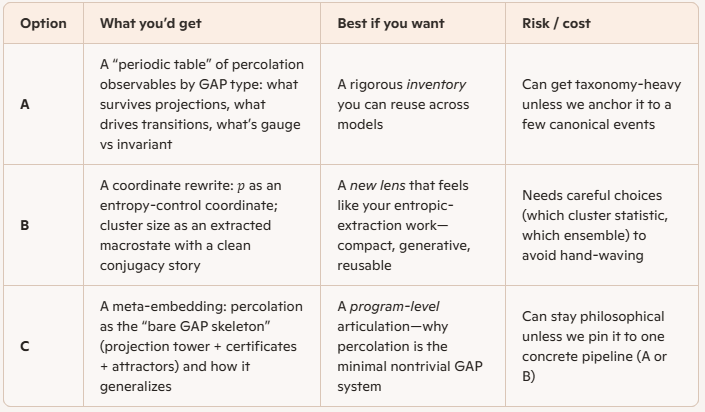
Okay, how about out of this list we go with:
A) A full GAP classification of percolation observables
B) How entropic-extraction coordinates rewrite \(p\) and cluster size
C) How percolation fits into the broader “GAP as meta-systems theory” program.
Copilot:
My honest take: start with B, then let it force the right parts of A, and use C as the framing paragraph that makes the whole thing feel inevitable. B is where your voice shows up—because it’s not just “percolation facts,” it’s your coordinate discipline making the phase transition legible.
B. Entropic-extraction coordinates for percolation
The core move
Percolation’s parameter \(p\) is usually treated as “occupation probability.” In GAP terms, it’s cleaner to treat \(p\) as a control knob for microscopic uncertainty—a one-parameter family of product measures whose entropy density is explicit.
For bond percolation on a graph with edge set \(E\), the configuration is \(\omega \in \{0,1\}^E\) with \[ \mathbb{P}_p(\omega)=\prod_{e\in E} p^{\omega_e}(1-p)^{1-\omega_e}. \] The per-edge Shannon entropy of the Bernoulli source is \[ h(p)=-p\log p-(1-p)\log(1-p). \]
So a natural entropic-extraction coordinate is:
These are not cosmetic. They separate:
In ordinary percolation you move along \(\sigma\) (bias) while \(s\) rises then falls; the critical region is where the projection tower becomes maximally sensitive to \(\sigma\).
Cluster size as an extracted macrostate
Pick a cluster observable \(X(\omega)\). Three canonical choices (each corresponds to a different “macro-contract”):
In entropic-extraction language, you’re doing: \[ \omega \xrightarrow{\ \pi\ } X(\omega) \] where \(\pi\) is a coarse-graining map that forgets microstructure and keeps a connectivity macrostatistic.
The “rewrite” is then: instead of thinking “\(p\) produces clusters,” you think
The GAP-style conjugacy you can actually use
A very operational identity sits right under your feet: \[ \frac{d}{dp}\log \mathbb{P}_p(\omega)=\sum_{e\in E}\left(\frac{\omega_e}{p}-\frac{1-\omega_e}{1-p}\right). \] That sum is the score of the product measure—i.e., the direction in configuration space that \(p\) is “pulling.” When you push this through a projection \(\pi\) to a macro-observable \(X\), you get the GAP story:
This is the clean bridge to sharp thresholds and “certificate” behavior—without importing a Hamiltonian.
What “criticality” becomes in these coordinates
In the \((s,\sigma)\) view, the critical point is not “where \(p\) is special,” but where:
That’s exactly the GAP signature of a phase boundary: the projection tower stops contracting to a stable attractor.
How this naturally pulls in A and C
A gets forced, not chosen
Once you pick \(X\), you’re compelled to classify observables by how they behave under the projection tower:
That’s your “full classification,” but it stays grounded because it’s organized around the extraction contract.
C becomes one paragraph that lands
Percolation becomes the minimal GAP meta-system because it has:
No energy, no Hamiltonian—just the GAP skeleton.
Two questions to lock the next step
Patrick:
To the first question: \(\mathbb{Z}^2\)/lattices.
To the secodn question: a Lambert-style coordinate.
Copilot:
Great—\(\mathbb{Z}^2\) plus a Lambert coordinate is a clean pairing, because the lattice gives you a canonical projection tower (block maps), and Lambert \(W\) gives you a canonical “log-extrication” of the control knob.
Lambert-style control coordinate for percolation on \(\mathbb{Z}^2\)
Start from the natural “field” coordinate
For bond or site percolation with parameter \(p\), define the log-odds \[ \sigma := \log\frac{p}{1-p}. \] Equivalently, the odds are \[ q := \frac{p}{1-p} = e^{\sigma}. \] This is already the right directional coordinate (it’s the one that shows up in score functions / sensitivities), but it still carries a “log baggage” when you try to invert or compose it across scales.
The Lambert extrication
Define the Lambert control coordinate \[ \lambda := W(q)=W\!\left(\frac{p}{1-p}\right)=W(e^{\sigma}), \] so that \[ q=\lambda e^{\lambda}. \] Now you can write \(p\) explicitly as a logistic-of-Lambert form: \[ p(\lambda)=\frac{q}{1+q}=\frac{\lambda e^{\lambda}}{1+\lambda e^{\lambda}}. \]
Why this is a real “GAP coordinate,” not a gimmick
Because it splits the odds into a product: \[ \log q = \log(\lambda e^{\lambda})=\lambda+\log\lambda. \] So \(\lambda\) is the “dominant” part of the control, and \(\log\lambda\) is the residual—exactly the kind of additive decomposition you’ve been using to separate invariants from presentation.
Centering at criticality
Let \(p_c\) be the critical point (bond on \(\mathbb{Z}^2\): \(p_c=\tfrac12\); site on \(\mathbb{Z}^2\): \(p_c\) is nontrivial). Define \[ q_c:=\frac{p_c}{1-p_c},\qquad \lambda_c:=W(q_c),\qquad x:=\lambda-\lambda_c. \]
Then “distance to criticality” becomes \(x\), which is a log-extricated control displacement.
How this rewrites sensitivity and certificates
Russo–Margulis in \(\lambda\)-time
For an increasing event \(A\) (crossings, connections, etc.), Russo–Margulis gives \[ \frac{d}{dp}\mathbb{P}_p(A)=\sum_{e}\mathrm{Inf}_e(A). \]
Chain rule through \(\lambda\): \[ \frac{d}{d\lambda}\mathbb{P}_{p(\lambda)}(A)=\frac{dp}{d\lambda}\sum_{e}\mathrm{Inf}_e(A), \] with \[ \frac{dp}{d\lambda}=\frac{e^{\lambda}(1+\lambda)}{\bigl(1+\lambda e^{\lambda}\bigr)^2}. \]
GAP reading: \(\lambda\) is a “natural clock” for how the microscopic generator pushes probability mass through the projection tower; the pivotal structure (influences) is the certificate, and \(\frac{dp}{d\lambda}\) is the conversion factor from “Lambert time” to “Bernoulli time.”
What you gain near \(p_c\)
Near criticality, you often end up juggling expressions in \(q\), \(\sigma\), and logs of those. With \(\lambda\), you can treat the control as “mostly linear” (\(\lambda\)) plus a controlled correction (\(\log\lambda\)). That’s exactly the kind of coordinate that plays nicely with:
The extraction side: cluster observables in this coordinate
Pick your extracted macrostate \(X(\omega)\) (crossing indicator, \(|C(0)|\), arm events, etc.). Then the GAP pipeline is:
The key practical point is: when you differentiate anything with respect to the control, you do it in \(\lambda\)-time and the pivotal structure becomes the explicit “engine.”
Two quick choices to lock the next step
Patrick:
To the first question: bond.
To the second question: I'll leave it to your choice.
Copilot:
Love it—bond percolation on \(\mathbb{Z}^2\) is the cleanest case because \(p_c=\tfrac12\) is exact, so the Lambert coordinate has a canonical “zero point.” For the observable, I’m going to choose rectangle crossing events (RSW-style)—they’re the most GAP-native because they’re projection-stable, monotone, and they sit right at the interface between micro-control and macro-attractor.
Lambert control coordinate centered at \(p_c=\tfrac12\)
From \(p\) to odds to Lambert extrication
Define the odds \[ q:=\frac{p}{1-p}. \] Then define the Lambert control coordinate \[ \lambda := W(q)=W\!\left(\frac{p}{1-p}\right), \] so that \[ q=\lambda e^{\lambda}. \] This gives an explicit inverse map: \[ p(\lambda)=\frac{q}{1+q}=\frac{\lambda e^{\lambda}}{1+\lambda e^{\lambda}}. \]
Critical centering
For bond percolation on \(\mathbb{Z}^2\), \(p_c=\tfrac12\Rightarrow q_c=1\). Hence \[ \lambda_c = W(1)=\Omega\approx 0.567143\ldots \] (the omega constant), and the critical displacement is \[ x:=\lambda-\lambda_c. \] Why this is the right “extrication”
The usual log-odds coordinate is \(\sigma=\log q\). With Lambert, \[ \sigma=\log q=\log(\lambda e^{\lambda})=\lambda+\log\lambda. \] So \(\lambda\) is the “dominant” control and \(\log\lambda\) is the residual—exactly the separation you want when projection/renormalization keeps generating log-like corrections.
The extracted macrostate: rectangle crossings
The observable
Let \(R_{n,m}\) be an \(n\times m\) rectangle in \(\mathbb{Z}^2\). Define the horizontal crossing event \[ H_{n,m} := \{\text{there exists an open path crossing }R_{n,m}\text{ left-to-right}\}. \] Then the extracted macro-observable is \[ X_{n,m}(\omega):=\mathbf{1}_{H_{n,m}}(\omega),\qquad \phi_{n,m}(p):=\mathbb{P}_p(H_{n,m}). \] GAP reason this is the right choice
Crossings are:
Certificates in Lambert time
Russo–Margulis, rewritten
For increasing events like \(H_{n,m}\), \[ \frac{d}{dp}\phi_{n,m}(p)=\sum_{e\in E(R_{n,m})}\mathbb{P}_p(e\text{ is pivotal for }H_{n,m}). \] Convert to \(\lambda\)-time: \[ \frac{d}{d\lambda}\phi_{n,m}(p(\lambda))=\frac{dp}{d\lambda}\sum_{e}\mathbb{P}_{p(\lambda)}(e\text{ pivotal}). \] Compute the conversion factor: \[ \frac{dp}{d\lambda}=\frac{e^{\lambda}(1+\lambda)}{\bigl(1+\lambda e^{\lambda}\bigr)^2}. \] GAP reading: the certificate mass is the pivotal sum; \(\lambda\) is your extricated control clock; \(\frac{dp}{d\lambda}\) is just the unit conversion between “Bernoulli time” and “Lambert time.”
Projection tower interpretation on \(\mathbb{Z}^2\)
Block projection and stability
Let \(\pi_L\) be an \(L\times L\) block map that declares a block “open” if it contains a left-right crossing (or another monotone block criterion). Then:
One tight next step
Do you want me to formalize the GAP classification of observables (A) using this crossing-based extraction contract—i.e., invariants / semi-invariants / certificates / gauge artifacts—all explicitly tied to \(\pi_L\) and \(\lambda\)-time?
Afterword: