Solving word problems in introductory algebra is basically a three-step
process:
1) Model the system in terms of interacting "primitive" parts,
2) extract a system of simultaneous equations, and
3) solve the system for the requested results.
Below are links to two papers I wrote that begin the process of learning how to do this efficiently. They are old but I still hold to their precepts. In fact, all I will do in subsequent writings is to build on those precepts. I will eventually work out lots of problems that I feel will cover the topic adequately.
The actual method I recommend is more detailed than I just gave and the details are to be found in the problems that I solved in the PDF papers.
The following link will take you immediately to my collection of solved algebra word problems in various PDF files:
As a first example, consider the following problem, know as the Cucumber Problem:
A fresh cucumber is originally 99% water by weight (or mass). After it has lost some of its moisture due to evaporation it is then 98% water by weight. What is the fractional weight of the water lost to evaporation compared to the original weight of the cucumber?
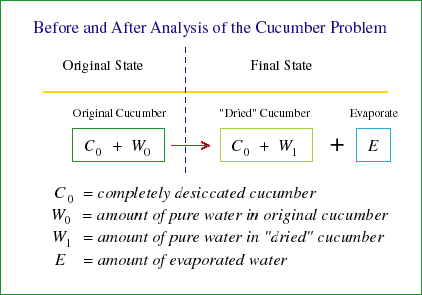
The first step is to decide which general class of problems this problem fall into. I refer to it as a "Before-and-After" class of problem. In this modeling class we claim that there is a well defined "Before" state and a well defined "After" state. In the before state we have the initial cucumber, which is defined as all the dry mass of the cucumber (that is, when it is totally desiccated). In the after state we have the cucumber which lost some water and we have the water lost as evaporation E, where E is mass or weight. It is usually very helpful to diagram the before and after states such I have have done in the figure below:
OK, we have finished modeling the problem as a collection of interacting primitive parts, which is step 1) given above.
Now, we find all the relevant conserved quantities. But why? Because on great way to get an equation is to set the before part of some quantity equal to its after part. In this problem, that means that the total amont of water in teh before state is equal to the total amount of water in the after state.
(1) W0 = W1 + E
Now, we have two constitutive relations to write down, and in this case they come from the information about percentages. I leave it to the student to learn about how to work with percentages and I'll continue with the analysis. Since the cucumber in the original state is 99% (pure) water by mass, that means that
(2) W0 = .99(C0 + W0 )
and since the amount of pure water in the cucumber is 98% in the final state then we have that
(3) W1 = .98(C0 + W1 )
So, we have finished Step 2) of the list above. Now we have our system of equations to solve simultaneously, but for what? For the fraction f of the mass of evaporated water to the initial mass of the fresh cucumber,
(4) f = E / (C0 + W0 )
But from (1) we have that E = W0 - W1 . So, substituting this into (4) we get
(5) f = (W0 - W1) / (C0 + W0 )
So, if we solve equations (2) and (3) for W0 and W1 in terms of C0 and then substitute those values into (5) we will get our answer, which will be a pure number because of the cancellations of all the C0's in the fraction. Thus,
(2a) W0 = 99 C0
(3a) W1 = 49 C0
and
(5a) f = (99C0 - 49C0) / (C0 + 99C0 ) = 50C0 / 100C0 = 50 / 100 = .5
which ends the Step 3) listed above and the problem as well.