\(
\newcommand{\bx}{\boldsymbol{x}}
\newcommand{\by}{\boldsymbol{y}}
\newcommand{\bp}{\boldsymbol{p}}
\newcommand{\bq}{\boldsymbol{q}}
\newcommand{\br}{\boldsymbol{r}}
\renewcommand{\bk}{\boldsymbol{k}}
\renewcommand{\ba}{\boldsymbol{a}}
\renewcommand{\bb}{\boldsymbol{b}}
\newcommand{\bc}{\boldsymbol{c}}
\newcommand{\bh}{\boldsymbol{h}}
\newcommand{\bA}{\boldsymbol{A}}
\newcommand{\bB}{\boldsymbol{B}}
\newcommand{\bC}{\boldsymbol{C}}
\newcommand{\definedas}{\equiv}
\newcommand{\half}{\frac{1}{2}}
\newcommand{\bsigma}{\boldsymbol \sigma}
\newcommand{\rectangle}{{%
\ooalign{$\sqsubset\mkern3mu$\cr$\mkern3mu\sqsupset$\cr}%
}}
\newcommand{\Rectangle}{\sqsubset\!\sqsupset}
\newcommand{\abs}[1]{\left|\,#1\,\right|}
\)
Triangles
Here are presented papers on the triangle,
but not using geometric algebra. Those papers are elsewhere
on this website.
The Angle-Bisector Theorem:
This paper demonstrates a possibly novel approach to the proof of
the ancient Angle-Bisector Theorem.
The Right Triangle Diameter Theorem:
Let the vertex at which is the right angle of
a right triangle be called the `apex' of the triangle, just to give
it a convenient label. Let the right triangle
have its hypotenuse exactly over a diameter of a circle of radius $r$.
Then, of course, the apex of the
triangle is either inside the circle, outside the circle, or on the circle. I intend
to prove that it
must be on the circle.
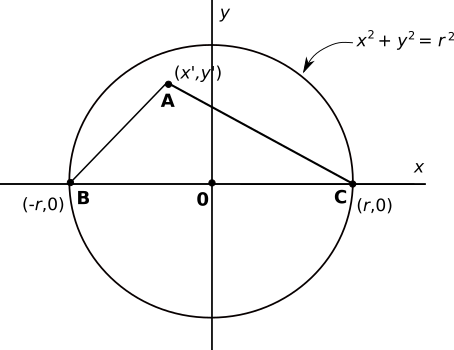
Setup: Let points B,C be points on the circle, being connected by a
diameter of the circle, whose center is at point 0. Point A is the apex
point of the triangle. Therefore, as explained above, the non-apex points
of the triangle are on points B,C, and the angle at A is a right angle.