Patrick Reany
Abstract: This page presents mathematics diversions, which are basically just
math problems of varying difficulty, which one can try to solve for fun or for
testing one's math skills, or for learning new methods and concepts.
Disclaimer: Many of the following problems were taken from SATs or old
Olympiad tests. My alternative solutions may not follow Olympiad rules, however.
The techniques I use may not be fit for use in Olympiads or entrance exams or
the like. I believe that it's good to see alternative solutions to better fill out one's
mathematical abilities. Four decades ago, I quipped that one cannot truly
understand a theorem until one is able to prove it in essentially two different ways.
It's meant to be a thought-provoking claim, perhaps containing a morsel of truth.
Announcement: If I'm to continue posting on this page, I need to broaden
the scope of the mathematics I cover here. So, I intend to include topics on
groups, rings, matrices, abstract algebra, partial differentiation, word problems,
integration, chemistry, physics, and others. I also intend to include some
theory and proofs.
Note: The comments 'Unipodal' or 'Not Unipodal' placed besides the problems
is there to indicate whether or not the problem solution has incorporated the
Unipodal algebra or not. If it has, the proof will be 'nonstandard', though
(hopefully) still correct.
Note: Here are some short monographs on standard math that I use in my papers:
Link to my write-up on Basic Complex Numbers.
Link to my write-up on Pascal's Triangle.
Link to my write-up on Geometric Series.
Link to my first write-up on Group Theory 1 (very basic).
Link to my write-up on logarithms over the real numbers.
Link to my write-up on Hyperbolic trig functions over the real numbers.
Link to my write-up on A History of Scheme for solving word problems and stoichiometry problems.
Link to my write-up on An introduction to stoichiometry (long version).
Link to my write-up on An introduction to stoichiometry (short version).
Link to my write-up on Trigonometric functions.
Link to my write-up on the Lambert W function.
Link to my write-up on Word Problem solving.
Link to my write-up on Basic Matrix Algebra.
Link to my write-up on Mathematical Induction.
Link to my write-up on GCD & LCM.
Link to my write-up on Virtual Emplacement.
Link to my write-up on the Fibonacci sequence.
Link to my write-up on the Method of Partial Fractions.
Link to my write-up on Set Theory Basics.
Link to my write-up on Basic Ring Theory, 1.
Link to my write-up on Basic Gibbs Vector Calculus.
Link to my write-up on Basic Integration Techniques. (Short Paper)
Link to my write-up on Basic Probability.
Link to my write-up on Basic Geometric Algebra.
To go to Diversions1 page Link to Diversions1
To go to Diversions2 page Link to Diversions2
To go to Diversions3 page Link to Diversions3
To go to Diversions5 page Link to Diversions5
To go to Diversions6 page Link to Diversions6
Problem 600 [Not Unipodal: Lambert W Function]:
Source: https://www.youtube.com/shorts/swZmfHgE_UUGiven the relation \begin{equation} x^{x} = 2^{2048}\,, \end{equation} find the real values of $x$.
Title: The trickiest problem on the SAT
Presenter: YourSATCoach (shorts)
Solution to this problem.
Link to my write-up on the Lambert W function.
Problem 601 [Not Unipodal: Word Problem]:
Source: https://www.youtube.com/shorts/nJtj8XCGT5IThe average age of a class of 40 students is 12 years. If the
Title: Math Word Problems
Presenter: GuinessAndMathGuy (shorts)
teacher's age is also included (in the average), the average
age increases by 1. The teacher's age is
(a) 41 years (b) 52 years (c) 53 years (d) 54 years?
Problem 602 [Not Unipodal: Word Problem: Percentages]:
Source: https://www.youtube.com/watch?v=BOTqy-OYTxwThe function $f(n) = 7(20.44)^{n/4}$ gives each terms of a
Time Stamp: 5:36
Title: [June SAT Math] 5 Hardest SAT MATH Questions
Presenter: DSAT Hackers
sequence as a function of the term's position, $n$, in the sequence,
where $n$ is a whole number. The value of the term in position 14 is $p\%$
more than the value of the term in position 10. What is the value of $p$?
(a) 20.44 (b) 44 (c) 1,944 (d) 2,044?
Problem 603 [Not Unipodal: Algebra]
Source: ???Given the relations \begin{align} x - 2y &=3\,,\\ x^2 - 4xy &=5\,, \end{align} find the real values of $x$ and $y$.
Title: ???
Presenter: GRE Practice: Manhattan Review
Problem 604 [Not Unipodal: Calculus: Integration]
Source: The Ether of Mathematical IdeasShow that \begin{equation} \int \frac{e^x + 1}{e^x - 1}\, dx = 2\ln\, \left|\,\sinh \frac{x}{2}\right| + C\,. \end{equation}
Presenter: Patrick
Problem 605 [Not Unipodal: Geometric Algebra]:
This problem is by
Source: New Foundation for Classical Mechanics (textbook)
Title: Ceva's Theorem.
Presenter: Patrick
On page 93 of NFCM \cite{HestenesNFCM}, we find problem (6.10) to
prove Ceva's Theorem.

Based on the above figure, show that \begin{equation} \left(\frac{\ba- \bc{}'}{\bc'-\bb} \right) \left(\frac{\bb-\ba'}{\ba'-\bc} \right) \left(\frac{\bc-\bb'}{\bb'-\ba} \right) = 1\,. \end{equation}
Solution to the problem.
Link to my write-up on Basic Geometric Algebra.
Problem 606 [Not Unipodal: GRE Word Problem: Percentages]:
Source: https://www.youtube.com/watch?v=QFBa7PrAL7gFranky sells a calculator to Wren at a gain of 17% and Wren sell it
Title: GRE Quants - WORD PROBLEMS
Presenter: Manhattan Review
to John at loss 25%. If John pays \$1842.75 for it, what did Franky
pay for it?
(a) \$ 2080 (b) \$ 2100 (c) \$ 2800 (d) \$ 3000?
Problem 607 [Not Unipodal: Lambert W Function Derivative]:
Source: The Ether of Mathematical IdeasGiven the relation \begin{equation} y = x\, e^{x}\,, \end{equation} find $y' = dy/dx$.
Title: Contrived Lambert W Function Problem #1
Presenter: Patrick
Note: I have been patiently waiting for an opportunity
to use the derivative of the Lambert $W$ function in a real problem,
but so far I haven't succeeded. So, I'm going to force it into this
problem, just for the experience of using it. The experience I get here
may come in handy later on.
Problem 608 [Not Unipodal: Lambert W Function Derivative]:
Source: The Ether of Mathematical Ideas
Title: Contrived Lambert W Function Problem #2
Presenter: Patrick
Given the relation \begin{equation} y = x\, \ln x\,, \end{equation} find $y' = dy/dx$.
Note: I have been patiently waiting for an opportunity
to use the derivative of the Lambert $W$ function in a real problem,
but so far I haven't succeeded. So, I'm going to force it into this
problem, just for the experience of using it. The experience I get here
may come in handy later on.
Problem 609 [Not Unipodal: Integration]
This problem is by
Source: https://www.youtube.com/watch?v=UyTPznZpLSg
Title: Definite Integral x(x^2 + 1)^3 from 0 to 1
Presenter: Cole's World of Mathematics
Integrate the following integral: \begin{equation} I = \int_0^1 x(x^2 + 1)^3\, dx\,. \end{equation}
Problem 610 [Unipodal]
This problem is by
Source: The Ether of Mathematical Ideas
Title: Logarithm and square root of a vector
Presenter: Patrick
Using the unipodal algebra, find the Logarithm of the unit
vector $u$ to be
\begin{equation}
\Log u = i\pi u_- \,.
\end{equation}
And then find the square root of $u$.
Problem 611 [Not Unipodal: Integration]
This problem is by
Source: https://www.youtube.com/watch?v=Na1yzT97PxQ
Title:How to Find the Indefinite Integral
Presenter: Cole's World of Mathematics
Integrate the following integral: \begin{equation} I = \int \frac{(\sqrt{x} - 1)^2}{\sqrt{x}}\, dx\,. \end{equation}
Problem 612 [Not Unipodal: Word Problem: Ratios]:
Source: Many locations
Title: Final-ratio problem
Presenter: ---
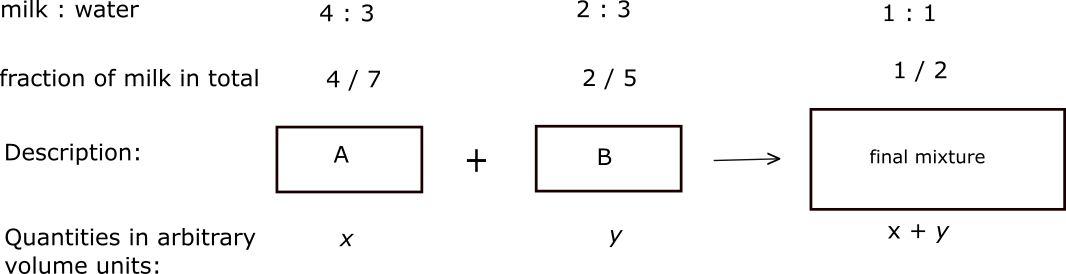
Two vessels $A$ and $B$ containing milk and water in ratios $4 : 3$ and $2 : 3$, respectively.
In what ratio should they be added together so that their final mixture is
in ratio $1 : 1$?
Problem 613 [Not Unipodal: Integration]
This problem is by
Source: https://www.youtube.com/watch?v=iPN91UfVuJg&
list=PL81IATpFpPBgrG8fZ3tRO41nNypY5xtEP
Title: Math Subject GRE Practice Exam #1 GR1268
Presenter: LearnYouSomeMath
Integrate the following integral: \begin{equation} \obI = \int_{e^{-3}}^{e^{-2}} \frac{1}{x\log\, {x}}\, dx\,. \end{equation}
(A) 1 (B) $\frac{2}{3}$ (C) $\frac{3}{2}$ (D) $\log\left(\frac{2}{3}\right)$ (E) $\log\left(\frac{3}{2}\right)$
Problem 614 [Not Unipodal: Use of Differential Forms in Thermodynamics,
Part 2 --- or close to it]:
Source: https://johncarlosbaez.wordpress.com/2012/01/19/
classical-mechanics-versus-thermodynamics-part-1/
Title: Classical Mechanics versus Thermodynamics (Part 1)
Presenter: John Baez
How to go from \begin{equation} dS = pdq - Hdt \end{equation} to there exists and $X$ such that \begin{equation} X = S - pq\,. \end{equation} Look for the Poincare Lemma.
Differential Forms in Thermodynamics, Part 2.
Problem 615 [Not Unipodal: Group Theory: Homomorphims]:
Source: https://www.youtube.com/watch?v=6L6dWdHC0RE
Title: Math subject GRE 3768 problem 59
Presenter: LearnYouSomeMath
Let $\Integers_{30}$ be the ring of integers modulo 30. Let $U_{30}$
be the multiplicative
group
formed out of all the invertible elements of $\Integers_{30}$,
with identity element equal to unity.
Let $\phi$ be a group homomorphism from
$U_{30}$ to itself, with $\ker \phi = \{ 1,11\}$. Now, if
$\phi(7)=7$, which other element in $U_{30}$ does $\phi$ map to 7?
(A) 11 (B) 13 (C) 17 (D) 19 (E) 29
Problem 616 [Not Unipodal: Word Problem: Ratios]:
This problem is found at:
Source: Many locations
Title: Final-ratio, then the quantity problem
A can contains a mixture of two liquids $A$ and $B$ in ratio 7 : 5.
After 9 liters are drawn off and replaced by 9 liters of liquid $B$,
the ratio of $A$ to $B$ becomes 7 : 9. How many liters of liquid
$A$ was in the can initially.
Problem 617 [Not Unipodal: Word Problem: The Boron Isotrope Problem]:
Presenter: Patrick
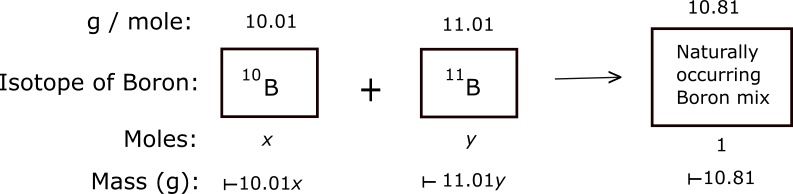
Naturally occurring Boron (molar mass of 10.81 g/mol = 10.81 gmol) is the mixture
of two of its isotopes:
Boron 10 ($^{10}$B) and Boron 11 ($^{11}$B), of atomic masses
10.01 g/mol and 11.01 g/mol, respectively.
Find the relative abundances of $^{10}$B
and $^{11}$B in natural Boron, expressed in percentages.
Problem 618 [Not Unipodal: Geometric Algebra]:
This problem is by
Source: New Foundation for Classical Mechanics (textbook)
Title: Vector Calculus Identity.
Presenter: Patrick
On page 117 of NFCM \cite{HestenesNFCM}, we find problem (8.2b): Show that \begin{equation} \ba\cdot\nabla\hat{\br} = \frac{\hat{\br}\, \hat{\br}\wedge\ba}{r}\,, \end{equation} where \begin{equation} \br = \bx - \bx'\quad\text{and}\quad r = |\,\bx - \bx'\,|\,. \end{equation}
Solution to the problem.
Link to my write-up on Basic Geometric Algebra.
Problem 619 [Not Unipodal: Complex Numbers]:
This problem is by
Source: https://www.youtube.com/watch?v=0J5PcbB8lNI
Title: A Nice and EZ Equation | Problem 538
Presenter: aplusbi
Given the relation \begin{equation} z(z+i) = \obz\,, \end{equation} find the nonzero complex values of $z$.
Link to my write-up on Basic Complex Numbers.
Problem 620 [Not Unipodal: Algebra]:
This problem is by
Source: The Ether of Mathematical Ideas
Title: Ratios vs Fractional Amounts
Presenter: Patrick
A composite fluid is composed of precisely two distinct fluids $A$ and $B$.
Given the ratio of $A : B = 4 : 3$, show that the fractional conversion factor
amounts $A$ and $B$ in the composite are
\begin{equation}
\frac{4}{7}\quad\mbox{and}\quad \frac{3}{7}\,,
\end{equation}
respectively.
Problem 621 [Not Unipodal: Chemistry: Linear Algebra]:
This problem is by
Source: The Ether of Mathematical Ideas
Title: Balancing chemical equation with linear algebra
Presenter: Patrick
Using algebraic methods, balance the following unbalance chemical equation: \begin{equation} \mbox{KCN} + \mbox{FeCl}_2 \rightarrow \mbox{K}_4\mbox{Fe(CN)}_6 + \mbox{KCl}\,. \end{equation}
Problem 622 [Not Unipodal: Alpha Transformation]:
This problem is by
Source: https://www.youtube.com/watch?v=qP0mghCvG64
Title: Italy l can you solve??
Presenter: Math Master TV
Given the relation \begin{equation} x^{27} = 27^{x^2}\,, \end{equation} find the real values of $x$.
Problem 623 [Not Unipodal: Vector Calculus: Maxwell Equations]
This problem is from
Source: Gauge Fields, Knots and Gravity
(World Scientific, 1994 [2013])
Title: Vector calculus and Maxwell equations
Presenters: John Baez & Javier P. Muniain
By introducing the new (complex) field $\mathcal{E}$, given by \begin{equation} \mathcal{E} = \bE + i\bB\,, \end{equation} show that the four Maxwell equations for free space are contained in the two equations \begin{equation} \del\cdot \mathcal{E} = 0\,,\qquad\qquad \del\cross \mathcal{E} = i\,\frac{\partial \mathcal{E}}{\partial t}\,. \label{eq:four_Maxwell_contained} \end{equation}
Solution to the problem.
Link to my write-up on Basic Gibbs Vector Calculus.
Problem 624 [Not Unipodal: Alpha Transformation: Lambert]:
This problem is by
Source: https://www.youtube.com/watch?v=qP0mghCvG64
Title: Italy l can you solve??
Presenter: Math Master TV
Given the relation \begin{equation} x^{27} = 27^{x^2}\,, \end{equation} find the real values of $x$.
Solution to the problem.
Link to my write-up on the Lambert W function.
Problem 625 [Not Unipodal: Alpha Transformation: Lambert]:
This problem is by
Source: https://www.youtube.com/watch?v=bIU9I2PepiY
Title: OLYMPIADS || How to Solve t^2t^6 = 3
Presenter: ABIODUN Scholars Academy
Given the relation \begin{equation} t^{2t^6} = 3\,, \end{equation} find all values of $t$.
Solution to the problem.
Link to my write-up on the Lambert W function.
Problem 626 [Not Unipodal: Word Problem: Mixed-rates]:
This problem is found at:
Source: ??
Title: Mixed-rate problem
Presenter: Patrick
Consider the following problem: Printer #1 can print 100 copies
of a document in 3.4 hours and Printer #2 can print out the same
print job in 2.5 hours. How long will it take for the print job
to complete if both printers work on the job together, starting
and stopping at the same times?
Solution to the problem.
Link to my write-up on Word Problem solving.
Problem 627 [Not Unipodal: Complex Numbers]:
This problem is by
Source: https://www.youtube.com/watch?v=b2FV-LMoqcE
Title: An Exponent That Conjugates | Problem 533
Presenter: aplusbi
Given the relation \begin{equation} (1-i)^z = 1+i\,, \end{equation} find the complex values of $z$.
Solution to the problem.
Link to my write-up on Basic Complex Numbers.
Problem 628 [Not Unipodal: Geometric Algebra: Vector Calculus]:
This problem is by
Source: The Ether of Great Mathematical Ideas
Title: Some Vector Calculus Identities
Presenter: Patrick
Prove the identities: \begin{align} \del\cdot (\phi \bv) &= \bv\cdot \del \phi + \phi\, \del \cdot\bv \,,\\ \del\cross( \phi\bA) &= (\del \phi) \cross \bA + \phi \del\cross\bA\,,\\ \del\cross (\del \phi) &= 0\,. \end{align}
Solution to the problem.
Link to my write-up on Basic Gibbs Vector Calculus.
Problem 629 [Not Unipodal: Algebra: Logarithms]:
This problem is by
Source: https://www.youtube.com/watch?v=CiA9PBizEKk
Title: How to solve? | Nice Math Olympiad Question
Presenter: Math Beast
Given the relation \begin{equation} 6^{x+2} - 6^x = 60\,, \end{equation} find the real values of $x$.
Problem 630 [Not Unipodal: Complex Numbers]:
This problem is by
Source: https://www.youtube.com/watch?v=HIt7rSNpSCM
Title: Can you solve this? | iota maths problem
Presenter: Math Beast
Given the relation \begin{equation} \phi = i^{1/i}\,, \end{equation} find the real values of $\phi$.
Solution to the problem.
Link to my write-up on Basic Complex Numbers.
Problem 631 [Not Unipodal: Vector Calculus: Maxwell Equations]
This problem is from
Source: Gauge Fields, Knots and Gravity
(World Scientific, 1994 [2013])
Title: Vector calculus and Maxwell equations (part 2)
Presenters: John Baez & Javier P. Muniain
This paper is a continuation of the last paper I made on John Baez & Javier P. Muniain (from p. 9).
By introducing the new (complex) field $\mathcal{E}$, given by
\begin{equation}
\mathcal{E} = \bE + i\bB\,,
\end{equation}
we showed last time that the four Maxwell equations for free space are contained in the two equations
\begin{equation}
\del\cdot \mathcal{E} = 0\,,\qquad\qquad \del\cross \mathcal{E} = i\,\frac{\partial \mathcal{E}}{\partial t}\,.
\end{equation}
This time, show that
\begin{equation}
\mathcal{E} = \bE \, e^{-i(\omega t - \bk\cdot \bx)}
\end{equation}
satisfies the vacuum Maxwell equations, where $|\,\bk\,|=\omega$, with
$\bk\cdot \bE =0$
and $i\,\bk\cross\bE = \omega \bE$. This last equation
implies that $i\,\bk\cross \mathcal{E} = \omega\, \mathcal{E}$.
Solution to the problem.
Link to my write-up on Basic Gibbs Vector Calculus.
Problem 632 [Not Unipodal: Physics Problem: The Wheatstone Bridge]
Presenter: Patrick
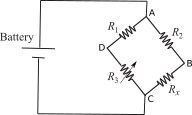
Explain how the Wheatstone Bridge can be used to measure the resistance
of an electrical
component.
Problem 633 [Not Unipodal: Lambert]:
This problem is by
Source: https://www.youtube.com/watch?v=bIU9I2PepiY
Title: https://www.youtube.com/watch?v=fdt3xvCTWOU
Presenter: Higher Mathematics
Given the relation \begin{equation} x^{\sqrt{x}} = 3\,, \end{equation} find all values of $x$.
Solution to the problem.
Link to my write-up on the Lambert W function.
Problem 634 [Not Unipodal: Alpha Transformation: Lambert]:
This problem is by
Source: ???
Title: Avoiding table assist this time
Presenter: Patrick
Given the relation \begin{equation} x^{x^3} = 36\,, \end{equation} find real values of $x$.
Solution to the problem.
Link to my write-up on the Lambert W function.
Problem 635 [Not Unipodal: Geometric Algebra: Vector Calculus 2]:
This problem is by
Source: The Ether of Great Mathematical Ideas
Title: Some Vector Calculus Identities
Presenter: Patrick
Prove the identities: \begin{align} \del \cdot(\del \cross \bA) &=0\,,\\ \del\cdot (\del f \cross\del g) &=0\,,\\ \del (\bA\wedge\bB) &= \dot{\nabla} (\dot\bA\wedge\bB) + \dot{\nabla} (\bA\wedge\dot\bB)\,. \end{align}
Solution to the problem.
Link to my write-up on Basic Gibbs Vector Calculus.
Link to my write-up on Basic Geometric Algebra.
Problem 636 [Not Unipodal: Trigonometry]:
This problem is by
Source: The Ether of Great Mathematical Ideas
Title: The Angle Bisectors of a Triangle Theorem.
Presenter: Patrick
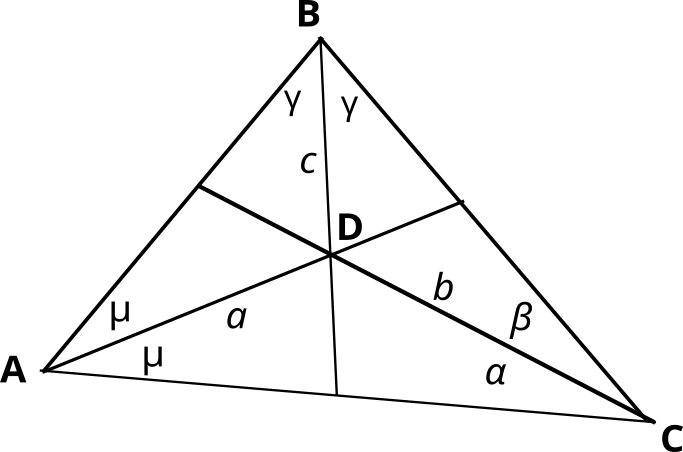
Our problem is to show that the angle bisectors of a triangle are concurrent. Referencing
Figure 1, we have that the angle bisectors from vertices A
and B meet at point D.
This proof will use trigonometry.
Solution to the problem.
Link to my write-up on Trigonometric functions.
Problem 637 [Not Unipodal: Word Problem: Mixed-rates]:
This problem is found at:
Source: Intermediate Algebra for College Students,
3rd Ed. (p. 169--171.)
Title:A Mixed-rate problem
Presenter: Robert Blitzer
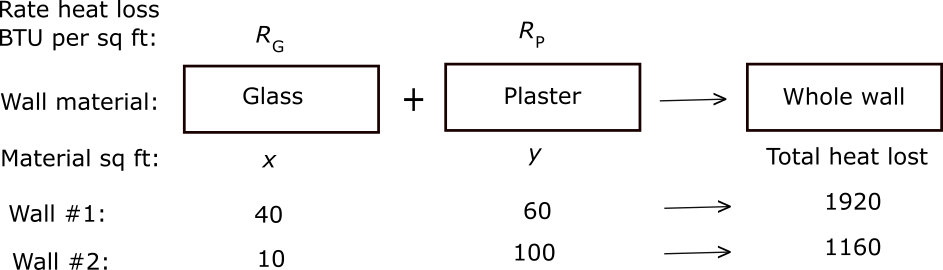
A heat-loss survey by an electrical company indicated that a wall of a house containing
40 ft$^2$ of glass and 60 ft$^2$ of plaster lost 1920 BTU of heat (in a given time period).
A second wall containing 10 ft$^2$ of glass and 100 ft$^2$ of plaster lost 1160 BTU of heat.
Determine the heat lost per square foot of glass and plaster in that house.
Solution to the problem.
Link to my write-up on Word Problem solving.
Problem 638 [Not Unipodal: Geometric Algebra: Vector Calculus 3]:
This problem is by
Source: The Ether of Great Mathematical Ideas
Title: Some Vector Calculus Identities
Presenter: Patrick
We will be using geometric calculus to establish the
following vector calculus identity.
\begin{equation}
\del^2\bA = \del(\del\cdot \bA) - \del\cross(\del\cross \bA)\,.
\end{equation}
Solution to the problem.
Link to my write-up on Basic Gibbs Vector Calculus.
Link to my write-up on Basic Geometric Algebra.
Problem 639 [Not Unipodal: WolframAlpha: Lambert]:
This problem is by
Source: https://www.youtube.com/watch?v=vfPQPVjYr0E
Title: Harvard University Admission Interview Tricks
Presenter: Super Academy
Given the relation \begin{equation} x^{27} = 27^{x^2}\,, \end{equation} find the real values of $x$.
Solution to the problem.
Link to my write-up on the Lambert W function.
Problem 640 [Not Unipodal: Algebra]
This problem is by
Source: https://www.youtube.com/watch?v=iiSQZ5dU8oA
Title: Can you Solve Stanford University Admission Interview Exam?
Presenter: Super Academy
Given the relation \begin{equation} 729^{x} - 9^x = 2 \sqrt{3}\,, \end{equation} find the real values of $x$.
Problem 641 [Not Unipodal: Thermodynamics: SD]
This problem is by
Source: https://www.youtube.com/watch?v=2BJYXuZZK3c&list=
PLpi18tMShZSAQFNTb8Ji7EgCFP9lXbkOe&index=5
Title: Statistical Mechanics Notes for L. Susskind's
Lecture Series (2013), Part 5
Presenters: Susskind and then Patrick
Establish the relation \begin{equation} \frac{\partial \overline{E}}{\partial V}\Bigg|_S = \frac{\partial \overline{E}}{\partial V}\Bigg|_T - \frac{\partial \overline{E}}{\partial S}\Bigg|_V \frac{\partial S}{\partial V}\Bigg|_T \,, \end{equation} where $\overline{E}$ is the average energy of a system. (This is a change in independent variables problem.)
Problem 642 [Not Unipodal: Geometric Algebra: Vector Calculus 4]:
This problem is by
Source: The Ether of Great Mathematical Ideas
Title: Some Vector Calculus Identities
Presenter: Patrick
We will be using geometric calculus (or just vector calculus) to establish
the following vector calculus identity.
\begin{equation}
\del \left(\frac{ 1}{|\,\bx-\bx'\,|} \right) = - \del' \left(\frac{ 1}{|\,\bx-\bx'\,|} \right) \,.
\end{equation}
Solution to the problem.
Link to my write-up on Basic Gibbs Vector Calculus.
Problem 643 [Not Unipodal: Linear Algebra: Geometry]:
This problem is by
Source: The Ether of Great Mathematical Ideas
Title: The intersection of two planes
Presenter: Patrick
It's easy to visualize that two non-parallel planes in $\calR^3$ intersect in a line.
We'll prove this by
parametarizing the intersection of these planes by a
single variable, proving that the intersection
space is one-dimensional.
Solution to the problem.
Link to my write-up on Basic Gibbs Vector Calculus.
Problem 644 [Not Unipodal: Algebra]:
This problem is by
Source: https://www.youtube.com/watch?v=GRU3MhyxO6A
Title: Harvard University Admission Interview Tricks
Presenter: Super Academy
Given the relations \begin{align} 3^{x} - 3^y &= 16 \,,\label{eq:TheGiven1}\\ 3^{x+y} &= 4\,,\label{eq:TheGiven2} \end{align} find the values of $x$ and $y$.
Solution to the problem.
Link to my write-up on Trigonometric functions.
Problem 645 [Not Unipodal: Self-similarity: Lambert]:
This problem is by
Source: https://www.youtube.com/watch?v=Gkg9Jd4k6SI
Title: Harvard entrance exam question
Presenter: Math Beast
Given the relation \begin{equation} \phi = i^{i^{.\cdot{}^{.}}} \,, \end{equation} find a closed form for $\phi$.
Solution to the problem.
Link to my write-up on the Lambert W function.
Problem 646 [Not Unipodal: Algebra]:
This problem is by
Source: https://www.youtube.com/watch?v=Uas7k2tri38
Title: Can you Solve Oxford University Admission Interview Exam?
Presenter: Super Academy
Given the relation \begin{equation} \left(\frac{1}{27} \right)^x - \left(\frac{1}{3} \right)^x = \sqrt{2}\,, \end{equation} find the real values for $x$.
Problem 647 [Unipodal]
This problem is by
Source: https://www.youtube.com/watch?v=GgORRgXLoiY
Title: Can you Solve Cambridge University Admission Interview Exam?
Presenter: Super Academy
Given the relation \begin{equation} \Big (\cuberoot{5+2\sqrt{6}}\,\Big)^x + \Big (\cuberoot{5-2\sqrt{6}}\,\Big)^x= 10\,, \end{equation} find the real values for $x$.
Problem 648 [Not Unipodal: Geometry: Vectors]
This problem is by
Source: The Ether of Great Mathematical Ideas
Title: Plane Interesects a Cone.
Presenter: Patrick
Show that the intersection of a horizontal plane of fixed $z$ coordinate $h$, with a
vertical cone as in Fig. 1, has the $x,y$ coordinates constrained by the following equation: \begin{equation} x^2 + y^2 = h^2(c^{-2} - 1) \,, \end{equation} where $c$ is a constant to be determined below.
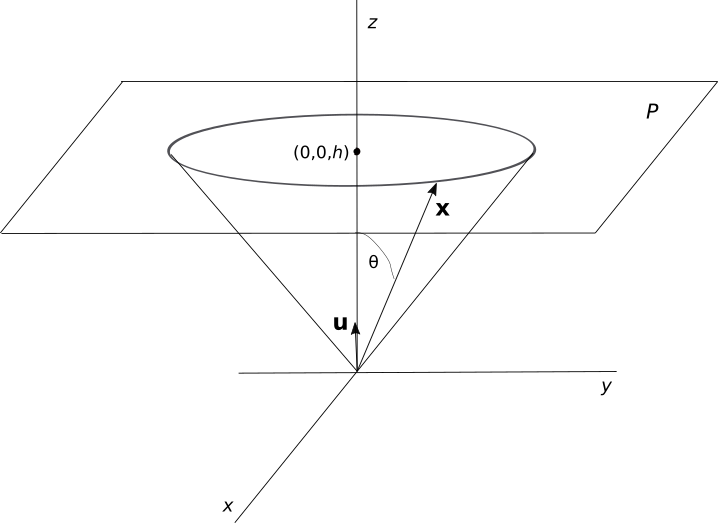
Figure 1. $P$ is a horizontal plane that contains the point $(0,0,h)$. The vector
$\bu$ is a unit vector in the $+z$ direction, the symmetry axis of the cone. The
cone is the set of all points $\bx$ satisfying the relation $\hat\bx\cdot\bu=\cos\theta$, for fixed $\theta$.$P$ is a horizontal plane that contains the point $(0,0,h)$. The vector $\bu$ is a unit
vector in the $+z$ direction. The cone is the set of all points
satisfying the relation, \begin{equation} \hat\bx\cdot\bu=\cos\theta \definedas c\,, \end{equation} where the angle $\theta$ is given and fixed.
Problem 649 [Not Unipodal: Electromagnetism: Vector Calculus]
This problem is by
Source: The Ether of Great Mathematical Ideas
Title: Proof of Poynting's Theorem.
Presenter: Patrick
Statement of the Problem:
Prove the identity
\begin{equation}
\frac{\partial U}{\partial t} = - \del\cdot\bS - \bJ\cdot\bE\,,
\end{equation}
where $\bB$ is the magnetic field, $\bJ$ is the electric current density, and $U$
is the electromagnetic field energy, given by
\begin{equation}
U = \frac{1}{2}\frac{1}{\mu_0}\bB^2 + \frac{1}{2} \epsilon_0\bE^2\,,
\end{equation}
where $\mu_0$ is the
permeability of free space, and $\epsilon_0$ is the
permitivity of free space.
We also have that $\bS$ is the Poynting vector, defined as
\begin{equation}
\bS = \frac{1}{\mu_0}\bE\cross\bB\,.
\end{equation}
Problem 650 [Not Unipodal: Matrices: Traces]
This problem is by
Source: https://www.ocf.berkeley.edu/~rohanjoshi/2020/06/05/
trace-is-the-derivative-of-determinant/
Title: Trace is the derivative of determinant
Presenter: rohanjoshi
Statement of the Problem:
Given an $n\times n$ matrix $M$ whose nonzero elements are each much larger than some small parameter $\epsilon$. Show that to first order in $\epsilon$, \begin{equation} \det\,(\bI + M\, \epsilon)\approx 1 + \epsilon\,\mbox{Tr}(M)\,,\end{equation} where $\bI$ is the $n\times n$ identity matrix, and 'Tr' stands for 'trace', and where \begin{equation} \mbox{Tr}( M) = m_{11} + m_{22} + \cdots + m_{nn}\,, \end{equation} which is the sum of the elements on the main diagonal of $M$.
Problem 651 [Not Unipodal: Geometric Calculus: Vector Calculus]
This problem is by
Source: The Ether of Great Mathematical Ideas
Title: Some Common Identities.
Presenter: Patrick
Statement of the Problem:
We will be using geometric calculus to establish the following vector calculus identities: \begin{equation} \bA\cross (\del \cross\bB) = -\bA\cdot\del \bB + \dot\del \bA\cdot\dot\bB\,,\label{eq:Ident1} \end{equation} and \begin{equation} \del (\bA \cdot \bB )=(\mathbf {A} \cdot \nabla )\mathbf {B} +(\mathbf {B} \cdot \nabla )\mathbf {A} +\mathbf {A} \times (\nabla \times \mathbf {B} )+\mathbf {B} \times (\nabla \times \mathbf {A} )\,.\label{eq:Ident2} \end{equation}
Solution to the problem.
Link to my write-up on Basic Geometric Algebra.
Problem 652 [Not Unipodal: Algebra]
This problem is by
Source: https://www.youtube.com/watch?v=vR9vb8qQpuA
Title: A very Interesting Exponential Problem
Presenter: Math Beast
Given the relation \begin{equation} 2^{2^x} = 16^{2^{3x}}\,,\label{eq:TheGiven} \end{equation} find the values for $x$.
Problem 653 [Not Unipodal: Complex Numbers]
This problem is by
Source: https://www.youtube.com/watch?v=vR9vb8qQpuA
Title: A very Interesting Exponential Problem
Presenter: Math Beast
Given the relation \begin{equation} \frac{\cos z + i\sin z}{\cos z - i\sin z} = e\,, \end{equation} find the values for $z$.
Problem 654 [Not Unipodal: Complex Numbers]
This problem is by
Source: https://www.youtube.com/watch?v=Mt1mZKDgKv8
Title: A Homemade Equation | Problem 475
Presenter: aplusbi
Given the relation \begin{equation} z^i = e^{\frac{\textstyle\pi}{2}}\,, \end{equation} find the values for $z$.
Problem 655 [Not Unipodal: Geomtric Calculus: Vector Calculus]
This problem is by
Source: The Ether of Great Mathematical Ideas
Title: A Common Identity.
Presenter: Patrick
Statement of the Problem:
We will be using geometric calculus to establish the following
vector calculus identity:
\begin{equation}
\nabla \times \left(\mathbf {A} \times \mathbf {B} \right)=\mathbf {A} \left(\nabla \cdot \mathbf {B} \right)-\mathbf {B} \left(\nabla \cdot \mathbf {A} \right)+\left(\mathbf {B} \cdot \nabla \right)\mathbf {A} -\left(\mathbf {A} \cdot \nabla \right)\mathbf {B}\,.
\end{equation}
Solution to the problem.
Link to my write-up on Basic Geometric Algebra.
Problem 656 [Not Unipodal: Word Problem: Mixed-rates]
This problem is found at:
Source: Finite Mathematics, 5th Ed. Brooks/Cole (2002), p. 57
Title: A Mixed-rate problem
Presenter: H. Rolf
A woman must control her diet. She selects milk and bagel for breakfast.
How much of each should she serve in order to consume 700 calories and
28 grams of protein? Each cup of milk contains 170 calories and 8 grams
of protein. Each bagel contains 138 calories and 4 grams of protein.
Solution to the problem.
Link to my write-up on Word Problem solving.
Problem 657 [Not Unipodal: Stoichiometry]:
This problem is found at:
Source: Chemical Principles: The Quest for Insight
Title: Kilograms to kilograms
Presenter: P. Atkins and L. Jones.
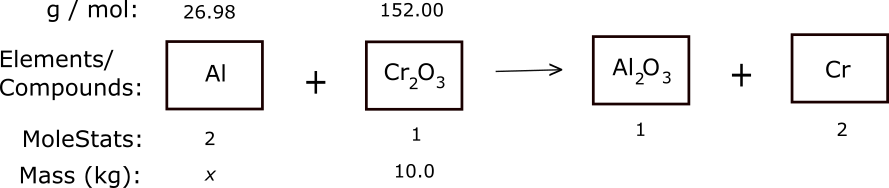
$\blacktriangleright$ What mass of aluminum is needed to reduce 10.0 kg of chromium (III)
oxide to produce chromium metal? The chemical equation for the reaction is
\begin{equation}
2\mbox{Al}\,\mbox{(l)} + \mbox{Cr$_2$O$_3$}\,\mbox{(s)}\ \overset{\Delta}{\rightarrow} \ \mbox{Al$_2$O$_3$}\,\mbox{(s)} + 2\mbox{Cr}\,\mbox{(l)}\,.
\end{equation}
Solution to the problem.
Link to my write-up on An introduction to stoichiometry (long version).
Link to my write-up on An introduction to stoichiometry (short version).
Problem 658 [Not Unipodal: Algebra]
This problem is by
Source: https://www.youtube.com/watch?v=pz7NaY_KUwI
Title: Tricky Maths Olympiad Question with Square Roots
Presenter: Math Beast
Given the relation \begin{equation} \phi = \sqrt{5\sqrt{6\sqrt{5\sqrt{6\cdots}}}}\,, \end{equation} find the values for $\phi$.
Problem 659 [Not Unipodal: Lambert]
This problem is by
Source: https://www.youtube.com/watch?v=z8GXCgiJOK8
Title: Can you Solve Oxford University Admission Interview Exam?
Presenter: Super Academy
Given the relation \begin{equation} 5^{\sqrt{x} + 1} + 5\sqrt{x} = 135\,, \end{equation} find the real values for $x$.
Solution to the problem.
Link to my write-up on the Lambert W function.
Problem 660 [Not Unipodal: Geometric Calculus: Vector Calculus]
This problem is by
Source: The Ether of Great Mathematical Ideas
Title: Some Common Vector Identities.
Presenter: Patrick
Some new identities for us to look at are: \begin{equation} \del \cdot (\bA\cross \bC) = (\del\cross \bA)\cdot \bC - (\del\cross \bC)\cdot \bA\,, \end{equation} and \begin{equation} \del \cross (\del\cross\bB) = \del(\del\cdot \bB) - \del^2 \bB\,, \end{equation}
Solution to the problem.
Link to my write-up on Basic Geometric Algebra.
Problem 661 [Not Unipodal: Algebra: Logarithms]
This problem is found at:
Source: https://www.youtube.com/watch?v=pMGz4fVXqGEGiven the relation \begin{equation} 3^{x} - (\sqrt{3})^{x+4} + 20 = 0\,, \end{equation} find the real values for $x$, and then add them together.
Title: Are YOU smart enough to get into Cambridge?
Presenter: Math Queen
Problem 662.1 [Not Unipodal: The geometries of 2D spaces]
This problem is found at:
Source: The Ether of Great Mathematical IdeasE2, R2, RP2 spaces.
Title: The 2D Spaces We Love to Hate:
An essay on the common 2D spaces in math and physics.
Presenter: Patrick and Copilot discuss these spaces
Problem 662.2 [Not Unipodal: Stoichiometry]:
This problem is found at:
Source: Chemical Principles: The Quest for Insight
Title: Titration of Oxalic Acid
Presenter: P. Atkins and L. Jones.
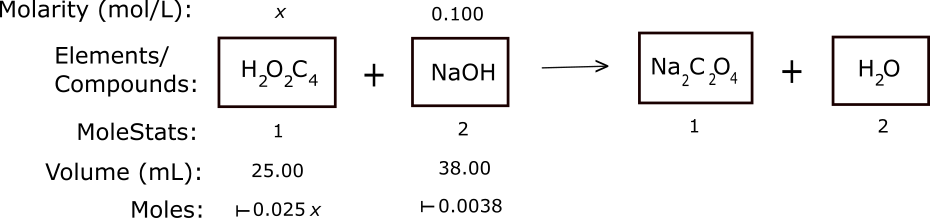
PROBLEM: (Paraphrased) 25.00 mL of oxalic acid is titrated with
0.100 M NaOH aq until all the acid is consumed. If it required 38.00 mL
of base to reach this point, what was the molarity (moles/liter) of the acid?
Solution to the problem.
Link to my write-up on An introduction to stoichiometry (long version).
Link to my write-up on An introduction to stoichiometry (short version).
Problem 663 [Not Unipodal: Algebra: Logarithms]
This problem is found at:
Source: https://www.youtube.com/watch?v=1t5EmpnnDe4
Title: Harvard University Admission Interview Tricks
Presenter: Super Academy
Given the relation \begin{equation} 9^{4^m} = 4^{9^m}\,, \end{equation} find the real values for $m$.
Problem 664 [Not Unipodal: Algebra: Roots to a polynomial]
This problem is found at:
Source: https://www.youtube.com/watch?v=YlXvlZM0Cos
Title: Can You Solve An Octic Equation | Problem 547
Presenter: aplusbi
Given the relation \begin{equation} z^8+z^6+z^4+z^2+1=0\,, \end{equation} find the complex values for $z$.
Problem 665 [Not Unipodal: Physics: Kinematics of Circular Motion]
This problem is found at:
Source: https://www.youtube.com/watch?v=5qxxBksZsT8
Title: GRE Quants - WORD PROBLEMS |
Presenter: Manhattan Review
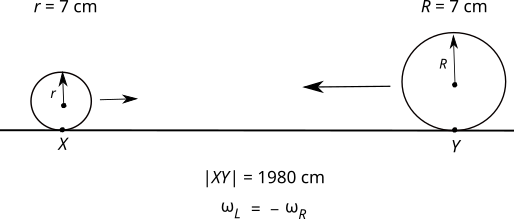
Wheels of radius 7 cm and 14 cm start rolling simultaneously from X and Y,
which are 1980 cm apart, towards each other in opposite directions. Both
of them make the same number of revolutions per second. Both of them met
after ten seconds.
Problem 666 [Not Unipodal: Self-similarity: Lambert]:
This problem is by
Source: https://www.youtube.com/watch?v=KuOZeA0pwlU
Title: A Nice Math Olympiad Exponential Equation
Presenter: MrMath
Given the relation \begin{equation} \sqrt{6}^x = x^9 \,, \end{equation} find the real values for $x$.
Solution to the problem.
Link to my write-up on the Lambert W function.
Problem 667 [Not Unipodal: Physics: Collision Problem]
This problem is found at:
Source: The Ether of Great Physics Ideas
Title: Hard-Sphere Collision problem.
Presenter: Patrick
This Hard-Sphere Collision problem is rather special: the collision is elastic, the
spheres are of the same mass $m$, and of the same radius $r$. They are also undeformable
(hence, `hard') and smooth. So, to make the problem interesting, they will not collide head
on, but will be offset by the impact parameter $b$, which measures the distance between line
demarking the velocity of the incoming sphere's center and the center of the target
sphere.

Problem 668 [Unipodal: Algebra]
This problem is by
Source: https://www.youtube.com/watch?v=OmsaCaIgoeo
Title:Harvard University Admission Interview Tricks
Presenter: Super Academy
Given the relations \begin{align} x^2 - y^2&= 119\,,\\ xy &= 60\,, \end{align} find the values of $x,y$.
Problem 669 [Not Unipodal: Cubics: Logarithms]
This problem is found at:
Source: https://www.youtube.com/watch?v=r2btjZieyx0
Title: Cambridge University Admission Interview Tricks
Presenter: Super Academy
Given the relation \begin{equation} 10^{\log_2 x} +100^{\log_2 x} = 1000^{\log_2 x}\,, \end{equation} find the real values for $x$.
Solution to the problem.
Link to my write-up on logarithms over the real numbers.
Problem 670 [Not Unipodal: Stoichiometry]:
This problem is found at:
Source: Chemistry: The Molecular Nature of Matter and Change
Title: Grams-to-Liters
Presenter: M. S. Silberberg.
Given 0.10 grams of Mg(OH)$_2$ (a base) reacts completely with how many liters
of 0.10 M HCl?
The chemical equation for the reaction is
\begin{equation}
\mbox{Mg(OH)}_2\mbox{(s)} + 2\mbox{HCl}\mbox{(aq)} \longrightarrow \mbox{MgCl}\mbox{(aq)} + 2\mbox{H}_2\mbox{O}\mbox{(liq)} \,.
\end{equation}
2acidbase.png)
Solution to the problem.
Link to my write-up on An introduction to stoichiometry (long version).
Link to my write-up on An introduction to stoichiometry (short version).
Problem 671 [Not Unipodal: Word Problems]
This problem is by
Source: The Ether of Great Mathematical Ideas
Title: A Mixed-rate problem
Presenter: Patrick
The main oil pump at an oil refinery can fill a tanker in 2 hours. The engineer in
charge is concerned that the main pump is in need of repair and he doesn't want
to stress it too much. He has a pumping window of 4 hours to fill a tanker before
the main pump goes off-line. He also has available a slower pump that can fill the
tanker in 6 hours. If the engineer wants to start the tanker job with the slower
pump and then add in the main pump at the last possible moment, and then run
both simultaneously until the tanker is full, how long will the main pump be used?
Solution to the problem.
Link to my write-up on Word Problem solving.
Problem 672 [Not Unipodal: Calculus: Integration]
This problem is by
Source: The Ether of Great Mathematical Ideas
Title: A common integral
Presenter: Patrick
Perform the integral \begin{equation} I = \int\! x\, \ln x\,dx \,. \end{equation}
Solution to the problem.
Link to my write-up on Basic Integration Techniques. (Short Paper)
Problem 673 [Not Unipodal: Geometric Algebra: Dual Basis]
This problem is by
Source: D. Hestenes, New Foundations for Mathematical Physics,
Published on-line, 1998:
https://davidhestenes.net/geocalc/pdf/NFMPchapt2.pdf
Title: The Dual Basis.
Presenter: Patrick
Given the relations \begin{equation} \be^1 = \frac{\be_2 \cross \be_3}{e},\qquad \be^2 = \frac{\be_3 \cross \be_1}{e},\qquad \be^3 = \frac{\be_1 \cross \be_2}{e} \,, \end{equation} show that \begin{equation} \be^j \cdot \be_k = \delta_k^j \,, \end{equation} where this delta is the Kronecker delta.
Solution to the problem.
Link to my write-up on Basic Geometric Algebra.
Problem 674 [Not Unipodal: Probability]
This problem is by
Source: https://www.youtube.com/watch?v=1S7GeSC_rSs&list
=PL81IATpFpPBgrG8fZ3tRO41nNypY5xtEP&index=4
Title: Math Subject Gre Practice Test #4 GR1268
Presenter: LearnYouSomeMath
Sofia and Tess will each randomly choose one of the 10 integers
from 1 to 10. What is the probability that neither integer chosen
will be the square of the other?
(A) 0.64 (B) 0.72 (C) 0.81 D) 0.90 (E) 0.95
Solution to the problem.
Link to my write-up on Basic Probability.
Problem 675 [Not Unipodal: Logarithms]
This problem is by
Source: https://www.youtube.com/watch?v=3hrFv_GoPTM
Title: ALGEBRA/LOGARITHMIC EQUATIONS
Presenter: Maths Simplified Solutions
Given the relations \begin{align} ab = 10 \,,\\ \log a - \log b &= 2\,. \end{align} find the real values for $x$.
Solution to the problem.
Link to my write-up on logarithms over the real numbers.
Problem 676 [Not Unipodal: Logarithms: Lambert]
This problem is by
Source: https://www.youtube.com/watch?v=oDfuAbwCT_Q
Title: OLYMPIAD MATH
Presenter: Maths Simplified Solutions
\begin{equation} x^{x^5} =\left(\frac{1}{125}\right)^{1/75}\,, \end{equation} find the real values for $x$.
Solution to the problem.
Link to my write-up on the Lambert $W$ function.
Problem 677 [Not Unipodal: Ring Theory]
This problem is by
Source: The Ether of Great Mathematical Ideas
Title: The Mystery of Negative Numbers
Presenter: Patrick
Show that in a ring $R$ containing the integers that \begin{equation} (-1) (-1) = 1\,. \end{equation}
Solution to the problem.
Link to my write-up on Basic Ring Theory, 1.
Problem 678 [Not Unipodal: Calculus: Integration]
This problem is by
Source: The Ether of Great Mathematical Ideas
Title: A common integral
Presenter: Patrick
Perform the integral \begin{equation} I = \int\! \sqrt{x^2-x+1}\,dx\,. \end{equation}
Solution to the problem.
Link to my write-up on Basic Integration Techniques. (Short Paper)
Problem 679 [Not Unipodal: Calculus: Euler-Lagrange Equations: SD]
This problem is by
Source: The Ether of Great Mathematical Ideas
Title: Euler-Lagrange Equations in SD
Presenter: Patrick
Warning: 12 pages long and a lot of theory
Establish the Euler-Lagrange equation. \begin{equation} \frac{d}{dt} \left(\frac{\partial L}{\partial \dot x}\right) - \frac{\partial L}{\partial x} =0\,. \end{equation}
Problem 680 [Not Unipodal: Vector Calculus]
This problem is by
Source: D. Hestenes, New Foundations for Mathematical Physics,
Published on-line, 1998:
https://davidhestenes.net/geocalc/pdf/NFMPchapt2.pdf
Title: The Dual of the Dual Basis.
Presenter: Patrick
In Problem 673, we were introduced to the dual basis of a given basis
in 3D. This new basis was solved by formulas applied to the given basis vectors.
The task this time is to go the other way. So, given the dual basis
\begin{equation}
\be^1 = \frac{\be_2 \cross \be_3}{e},\qquad
\be^2 = \frac{\be_3 \cross \be_1}{e},\qquad
\be^3 = \frac{\be_1 \cross \be_2}{e} \,,
\end{equation}
show that
\begin{equation}
\be_1 = \frac{\be^2 \cross \be^3}{e^{-1}},\qquad
\be_2 = \frac{\be^3 \cross \be^1}{e^{-1}},\qquad
\be_3 = \frac{\be^1 \cross \be^2}{e^{-1}} \,,
\end{equation}
Solution to the problem.
Link to my write-up on Basic Geometric Algebra.
Problem 681 [Not Unipodal: Number Theory: Arithmetic Functions]
This problem is by
Source: The Ether of Great Mathematical Ideas
Title: Dirichlet Commutivity
Presenter: Patrick
Show that the Dirichlet convolution of two arithmetic functions $f,g$ is commutative. That is \begin{equation} (f*g)(n) = (g*f)(n) \,. \end{equation}
Problem 682 [Not Unipodal: Number Algebra: Alpha Transformation]
This problem is by
Source: https://www.youtube.com/watch?v=8jhQ5gG_NsY
Title: A Nice Math Olympiad Exponential Equation
Presenter: MrMath
Given the relation \begin{equation} x^{x^{16}} = 2^{2^2}\,, \end{equation} find the real values of $x$.
Problem 683 [Not Unipodal: Word Problem]
This problem is by
Source: https://www.algebra.com/algebra/homework/word/
travel/Travel_Word_Problems.faq.question.261460.html
Title: Mixed-Rate Problem
Presenter: Patrick
Question 261460: Working together, Sara and Heidi can milk the cows in 2 hours.
Working alone, Heidi takes 3 hours longer than Sara (working alone). How long will
it take Heidi to milk the cows alone?
Solution to the problem.
Link to my write-up on Word Problem solving.
Problem 684 [Not Unipodal: Calculus: Integration: Copilot Assist]
This problem is by
Source:https://www.youtube.com/watch?v=7cr6RQWF5ds
Title: Feynman's Technique of Integration
Presenter: Brain Station Advanced
\begin{equation} I =\int e^{-t^2}\cos{5t}\, dt \,. \end{equation}
Problem 685 [Not Unipodal: Stoichiometry]:
This problem is found at:
Source: Chemical Principles: The Quest for Insight
Title: Iron Content in Ore Sample
Presenter: P. Atkins and L. Jones
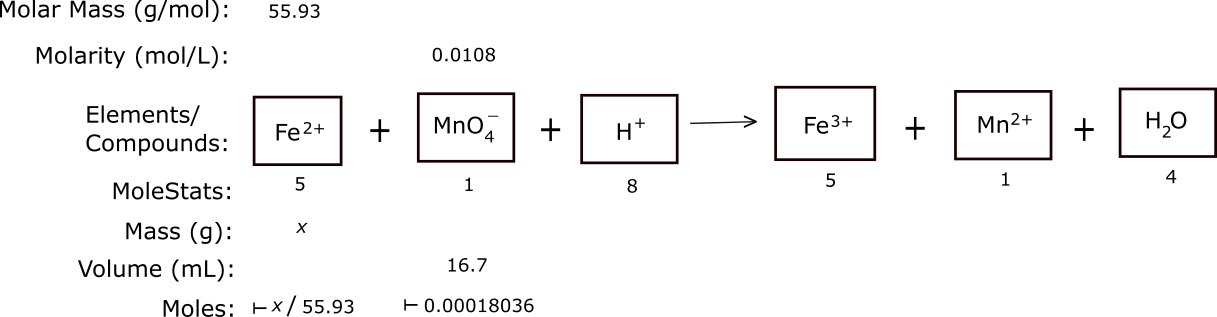
A sample of iron ore of mass 0.202 g is first dissolved in acid and then titrated
with potassium permanganate in the following reaction:
\begin{equation}
5\text{Fe}^{2+}\mbox{aq} + \mbox{MnO}_4^-\mbox{aq} +8\text{H}^{+}\mbox{aq} \longrightarrow
5\text{Fe}^{3+}\mbox{aq} + \mbox{Mn$^{2+}$}\mbox{aq} +4\mbox{H$_2$O}\,\mbox{liq}
\end{equation}
If it takes 16.7 mL of 0.0108 M KMnO$_4$ aq to reach the stoichiometric point
(the point at which all the Fe$^{2+}$ is consumed), what is the mass and percentage
of iron in the sample?
Solution to the problem.
Link to my write-up on An introduction to stoichiometry (long version).
Link to my write-up on An introduction to stoichiometry (short version).
Problem 686 [Not Unipodal: Logarithms: Lambert]
This problem is by
Source: https://www.youtube.com/watch?v=oDfuAbwCT_Q
Title: OLYMPIAD MATH
Presenter: Maths Simplified Solutions
Given the relation \begin{equation} x + y=6\,, \end{equation} find the real values for $x$ that maximize \begin{equation} \phi = x^y\,.\label{eq:TheArdent} \end{equation} Constraint: $x,y>0$.
Solution to the problem.
Link to my write-up on the Lambert $W$ function.
Link to my write-up on logarithms over the real numbers.
Problem 687 [Not Unipodal: Word Problem]
This problem is by
Source: The Ether of Great Mathematical Ideas
Title: Mixed-Rate Problem
Presenter: Patrick
Martin and Wood are hired to do a copyreading job together. Working alone,
Martin could do 2/3 rds of the job in 15 days. And Wood, working alone, could
do the job in 9 days. If they work together (start to finish) how long will it take?
Solution to the problem.
Link to my write-up on Word Problem solving.
Problem 688 [Not Unipodal: Trigonometry: Complex Numbers]:
This problem is found at:
Source: https://www.youtube.com/watch?v=uLXAHdFg_K8
Title: Do NOT Use Any Trigonometric Formula
Presenter: Brain Station Advanced
Given that \begin{equation} \tan \theta = \frac{3}{7}\,, \end{equation} show that (without using any trigonometric formula) \begin{equation} \tan \theta = \frac{21}{20}\,. \end{equation}
Solution to the problem.
Link to my write-up on Trigonometric functions.
Link to my write-up on Basic Complex Numbers.
Problem 689 [Not Unipodal: Logarithms]:
This problem is found at:
Source: https://www.youtube.com/watch?v=hquxO73_Ytc
Title: Harvard Entrance Exam Question
Presenter: Math Beast
Given the relation \begin{equation} \log_4 (\log_3 x)^3 = 4.5\,, \end{equation} find the real values of $x$ that solve this relation.
Solution to the problem.
Link to my write-up on logarithms over the real numbers.
Problem 690 [Not Unipodal: Word Problem]
This problem is by
Source: The Ether of Great Mathematical Ideas
Title: Mixed-Rate Problem
Presenter: Patrick
John can do a work in 24 days and Ethan can do the same work in 40 days.
This time, John starts alone and works for 12 days before Ethan starts and then
John stops. Ethan continues the job until the work is 75% finished. How much
time $T$ did Ethan work?
Solution to the problem.
Link to my write-up on Word Problem solving.
Problem 691 [Not Unipodal: Complex Numbers: Logarithms]
This problem is by
Source: https://www.youtube.com/watch?v=pOH5ex0nsSU
Title: When Imaginary Meets Euler | Problem 554
Presenter: aplusbi
Given the relation \begin{equation} i^z = e\,, \end{equation} find the complex values of $z$ that satisfy this relation.
Solution to the problem.
Link to my write-up on logarithms over the real numbers.
Link to my write-up on Basic Complex Numbers.
Problem 692 [Not Unipodal: Stoichiometry]:
This problem is found at:
Source: Chemical Principles: The Quest for Insight
Title: Iron Content in Ore Sample
Presenter: P. Atkins and L. Jones
Given:
\begin{equation}
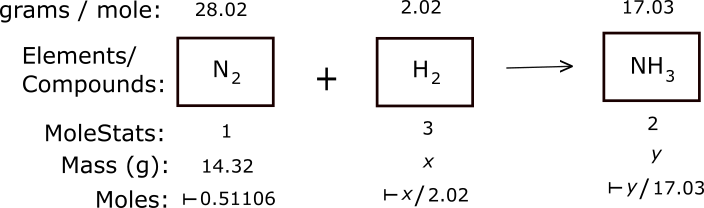
\mbox{N}_2 + 3 \mbox{H}_2 = 2 \mbox{NH}_3\,.
\end{equation}
This next problem is taken from Chemistry with Melissa Maribel. She also
covers the production of ammonia but begins with known masses reactants. I state her
version of the problem in paraphrase:
If 14.32 g of N$_2$ reacts with 4.21 g of H$_2$ to produce NH$_3$, what is the limiting reactant?
Solution to the problem.
Link to my write-up on An introduction to stoichiometry (long version).
Link to my write-up on An introduction to stoichiometry (short version).
Problem 693 [Not Unipodal: Calculus: Integration: HyperbolicTrig Functions]
This problem is by
Source: https://www.youtube.com/watch?v=ddwXqK24PGA
Title: Integral of (5*x^3)/(x^2 + 1)
Presenter: Calculus Booster
Find the indefinite integral \begin{equation} I(x) = \int \frac{x^3}{x^2+1}\, dx \,. \end{equation} Note: I'm ignoring the factor of 5.
Solution to the problem.
Link to my write-up on Hyperbolic trig functions over the real numbers.
Problem 694 [Not Unipodal: Logarithms: Alpha Substitution]
This problem is by
Source: https://www.youtube.com/watch?v=mLDj9TJJ7wQ
Title: Harvard University Admission Interview Tricks
Presenter: Super Academy
Given the relation \begin{equation} \log_{81}x + \log_9 x = 6\,, \end{equation} solve for $x$.
Solution to the problem.
Link to my write-up on logarithms over the real numbers.
Problem 695 [Not Unipodal: Complex Numbers: Lambert]
This problem is by
Source: https://www.youtube.com/watch?v=BQ0B9JL-VjQ
Title: How to solve? | Oxford entrance exam question
Presenter: Math Beast
Given the relation \begin{equation} x^{x} =e^{-\pi+i\ln 4}\,, \end{equation} find the values for $x$.
Solution to the problem.
Link to my write-up on the Lambert $W$ function.
Link to my write-up on Basic Complex Numbers.
Problem 696 [Not Unipodal: Logarithms]
This problem is by
Source: https://www.youtube.com/watch?v=IXg9Xic2-h4
Title: Solve this Logarithmic equation with different bases
Presenter: MATHEMATICS BY LEVI
Given the relation \begin{equation} \log_{2}x = \log_4 2\,, \end{equation} solve for $x$.
Solution to the problem.
Link to my write-up on logarithms over the real numbers.
Problem 697 [Not Unipodal: Geometric Algebra: Euclidean Geometry]
This problem is by
Source: The Ether of Great Mathematical Ideas
Title: Internal Reflection Through a Wedge
Presenter: Patrick

The figure depicts a wedge that is reflective on its insides. A light ray enters
it from the right, reflects twice off the interior of the wedge and then exits,
passing the incoming path along the way. The angle of the wedge at $P$ is
$\alpha$. The angle that the incoming and outgoing rays make is $\beta$. Show that
$\beta = 2\alpha$. We'll solve this two ways: First, with Euclidean geometry and
second with Geometric Algebra. It is assumed that the reader already knows
the basics of geometric algebra.
Solution to the problem.
Link to my write-up on Basic Geometric Algebra.
Problem 698 [Not Unipodal: Word Problem: Mixed Rate]
This problem is by
Source: The Ether of Great Mathematical Ideas
Title: Mixed-Rate Problem
Presenter: Patrick
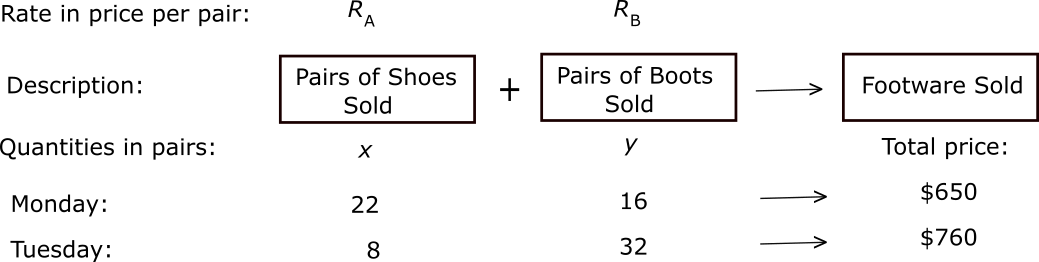
A footwear store sells only shoes and boots. The price of all pairs of shoes are
the same, namely $R_S$, and the price of all pairs of boots are the same, namely
$R_B$. Determine the price per pair of shoes and boots if, on Monday, the store
sold 22 pairs of shoes and 16 pairs of boots for a total of \$650, and on Tuesday it
sold 8 pairs of shoes and 32 pairs of boots for a total of \$760.
Solution to the problem.
Link to my write-up on Word Problem solving.
Problem 699 [Not Unipodal: Logarithms: Table]
This problem is by
Source: https://www.youtube.com/watch?v=45oJZMBPSL8
Title: Harvard University Admission Interview Tricks
Presenter: Super Academy
Given the relation \begin{equation} 8^{\log x} - 2^{\log x} = 5!\,, \end{equation} find the real values of $x$.
Solution to the problem.
Link to my write-up on logarithms over the real numbers.
Problem 700 [Not Unipodal: Logarithms: Hyperbolic Functions]
This problem is by
Source: https://www.youtube.com/watch?v=2rtj47fUvP0
Title: Harvard University Admission Interview Tricks
Presenter: Super Academy
Given the relation\begin{equation} (\log_3 2)^x + (\log_2 3)^x = 6\,, \end{equation} find the real values of $x$.
Solution to the problem.
Link to my write-up on logarithms over the real numbers.
Link to my write-up on Hyperbolic trig functions over the real numbers.
Problem 701 [Not Unipodal: Word Problem: Mixed Rate]
This problem is by
Source: https://www.algebra.com/algebra
Question 200033
Title: Mixed-Rate Problem
Presenter: Patrick
Soybean meal is 14% protein, corn meal is 7% protein. How many pounds
of each should be mixed together to get 280 lb mixture at 13% protein?

Solution to the problem.
Link to my write-up on Word Problem solving.
Problem 702 [Not Unipodal: Lambert]
This problem is by
Source: https://www.youtube.com/watch?v=fq8jvLPET5c
Title: A Nice Exponential Equation (e^x=x^e) (SyberMath)
Presenter: kiki ak
Given the relation \begin{equation} e^{x} = x^e\,, \end{equation} find the real values for $x$.
Solution to the problem.
Link to my write-up on the Lambert $W$ function.
Problem 703 [Not Unipodal: Logarithms]
This problem is by
Source: https://www.youtube.com/watch?v=wR8UL8V7SaU
Title: The Unexpected Harmony of Logarithmic Powers
Presenter: SyberMath
Given the relation \begin{equation} x^{\ln 3} + x^{\ln 6} = x^{\ln 12}\,, \end{equation} find the real values of $x$.
Solution to the problem.
Link to my write-up on logarithms over the real numbers.
Problem 704 [Not Unipodal: Geometric Algebra: Euclidean Geometry]
This problem is by
Source: D. Hestenes, New Foundations for Classical Mechanics,
2nd Ed., Kluwer Academic Publishers, 1999.
Title: Theorems Involving Trangles
Presenter: Patrick
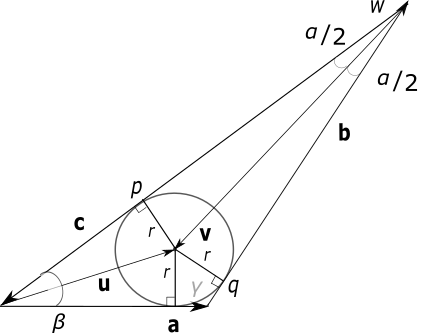
For the triangle in Figure 4.5a (in the textbook) establish the results:
(a) \begin{equation} |\bA| = \half a^2 \frac{\sin \beta \sin \gamma}{\sin \alpha}\,,\quad \alpha + \beta + \gamma = \pi\,. \end{equation}
(b) Hero's Formula \begin{equation} |\bA|^2 = s(s-a)(s-b)(s-c) = s^2r^2\,, \end{equation} where $r$ is the radius of the inscribed circle and $s$ is half the perimeter of the triangle: \begin{equation} s = \half(a+b+c)\,.\label{eq:s=} \end{equation} (c) Half-angle Formulas: \begin{equation} \tan \frac{\alpha}{2} = \frac{r}{s-a}\,,\quad \tan \frac{\beta}{2} = \frac{r}{s-b}\,,\quad \tan \frac{\gamma}{2} = \frac{r}{s-c}\,, \end{equation} where, again, $s$ is half the perimeter of the triangle and $r$ is the radius of the inscribed circle.
(d)The Law of Tangents: \begin{equation} \frac{a-b}{a+b} = \frac{\tan\half(\alpha-\beta)}{\tan\half(\alpha+\beta)}\,, \quad \text{etc}\,. \end{equation}
Solution to the problem.
Link to my write-up on Basic Geometric Algebra.
Problem 705 [Not Unipodal: SAT Problem]
This problem is by
Source: https://www.youtube.com/shorts/hj0lmUyNaf8
Title: Complicated SAT math, linear algebra
Presenter: gotutormaths
Given the following system of equations
\begin{align}
3x - ay &= 1\,,\\
9x + 6y &= b\,,
\end{align}
find the values for $a,b$ such that the system has an infinite solution set,
and then determine the value of $b - a$ among the following choices:
A. 5
B. 1
C. 7
D. 2.
Problem 706 [Not Unipodal: Lambert: Integration]
This problem is by
Source: https://www.youtube.com/watch?v=MJsXxUMpKPo
Title: Can We Integrate Lambert's W(x)/x
Presenter: SyberMath
Do the following indefinite integral: \begin{equation} I(x) = \int \frac{ W(x)}{x}\, dx\,, \end{equation} where $W(x)$ is the Lambert $W$ function.
Problem 707 [Not Unipodal: Exponential Growth: GRE]
This problem is by
Source: https://www.youtube.com/watch?v
=DvCeDCjrxyU&list=PLD0D070C218D8F5A3&index=18
Title: GRE Math Practice: Word Problem - Example 5
Presenter: Magoosh Test Prep for GRE
The population of bacteria doubles every 30 minutes. At 3:30 pm on
Monday, the population was 240. Which is larger: Column A or Column B:
Column A Column B
The bacteria 40
population at 2:00
pm on Monday
Problem 708 [Not Unipodal: Percent Change: SAT]
This problem is by
Source: The Ether of Great Mathematical Ideas
Title: Initial Percent Change
Presenter: Patrick
I was inspired to invent an SAT-style problem from reading a real SAT problem
from years ago. Copilot helped me gather some facts to make the problem authentic.
The problem concerns the firing off of a hobbyist field rocket.
Assuming a steady fuel consumption rate of 7.625 grams/sec for a hobbyist field
rocket, what percent of the original fuel capacity is consumed in the first 0.2 second,
if the original weight of the fuel is 12.2 grams?
Problem 709 [Not Unipodal: Geometric Reasoning]
This problem is by
Source: https://www.youtube.com/watch?v=D6HwZgoT6kc
Title: Only 3% Solved this Germany Olympiad Problem
Presenter: MathMinds
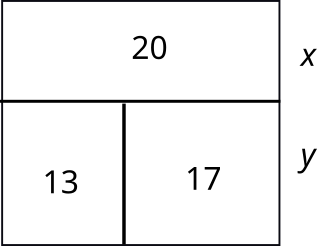
We start with a square subdivided into three rectangles as shown in Fig. 1.
The side length of the square is $L$, and the numbers inside the rectangles
are their respective areas of the rectangles. [Note: This is not the original
problem given in the video, which treated the numbers as representing
the perimeters of the rectangles.]
Problem 710 [Not Unipodal: Stoichiometry]:
This problem is found at:
Source: https://www.dsd.k12.wi.us/faculty/SBAXTER/Unit%205
%20Practice%20Problems%20(answers).pdf
Title:Chemistry--Unit 5: Stoichiometry: Practice Problems
How many liters of carbon monoxide at STP are needed to react with 4.80 g of O2
to produce CO2? The equation for
the reaction is
\begin{equation}
2\hbox{CO}\,\mbox{(g)} + \hbox{O}_2\, \mbox{(g)} \rightarrow 2\mbox{CO}_2\,\mbox{(g)} \,.
\end{equation}
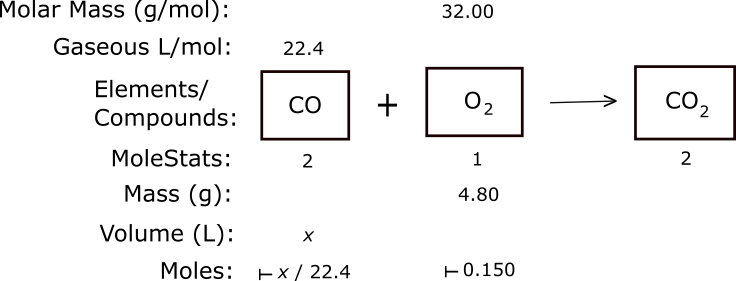
Solution to the problem.
Link to my write-up on An introduction to stoichiometry (long version).
Link to my write-up on An introduction to stoichiometry (short version).
Problem 711 [Not Unipodal: Algebra: Self-Similarity]
This problem is by
Source: https://www.youtube.com/shorts/xCnoPI4zxdM
Title: Most Difficult SAT Question
Presenter: Brain Station Video (short)
Given the relation \begin{equation} \sqrt{x}^{ \sqrt{x}^{ \sqrt{x}^{.\cdot{}^{.}}}} = \frac{1}{3}\,, \end{equation} find the value for $x$.
A. $\frac{1}{3}\qquad$ B. $\frac{1}{81}\qquad$ C. $\frac{1}{27}\qquad$ D. $\frac{1}{729}$
Problem 712 [Not Unipodal: Analysis: Calculus]
This problem is by
Source: https://www.youtube.com/watch?v=hVCccahm6WA
Title: logarithm with base and negative argument
Presenter: Shortredematematica
Let $n$ be a positive integer. Show that \begin{equation} \lim_{n\to\infty}\left(1 + \frac{1}{n}\right)^n = e\,, \end{equation} where $e$ exponential base.
Problem 713 [Not Unipodal: Logarithms: Complex Numbers]
This problem is by
Source: https://www.youtube.com/watch?v=hVCccahm6WA
Title: logarithm with base and negative argument
Presenter: Shortredematematica
Given the relation \begin{equation} x = \log_{-3}(-27)\,, \end{equation} find the value for $x$ more simply.
Solution to the problem.
Link to my write-up on logarithms over the real numbers.
Problem 714 [Not Unipodal: Algebra: Percentages]
This problem is by
Source: The Ether of Interesting Math Ideas
Title: Working with percentages
Presenter: Patrick
Let $S$ be the subpopulation of a county of all members of age 25 years
old and older. Calculate the percent of people in $S$ that have a college degree if
a) The percent of males in $S$ with college degrees is 26%, and the percent
$\hskip.2in$of females in $S$ with college degrees is 16%.
b) The percentage females in $S$ is 55%.

Problem 715 [Not Unipodal: Complex Numbers: Lambert]
This problem is by
Source: https://www.youtube.com/watch?v=-PzIkRa4dlQ
Title: Math Exam from Germany – Can you solve it?
Presenter: Higher Mathematics
Given the relation \begin{equation} 3^{x} =x\,, \end{equation} find the values for $x$.
Solution to the problem.
Link to my write-up on the Lambert $W$ function.
Problem 716 [Not Unipodal: Algebra: Mixed-Rate Problem]
This problem is by
Source: https://www.algebra.com/algebra
Title: Question 22466
Presenter: Patrick
An apprentice $A$ takes three hours longer to do a certain job than his mentor $M$.
Working together, they can do the job in two hours. What are their individual rates?
Problem 717 [Not Unipodal: Probability]
This problem is by
Source: The Ether of Great Mathematical Ideas
Title: The probability of a birthday match in $n$ people
Presenter: Patrick
A lecture hall is filling up with students for the next lecture. How many
students $n$ are needed in the hall so that at least two of them have the same
birthday. (Just to clarify: We're looking for the smallest $n$ that satisfies
the constraint.)
Solution to the problem.
Link to my write-up on Basic Probability.
Problem 718 [Not Unipodal: Complex Numbers]
This problem is by
Source: The Ether of Great Mathematical Ideas
Title: Trespassing into the complex number space
Presenter: Patrick
Use the relation (known as Viete's formula) \begin{equation} z^{n} -(z_1+z_2+\cdots+z_n)z^{n-1}+c_{n-2}-\cdots +(-1)^n\, z_1z_2\cdots z_n=0\,, \end{equation} with roots $ z_1, z_2, \ldots, z_n$ to the following equation \begin{equation} (z -z_1) (z -z_2) \cdots (z -z_n) =0\,, \end{equation} when applied to the special polynomial over the complex numbers \begin{equation} z^{n} -1=0\,, \end{equation} to show that \begin{align} 1 + \cos \frac{2\pi}{n}+ \cos \frac{4\pi}{n}+\cdots + \cos \frac{2\pi(n-1)}{n} &=0\,,\\ \sin \frac{2\pi}{n}+ \sin \frac{4\pi}{n}+\cdots + \sin \frac{2\pi(n-1)}{n}&=0\,. \end{align}
Solution to the problem.
Link to my write-up on Basic Complex Numbers.
Problem 719 [Not Unipodal: Algebra: half-life]
This problem is by
Source: https://www.basic-mathematics.com/
hard-word-problems-in-algebra.html
Title: #70. The half-life of a medication
Presenter: Patrick
The half-life of a medication prescribed by a doctor is 6 hours. How
many mg of this medication is left after 78 hours if the doctor
prescribed 100 mg?
Problem 720 [Not Unipodal: Geometry: Linear Algebra]
This problem is by
Source: The Ether of Great Mathematical Ideas
Title: Constructing a Circle from Three Non-collinear points
Presenter: Patrick
It's a well-known theorem that any three noncollinear, distinct points
in a plane
determine a circle that contains the three points. We will prove this
theorem
algebraically by finding the coordinates of the center of this circle as
functions of the coordinates of the three points.
Solution to the problem.
Link to my write-up on Basic Matrix Algebra.
Problem 721 [Not Unipodal: Complex Numbers: Logarithms]
This problem is by
Source: https://www.youtube.com/watch?v=q1sSAu7TvEY
Title: Stanford University Admission Interview Tricks
Presenter: Super Academy
Given the relation \begin{equation} 10^{x+1} - 10^{x-1} = 100\,, \end{equation} solve for $x$ over the complex numbers
Solution to the problem.
Link to my write-up on Basic Complex Numbers.
Link to my write-up on logarithms over the real numbers.
Problem 722 [Not Unipodal: Lambert: Logarithms]
This problem is by
Source: https://www.youtube.com/watch?v=BgnvGEffiDI
Title: A Nonstandard Equation
Presenter: SyberMath
Given the relation \begin{equation} e^x = \sqrt{x+a}\,, \end{equation} solve for $x$ over the real numbers.
Normally, in a situation like this, I would solve over the complex numbers
(except when I'm too tired to do that), but on this equation, WolframAlpha
only solved for a real solution.
Solution to the problem.
Link to my write-up on the Lambert $W$ function.
Link to my write-up on logarithms over the real numbers.
Problem 723 [Not Unipodal: Word Problem: Mixed Rate]
This problem is by
Source: https://www.algebra.com/algebra
Title: Question 22466
Presenter: Patrick
Working together, $A$ and $B$ can do a job in 4 days.
Working alone, $A$ takes twice as long as $B$ to do
the job. Find their individual rates.
Problem 724 [Not Unipodal: Algebra]
This problem is by
Source: https://www.youtube.com/watch?v=l12TshxBXYE
Title: Can solve this Olympiad Question?
Presenter: VIJAY Maths
Given the relation \begin{equation} x^3 + \frac{1}{x^3} = 18\,, \end{equation} find the real values of \begin{equation} \phi = x^7+ \frac{1}{x^7} \,. \end{equation}
Problem 725 [Not Unipodal: Algebra]
This problem is by
Source: https://www.basic-mathematics.com/
hard-word-problems-in-algebra.html
Title: Problem #53
Presenter: Patrick
Find three consecutive integers such that one half of their
sum is between 15 and 21.
Problem 726 [Not Unipodal: Algebra: Conversion Factors]
This problem is by
Source: https://www.basic-mathematics.com/
hard-word-problems-in-algebra.html
Title: 100 hard word problems in algebra: #57
Presenter: Patrick
The amount of water a dripping faucet wastes water varies directly with the
amount of time the faucet drips. If the faucet drips 2 cups of water every
6 minutes, find out how long it will take the faucet to drip 10.6465 liters of water.
Problem 727 [Not Unipodal: Word Problem: Mixed Rate]
This problem is by
Source: The Ether of Great Mathematical Ideas
Title: Mixed Rate
Presenter: Patrick
You are in the wilderness when a medical situation arises: A number of
persons of your wilderness party have taken cuts and scrapes, requiring
immediate first-aid attention. Unfortunately, you do not have enough
disinfectant to treat them all. But you have two sources of alcohol available
to you in your cabin to make more disinfectant. The literature claims that
effective alcohol should be at least 70% to use as a disinfectant.
On hand in the cabin is 0.40 liters of 30% rubbing alcohol and .25 liters of 90%
rubbing alcohol. Using these two sources, how much 70% rubbing alcohol can
you make?
Problem 728 [Not Unipodal: Algebra]
This problem is by
Source: https://www.youtube.com/watch?v
=Dun-cR6c-1s
Title: Solving a `Harvard' University entrance exam
Presenter: Math Olympiad
Given the relation \begin{equation} \sqrt{t} + t = t\sqrt{t}\,, \end{equation} find the real values of $t$ over the positive real numbers.
Problem 729 [Not Unipodal: Algebra: Percentages]
This problem is by
Source: The Ether of Interesting Math Ideas
Title: Working with percentages
Presenter: Patrick
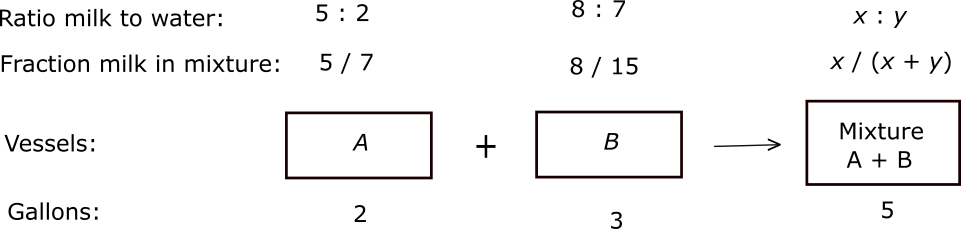
Two vessels $A$ and $B$ have mixtures of milk and water. $A$ has them in ratio 5 : 2
and $B$ has them in ratio 8 : 7. The volume of vessel $A$ is 2 gallons, and the
volume of vessel $B$ is 3 gallons. If the contents of $A$ and $B$ are mixed together,
what will be the milk-to-water ratio of this mixture?
Problem 730 [Not Unipodal: Calculus: Integration]
This problem is by
Source: The Ether of Great Mathematical Ideas
Title: A common integral
Presenter: Patrick
\begin{equation} I = \int\! \ln\, \sqrt{1+x^2}\,dx\,. \end{equation}
Solution to the problem.
Link to my write-up on Basic Integration Techniques. (Short Paper)
Problem 731 [Not Unipodal: Infinite Series]
This problem is by
Source: https://math.stanford.edu/~vakil
/putnam02/02/putnam3.pdf
Title: COMPLEX NUMBERS
Presenter: ALOK AGGARWAL and RAVI VAKIL
Suppose $\cos \theta = 1/\pi$. Evaluate: \begin{equation} \phi = \sum_{n=0}^\infty \frac{\cos\, n\theta}{2^n}\,.\label{eq:phi} \end{equation}
Problem 732 [Not Unipodal: Exponential Decrease: Half-Lives]
This problem is by
Source: The Ether of Great Mathematical Ideas
Title: Concentration of Drugs Diminishes by a Half-Life Model
Presenter: Patrick
At time $t=0$, 30 mg of drug A is injected into a patient. 60 minutes later,
10 mg of drug B is injected into the patient as a follow-up. Drug A has a
half-life of 120 minutes, and drug B has a half-life of 60 minutes. At what
time $T$ will there be a combined sum of 5 mg of drug A and drug B in the
patient's system?
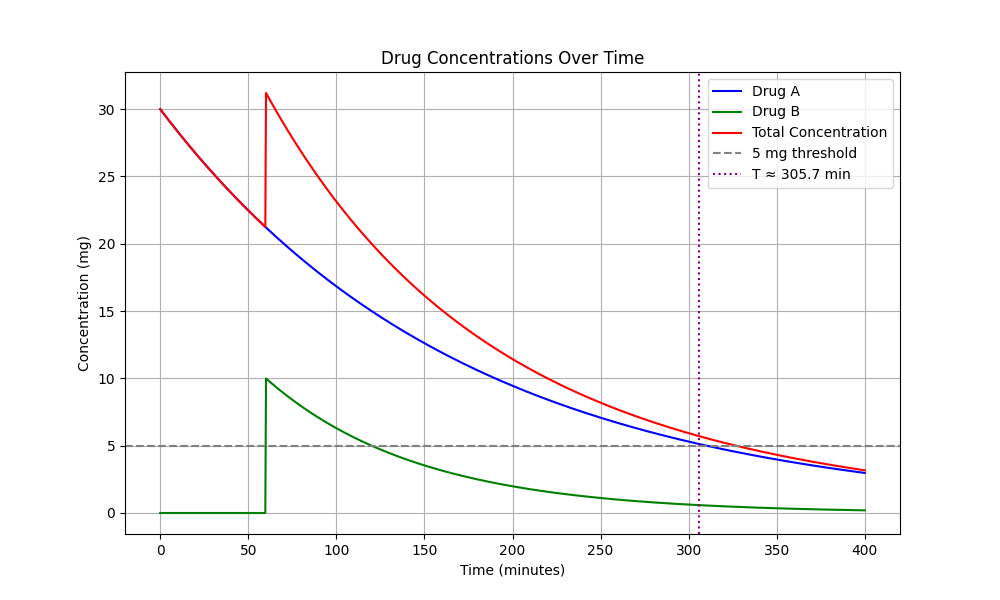
Copilot's solution, graphed by a SymPy script.
Solution to the problem.
Copilot's solution to the problem, with a description of the biochemistry involved, and the SymPy script..
Problem 733 [Not Unipodal: Logarithms]
This problem is by
Source: https://www.youtube.com/watch?v=gWj-gXjCceg
Title: Can You Solve This Advanced Logarithm Equation?
Presenter: Khem math
Given the relation \begin{equation} x^{2 + \ln x} = 0.1 \,, \end{equation} solve for $x$.
Solution to the problem.
Link to my write-up on logarithms over the real numbers.
Problem 734 [Not Unipodal: Complex Numbers]
This problem is by
Source: https://www.youtube.com/watch?v=dWjcOIkNBzM
Title: Nice Algebra | Math simplification Problem
Presenter: Khem math
If $\alpha$ and $ \beta$ are solutions to \begin{equation} x^2 + 2x +2 = 0 \,, \end{equation} solve for \begin{equation} \phi = \alpha^{15} + \beta^{15} \,. \end{equation}
Solution to the problem.
Link to my write-up on Basic Complex Numbers.
Problem 735 [Not Unipodal: Geometry: Lagrange Multipliers]
This problem is by
Source: The Ether of Great Mathematical Ideas
Title: The distance from the origin to a plane
Presenter: Patrick
Find the distance from the origin of $\Reals^{\!3}$ to the plane $\pi$, given by \begin{equation} ax+by+cz=d\,, \end{equation} where $d\ne 0$.
Solution to the problem.
Link to my write-up on Basic Complex Numbers.
Problem 736 [Unipodal: Logarithms]
This problem is by
Source: https://www.youtube.com/watch?v=OkJc1pyowP0
Title: How Fast Can You Crack This Math Challenge?
Presenter: Khem math
Given the relations \begin{equation} (\sqrt{5}-1)^x - (\sqrt{5}+1)^x= 2^x\,, \end{equation} find the values of $x$ over the complex numbers.
Solution to the problem.
Link to my write-up on Basic Complex Numbers.
Link to my write-up on logarithms over the real numbers.
Problem 737 [Not Unipodal: Algebra]
This problem is by
Source: https://www.youtube.com/watch?v=LTIh_DcP_is
Title: KCSE QUESTION ON VARIATION
Presenter: Mathematics by Levi
If $p$ and $q$ vary inversely, and if $q=3$ when $p=1/6$,
then what is the value of $p$ when $q=9$?
Problem 738 [Not Unipodal: Algebra]
This problem is by
Source: https://www.youtube.com/watch?v=VZT_0kgGbF8
Title: Can You Crack This Power Puzzle?
Presenter: SyberMath
Given the relation \begin{equation} 5^x=4\,, \end{equation} find the real value of \begin{equation} \phi = 20^{\frac{x}{x+1}}\,. \end{equation}
Problem 739 [Not Unipodal: Thermodynamics: Calculus]
This problem is by
Source: American Journal of Physics (AJP), Vol. 27 (May 1959),
pp 302--306
Title: Systematic Approach to the Calculation of Thermodynamic
Transforms
Presenter: Charles W. Carroll
Sample calulation:
\begin{align} \left(\frac{\partial A}{\partial T}\right)_G &= J\left(\frac{A,G}{T,G}\right) = J\left(\frac{A,G}{T,V}\right) / J\left(\frac{T, G}{T,V}\right)\qquad[\mbox{$J$ stands for Jacobian}\,]\notag\\ &= \left\{-S V\left(\frac{\partial P}{\partial V}\right)_T-\left[(-P)\left(-S+V \left(\frac{\partial P}{\partial T}\right)_V\right)\right]\right\} / V\left(\frac{\partial P}{\partial V}\right)_T\notag\\ &= kP(S-V\pi P) - S \,. \end{align}
Problem 740 [Not Unipodal: Thermodynamics: Calculus]
This problem is by
Source: https://www.youtube.com/watch?v=n3wTj2Os2bE
Title: The average age of three boys is 15 years.
Presenter: Mr Math
Statement of the problem:
The average age of three boys is 15 years. If their ages
are in ratio 3:5:7, what is the age of the youngest boy?
Problem 741 [Not Unipodal: Thermodynamics: Ideal gas entropy]
This problem is by
Source: The Ether of Great Mathematical Ideas
Title: The entropy of a reversible process on an ideal gas
Presenter: Patrick
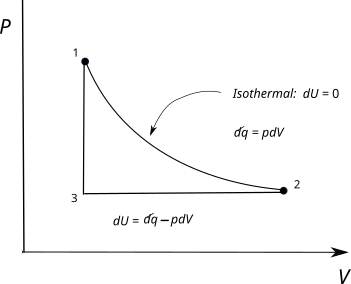
Show that the entropy of a reversible process on
an ideal gas is unchanged over a single cycle.
Problem 742 [Not Unipodal: Complex Numbers: Logarithms]
This problem is by
Source: https://www.youtube.com/watch?v=9aEkY3OSsBw
Title: The Complex Equation That Outsmarts Expectations
| P 561
Presenter: aplusbi
Given the relation \begin{equation} i^{i^z} = i\,, \end{equation} find the complex values of $z$.
Solution to the problem.
Link to my write-up on Basic Complex Numbers.
Link to my write-up on logarithms over the real numbers.
Problem 743 [Not Unipodal: Euclidean Geometry]
This problem is by
Source: https://www.youtube.com/shorts/-iiY2bqn9Wo
Title: This impossible SAT question ruins perfect scores
Presenter: yoursatcoach
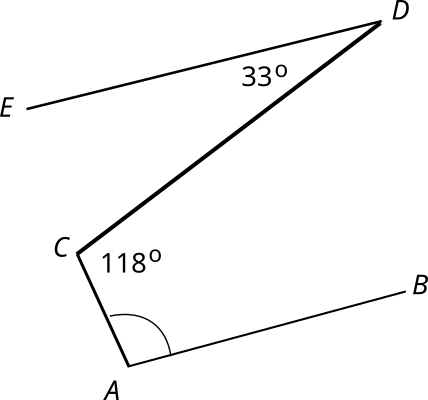
If $AB$ is parallel to $ED$, what is angle $CAB$?
Problem 744 [Not Unipodal: Thermodynamics: Specific Heats of the Ideal Gas]
This problem is by
Source: The Ether of Great Mathematical Ideas
Title: Specific Heats of the Ideal Gas Relation
Presenter: Patrick
\begin{equation}
\overline{c}_P = \overline{c}_V + R \,,
\end{equation}
where $ \overline{c}_P$ and $ \overline{c}_V$ are the molar ideal gas specific heats
at constant pressure and constant volume, respectively.
Problem 745 [Not Unipodal: Logarithms]
This problem is by
Source: https://www.youtube.com/watch?v=myn4KzdA-CU
Title: Nice Math Olympiad Question
Presenter: Math Beast
Given the relation \begin{equation} \log_2 x + \log_3 x = 1 \,, \end{equation} find the real values of $x$.
Solution to the problem.
Link to my write-up on logarithms over the real numbers.
Problem 746 [Not Unipodal: Thermodynamics: Ideal gas lemma]
This problem is by
Source: The Ether of Great Mathematical Ideas
Title: A lemma for a reversible process on an ideal gas
Presenter: Patrick
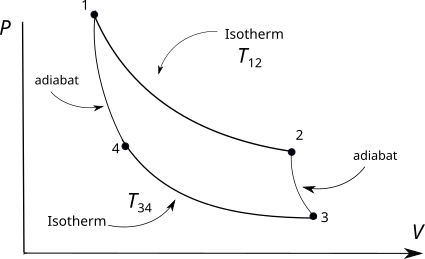
Starting with an ideal gas of fundamental relation \begin{equation} PV = nRT \,. \end{equation} show that when taken through a Carnot cycle by reversible processes, as shown in Fig. 1, that \begin{equation} \frac{V_2V_4}{V_1V_3} = 1 \,. \end{equation}
Problem 747 [Not Unipodal: Logarithms: Lambert]
This problem is by
Source: https://www.youtube.com/watch?v=gmGLBhS4fXY
Title: A Nice Nonstandard Equation
Presenter: SyberMath
Given the relation \begin{equation} 4^x = -x \,,\ \end{equation} find the real values of $x$.
Solution to the problem.
Link to my write-up on logarithms over the real numbers.
Link to my write-up on the Lambert W function.
Problem 748 [Not Unipodal: Word Problem: Mixed-Rate]
This problem is by
Source: The Ether of Great Mathematical Ideas
Title: A Nice Mixed-Rate Problem
Presenter: Patrick
$A$ and $B$ together can do a job in 8 days. $A$ and $C$ together
can do the job in 9 days. And $B$ and $C$ together can do the job in
10 days. What is $B$'s individual rate?
Problem 749 [Not Unipodal: Word Problem: Mixed-Rate]
This problem is by
Source: The Ether of Great Mathematical Ideas
Title: A Nice Mixed-Rate Problem (Continuation)
Presenter: Patrick
In the last problem, we had this to do: $A$ and $B$ together can do a job
in 8 days. $A$ and $C$ together can do the job in 9 days. And $B$ and $C$
together can do the job in 10 days. What is $B$'s individual rate?
This time, given the same information, determine how long it will take to
have the job completed if all three start and stop on the project till it's finished.
However, it's not allowed to compute the individual rates to compute the answer.
Problem 750 [Not Unipodal: Thermodynamics: Ideal gas lemma]
This problem is by
Source: The Ether of Great Mathematical Ideas
Title: S is a state for a reversible process on an ideal gas
Presenter: Patrick
Starting with an ideal gas of fundamental relation
\begin{equation}
PV = nRT \,.\label{eq:ideal.gas.law}
\end{equation}
show that on the Carnot cycle of an ideal gas $S$ is a state function.
In Problem 746, we've already shown that
\begin{equation}
\frac{V_2V_4}{V_1V_3} = 1 \,.\end{equation}
Problem 751 [Not Unipodal: Lagrange Multipliers]
This problem is by
Source: https://math.stackexchange.com/questions/
147324/min-max-of-fx-y-exy-where-x3y3-16
Title: A Lagrange multipliers problem
Presenter: Asker
Given the relation \begin{equation} f(x,y) = e^{xy}\,, \end{equation} subject to the constraint \begin{equation} g(x,y) = x^3 + y^3 = 16\,, \end{equation} find the critical points of this system.
Problem 752 [Not Unipodal: Thermodynamics: Ideal gas lemma]
This problem is by
Source: The Ether of Great Mathematical Ideas
Title: A lemma on the Carnot cycle of an ideal gas using TS plane
Presenter: Copilot
Let's reconstruct the volume identity
\begin{equation}
\frac{V_2V_4}{V_1V_3}=1
\end{equation}
within the Carnot cycle using thermodynamic principles, focusing on reversible
processes and the ideal gas law in both $PV$ and $TS$ planes.
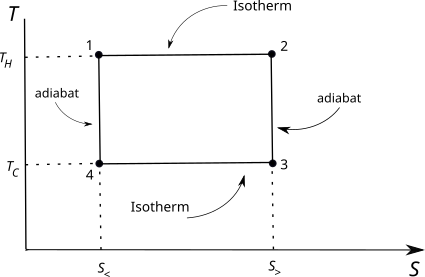
Problem 753 [Not Unipodal: Word Problem: Mixed-Rate]
This problem is by
Source: The Ether of Great Mathematical Ideas
Title: A Nice Mixed-Rate Problem
Presenter: Patrick
A woman sold 100 oranges for $12.10 total. She sold the first
kind at the rate of 3 for 35 cents and the second kind at the rate
of 7 for 85cents. How many were sold at the first rate?
Problem 754 [Not Unipodal: Logarithms: Hyperbolic Trig Functions]
This problem is by
Source: https://www.youtube.com/watch?v=Jsn6-_qTTDw
Title: Tricky Maths Questions for Competitive Exams
Presenter: Math Beast
Given the relation \begin{equation} \frac{e^x - e^{-x}}{3} = 1\,, \end{equation} find the values of $x$.
Solution to the problem.
Link to my write-up on logarithms over the real numbers.
Link to my write-up on Hyperbolic trig functions over the real numbers.
Problem 755 [Not Unipodal: The Pauli Algebra: Part 1]
This problem is by
Source: The Ether of Great Mathematical Ideas
Title: An Identity in the Pauli Algebra
Presenter: Patrick
Establish the 'vector' identity in the Pauli algebra: \begin{equation} (\ba\cdot\bsigma) (\bb\cdot\bsigma) = \ba\cdot\bb\, \bI + i\, \ba\cross\bb\cdot\bsigma \,, \end{equation}
Problem 756 [Not Unipodal: Logarithms]
This problem is by
Source: https://www.youtube.com/watch?v=B26vyP_917k
Title: A Nice Algebra Problem
Presenter: SALogic
Given the relation \begin{equation} \log_{\frac{3}{4}}\left( \frac{x}{3} \right) + \log_{\half}\left( \frac{x}{2} \right) = -2 \,, \end{equation} find the real values of $x$.
Solution to the problem.
Link to my write-up on logarithms over the real numbers.
Problem 757 [Not Unipodal: Logarithms]
This problem is by
Source: https://www.youtube.com/watch?v=sijD0cX4RFc
Title: Japanese Exponential Equation
Presenter: Mathpoints
Given the relation \begin{equation} 2^{3^x} = 3^{2^x} \,, \end{equation} find the real values of $x$.
Solution to the problem.
Link to my write-up on logarithms over the real numbers.
Problem 758 [Not Unipodal: Logarithms]
This problem is by
Source: https://www.youtube.com/watch?v=IrU2gW3lCYQ
Title: an interesting logarithm question that everyone
should be able to solve
Presenter: Mathtastic
Given the relation \begin{equation} \phi = \log_{32} 0.125 \,, \end{equation} find the real values of $\phi$ more simply.
Solution to the problem.
Link to my write-up on logarithms over the real numbers.
Problem 759 [Not Unipodal: Algebra]
This problem is by
Source: https://www.youtube.com/watch?v=-BsTqhZKeCw
Title: Can you solve?
Presenter: Mathpoints
Given the relation \begin{equation} a + b = 5\sqrt{ab} \,, \end{equation} find the real values of $a/b$.
Problem 760 [Not Unipodal: Algebra: Alpha Substitution]
This problem is by
Source: https://www.youtube.com/watch?v=ArPQNEX9M3Y
Title: Can you solve?
Presenter: Leo Dorber
Given the relation \begin{equation} x^{x^7} = 196 \,, \end{equation} find the real values of $x$.
Problem 761 [Not Unipodal: Algebra: Word Problem]
This problem is by
Source: https://www.algebra.com
Title: Question 224473
Presenter: Patrick
Question 224473: Three skilled laborers $a$, $b$, and $c$ can do
a job in 20 days. Just $a$ and $b$ can do the job in 30 days. Just $b$
and $c$ can do the job in 40 days. What are their individual rates
in units job/days?
Problem 762 [Not Unipodal: Logarithms]
This problem is by
Source: https://www.youtube.com/watch?v=ySvzli6KhKo
Title: Japanese || Olympiad Logarithmic Math problem |
Presenter: Mathpoints
Given the relation \begin{equation} \log_{\sqrt{8}} x =\frac{10}{3} \,, \end{equation} find the real value of $x$.
Solution to the problem.
Link to my write-up on logarithms over the real numbers.
Problem 763 [Not Unipodal: Geometry: Ellipses]
This problem is by
Source: The Ether of Great Mathematical Ideas
Title: Coordinate Equation of an Ellipse
Presenter: Patrick
Show that the equation for the ellipse can be expressed in coordinates as \begin{equation} \frac{x^2}{a^2} + \frac{y^2}{b^2} = 1\,. \end{equation}
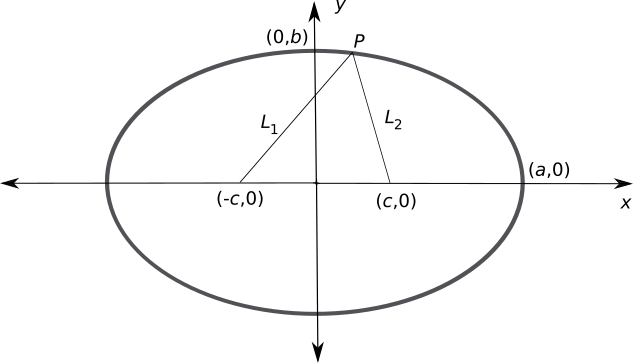
Problem 764 [Not Unipodal: Logarithms: Lambert]
This problem is by
Source: https://www.youtube.com/watch?v=oEtj2FhRB24
Title: Japanese | Math Olympiad Problem With Natural Log
Presenter: MathProwess
Given the relation \begin{equation} - x^2 = 5 \ln x \,, \end{equation} find the values of $x$.
Problem 765 [Not Unipodal: Word Problem: Mixed Rates]
This problem is by
Source: The Ether of Great Mathematical Ideas
Title: A Word Problem: Mixed Rates
Presenter: Patrick
A shop keeper wants to make 4 pounds of a tea blended from two ingredients:
black tea, costing \$2.20 per pound, and orange pekote tea, costing \$3.00
per pound. If the value of the blended tea is to be \$2.50 per pound, how much
of the ingredients are to be use to maintain the value of the ingredients in the blend?

Solution to the problem.
Link to my write-up on A History of Scheme for solving word problems and stoichiometry problems.
Problem 766 [Not Unipodal: Stoichiometry Problem:]
This problem is by
Source: The Ether of Great Mathematical Ideas
Title: A Word Problem: Mixed Rates
Presenter: Patrick
How many liters of SO2 will be produced from 26.9L O2? The equation for the reaction is
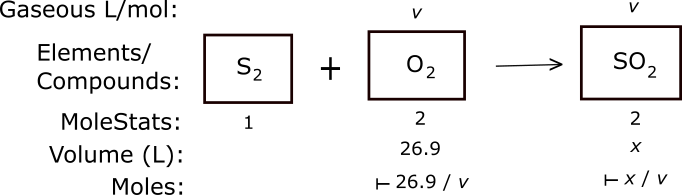
Solution to the problem.
Link to my write-up on A History of Scheme for solving word problems and stoichiometry problems.
Problem 767 [Not Unipodal: Quantum Mechanics: Isotropic Spinors]
This problem is by
Source: The Ether of Great Mathematical Ideas
Title: Proof that $\partial_\mu J^\mu = 0$ in a Particular QFT Problem Using Isotropic Spinors
Presenter: Patrick
This paper demonstrates the use of isotropic spinors (2-d complex vectors) to prove the
fundamental result that
\begin{equation}
\partial_\mu J^\mu = 0\,,
\end{equation}
where $J^\mu$ is the current vector for a problem in quantum field theory. [Note:
These 'spinors' are not associated with particle spin --- at least not directly.]
(This paper is a bit advanced. You don't have to know quantum physics, per se, but you do have
to get used to the spinor algebra and be able to use the Einstein summation convention.)
Problem 768 [Not Unipodal: Calculus: Trigonometric Integration]
This problem is by
Source: The Ether of Great Mathematical Ideas
Title: An Integration Problem
Presenter: Patrick
Find the integral \begin{equation} I = \int\! \frac{\tan x}{1+\tan^2x}\,dx\,. \end{equation}
Solution to the problem.
Link to my write-up on Trigonometric functions.
Link to my write-up on Basic Integration Techniques. (Short Paper)
Problem 769 [Not Unipodal: Logarithms]
This problem is by
Source: https://www.youtube.com/watch?v=skIwyzuV2mQ
Title: Solving a `Harvard' University Entrance Exam Question
Presenter: Maths Explorer
Given the relation \begin{equation} \log_2 x + \log_5 x = 6\,, \end{equation} find the real values of $x$
Solution to the problem.
Link to my write-up on logarithms over the real numbers.
Problem 770 [Not Unipodal: Algebra]
This problem is by
Source: https://www.youtube.com/watch?v=s85rHbSol1I
Title: Solving a `Harvard' University Entrance Exam
Presenter: Math Olympiad
Given the relation \begin{equation} (k+9)^2 = 81\,, \end{equation} find the real values of $k$.
Problem 771 [Not Unipodal: Algebra]
This problem is by
Source:The Ether of Great Mathematical Ideas
Title: Motivated Solution to the Cubic
Presenter: Patrick
Find the genral solution to the following cubic equation over the complex numbers. \begin{equation} z^3+az^2+bz+c=0\,. \end{equation}
Problem 772 [Not Unipodal: Algebra: Solution by Table]
This problem is by
Source: https://www.youtube.com/watch?v=bAGRzVh752o
Title: Nice Math Olympiad Algebra Question
Presenter: Math Beast
Given the relation \begin{equation} t^4 - 4^t = 17\,, \end{equation} find the positive integer solutions of $t$.
Problem 773 [Not Unipodal: Algebra: Logarithms]
This problem is by
Source: https://www.youtube.com/watch?v=-5qiRIOteU4
Title: Solve a logarithmic equation. Japanese
Presenter: Maths Enhancer's Class
Given the relation \begin{equation} \log_5(3^x+4^x) = \log_4(5^x- 3^x)\,, \end{equation} find a positive integer solution of $x$.
Solution to the problem.
Link to my write-up on logarithms over the real numbers.
Problem 774 [Not Unipodal: Algebra: Solution by Table]
This problem is by
Source: https://www.youtube.com/watch?v=4SdooW2yldo
Title: A Harvard University interview math tricks
Presenter: Maths Explorer
Given the relation \begin{equation} a! = a^3 - a\,, \end{equation} find the integer solutions of $a$.
Problem 775 [Not Unipodal: Conformal Field Theory Problem Problem #1]
This problem is by
Source: https://www.youtube.com/watch?v=NGYX6gtObec
Title: Introduction to conformal field theory, Lecture 1
Presenter: Tobias Osborne
(Read-along notes and a problem to solve.)
Given the relation (in a conformal field theory) \begin{equation} x'^\mu = x^\mu + \epsilon^\mu\,, \end{equation} where $\epsilon^\mu$ is small, show that \begin{equation} \partial_\mu \epsilon_\nu + \partial_\nu \epsilon_\mu =\frac{2}{d} (\partial \epsilon)\eta_{\mu\nu}\,. \end{equation}
Problem 776 [Not Unipodal: Algebra: Mixed Rate]
This problem is by
Source: The Ether of great mathematical ideas
Title: Another Word Problem
Presenter: Patrick
Amanda drove 50 miles. Then she dropped her speed by 20 miles per hour
and drove another 5 miles. If the entire trip took one hour and 30 minutes, what
was Amanda's initial speed?

Problem 777 [Not Unipodal: Geometry: Ellipses]
This problem is by
Source: The Ether of great mathematical ideas
Title: The area of an ellipse
Presenter: Patrick
Theorem:
The area of an ellipse of semimajor length $a$ and semiminor length $b$ is \begin{equation} \mbox{area} = \pi ab \,. \end{equation}
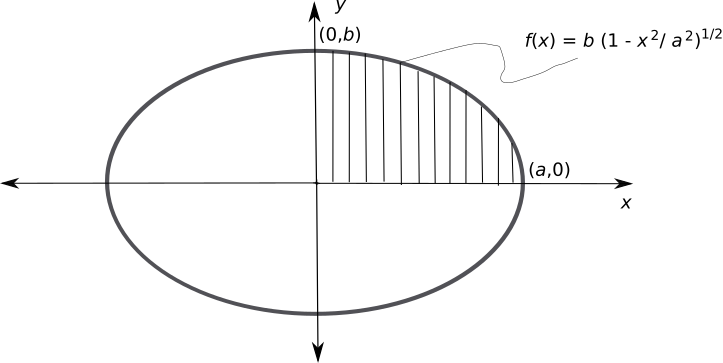
Problem 778 [Not Unipodal: Algebra: Logarithms]
This problem is by
Source: https://www.youtube.com/watch?v=caHAahy9W30
Title: A Nice Algebra Problem
Presenter: SALogic
Given the relation \begin{equation} \frac{2^{x^2}}{4^x} = 6\,, \end{equation} solve for the values of $x$.
Solution to the problem.
Link to my write-up on logarithms over the real numbers.
Problem 779 [Not Unipodal: Algebra: Exponents: Alpha Transformation]
Source: https://www.youtube.com/watch?v=C87XehBs0kg
Title: Oxford University | Entrance Exam
Presenter: Leo Dorber
Given the relation \begin{equation} x^{x} = 3^{18}\,, \end{equation} solve for the real values of $x$.
Problem 780 [Not Unipodal: Conformal Field Theory Problem #2]
This problem is by
Source: https://www.youtube.com/watch?v=NGYX6gtObec
Title: Introduction to conformal field theory, Lecture 1
Part 2 -- see problem 775 for Part 1
Presenter: Tobias Osborne
(Read-along notes and a problem to solve.)
Given the relation (in a conformal field theory) \begin{equation} \partial_\mu \epsilon_\nu + \partial_\nu \epsilon_\mu =\frac{2}{d} (\partial \cdot\epsilon)\eta_{\mu\nu}\,, \end{equation} show that \begin{equation} \big(\eta_{\mu \nu}\square +(d-2) \partial_\mu \partial_\nu\big)(\partial\cdot\epsilon) = 0\,, \end{equation} where \begin{equation} \square \definedas \partial^\rho \partial_\rho\,. \end{equation}
Problem 781 [Not Unipodal: Chemistry: Stoichiometry]
Source: Chemical Principles: The Quest for Insight
Title: Problem L21, p. F87
Presenters: P. Atkins and L. Jones.
The compound XCl2(NH3)2 can be formed by reacting XCl4 with NH3.
Suppose that 3.571g of
XCl4 reacts with excess NH3 to give 3.180g
of XCl2(NH3)2. What is element X?
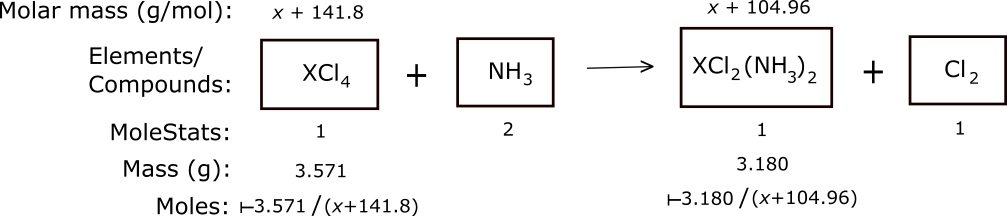
Problem 782 [Not Unipodal: Algebra: Mixed Rates]
Source: The Ether of Great Mathematical Ideas
Title: Mixing acids
Presenter: Patrick
A chemist needs to make as much 50% acid as he can starting with
5 liters of 70% acid and an unlimited amount of 40% acid (both
acids of the same type and percentages are by volume). How much
40% acid should be added to the 70% acid?

Solution to the problem.
Link to my write-up on Word Problem solving.
Problem 783 [Not Unipodal: Trigonometry: Complex Numbers]
Source: https://www.youtube.com/watch?v=8qbB7o-fqqc
Title: Trig Meets the Imaginary Realm | P 565
Presenter: aplusbi
Given the relation \begin{equation} \sec \theta + \tan \theta = i\,, \end{equation} solve for $\theta$.
Solution to the problem.
Link to my write-up on Trigonometric functions.
Link to my write-up on Basic Complex Numbers.
Problem 784 [Not Unipodal: Geometry: Ellipses]
Source: The Ether of Great Mathematical Ideas
Title: Much Ado About Ellipses, Part 3: Directrix Construction
Presenter: Patrick
Introduction
Our first construction of the ellipse was in Problem 763, in which we used the method of drawing a curve on a plane with a pencil constrained to a string of fixed length and attached at two points in the plane. Our first task this time will be to construct an ellipse by the `directrix' method of construction and then show that this construction is equivalent to that of the previous one, which gave us the standard equation in the $x,y$-plane \begin{equation} \frac{x^2}{a^2} + \frac{y^2}{b^2} = 1\,. \end{equation}
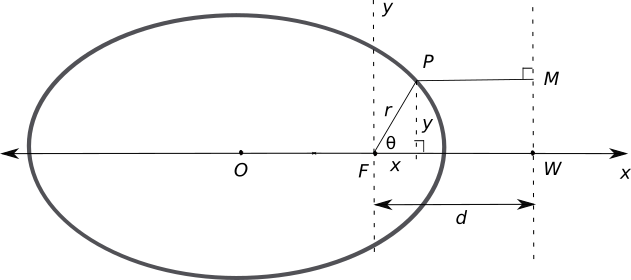
Problem 785 [Not Unipodal: Geometry: Ellipses]
Source: The Ether of Great Mathematical Ideas
Title: Much Ado About Ellipses, Part 4: Kepler's Laws
Presenter: Patrick
Introduction
This time I'm going over {\bf Kepler's Three Laws of Planetary Motion} because they're all related to ellipses, and this is how:
- Kepler's First Law: The orbits of the planets around the Sun are ellipses with the Sun at one focus of the ellipse.
- Kepler's Second Law: A radial line connecting a planet to the Sun sweeps out equal areas in equal times.
- Kepler's Third Law: The square of a planet's period is proportional to the cube of the length of its orbit's semimajor axis.

Problem 786 [Not Unipodal: Conformal Field Theory Problem #3]
This problem is by
Source: https://www.youtube.com/watch?v=NGYX6gtObec
Title: Introduction to conformal field theory, Lecture 1
Part 3 -- see problem 780 for Part 2
Presenter: Tobias Osborne
(Read-along notes and a problem to solve.)
Given the relations (in a conformal field theory) \begin{equation} \partial_\mu \epsilon_\nu + \partial_\nu \epsilon_\mu =\frac{2}{d} (\partial \cdot\epsilon)\eta_{\mu\nu}\,, \end{equation} and \begin{equation} \big(\eta_{\mu \nu}\square +(d-2) \partial_\mu \partial_\nu\big)(\partial\cdot\epsilon) = 0\,, \end{equation} where \begin{equation} \square \definedas \partial^\rho \partial_\rho\,, \end{equation} show that, if we assume that $\epsilon^\mu$ has a solution in the form \begin{equation} \epsilon^\mu = \omega^\mu_{\hskip5pt\nu}\, x^\nu\,, \end{equation} then $ \omega^\mu_{\hskip5pt\nu}$ is an antisymmetric tensor for condition $d >2$.
Problem 787 [Not Unipodal: Logarithms: Lambert $W$ Function]
Source: https://www.youtube.com/watch?v=z3qSpr1UrHs
Title: Complex Numbers Gone Wild | P 568
Presenter: aplusbi
Given the relation \begin{equation} z^{z} = -1\,, \end{equation} solve for the values of $z$.
Solution to the problem.
Link to my write-up on the Lambert W function.
Link to my write-up on logarithms over the real numbers.
Problem 788 [Not Unipodal: Logarithms]
Source: https://www.youtube.com/watch?v=pMGz4fVXqGE
Title: Are YOU smart enough to get into Cambridge?
Presenter: Math Queen
Given the relation \begin{equation} 3^{x} - (\sqrt{3})^{x+4} + 20 = 0\,, \end{equation} solve for the sum of the real values of $x$.
Solution to the problem.
Link to my write-up on logarithms over the real numbers.
Problem 789 [Not Unipodal: Logarithms]
Source: https://www.youtube.com/watch?v=L8DqynoKGUE
Title: A Complex Exponential Equation | Problem 343
Presenter: aplusbi
Given the relation \begin{equation} i^{iz} = 1\,, \end{equation} solve for the complex values of $z$.
Solution to the problem.
Link to my write-up on logarithms over the real numbers.
Problem 790 [Not Unipodal: Differential Equations]
Source: https://www.youtube.com/watch?v=qNXPpQan-WQ
Title: ODE with exponential solution - Oxford Mathematics Admissions Test 2018
Presenter: Math Out Loud
The function $y=e^{kx}$ satisfies the equation \begin{equation} \left(\frac{d^2y}{dx^2}+ \frac{dy}{dx}\right) \left(\frac{dy}{dx}-y\right) = y \frac{dy}{dx}\,, \end{equation} for how many values for $k$?
Problem 791 [Not Unipodal: Hyperbolic Trig Functions]
Source: https://www.youtube.com/watch?v=0aoeB6xkqhE
Title: Unexpected Symmetry
Presenter: Math Out Loud
Show that the function \begin{equation} f(x) = \ln\, (x+\sqrt{x^2+1}) \end{equation} is an odd function, and then find $f^{-1}(x)$.
Solution to the problem.
Link to my write-up on Hyperbolic trig functions over the real numbers.
Problem 792 [Not Unipodal: Lambert W Function]
Source: https://www.youtube.com/watch?v=Dbs6qhSVU5w
Title: The Journey to the Infinite Power Tower
Presenter: blackpenredpen
Given the relation \begin{equation} x^{x^3} = 2 \end{equation} solve for the values of $x$.
Solution to the problem.
Link to my write-up on the Lambert W function.
Problem 793 [Not Unipodal: Algebra: Absolute Values]
Source: https://www.youtube.com/watch?v=kL8srfaTw8w
Title: Absolute value equation
Presenter: Math Out Loud
Given the relation \begin{equation} x |x| + 1 = 3|x|\,, \end{equation} how many solutions for $x$ are there?
Problem 794 [Not Unipodal: Geometric Algebra: Reflections]
Source: The Ether of Great Mathematical Ideas
Title: Reflection off of a surface
Presenter: Patrick
Our job is to use geometric algebra find a formula for the reflection of an incoming
light ray off of a surface. The figure for it is below.
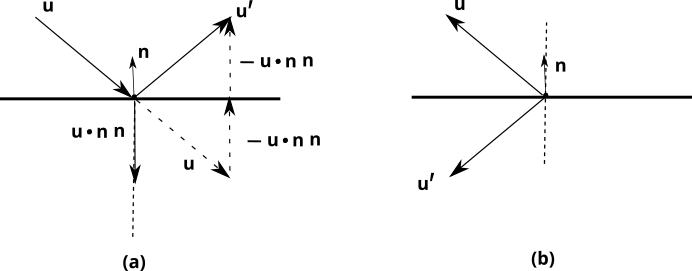
Solution to the problem.
Link to my write-up on Basic Geometric Algebra.
Problem 795 [Not Unipodal: Lambert W Function]
Source: https://www.youtube.com/watch?v=G-BQFUsFIZM
Title: A Nice Exponential Equation
Presenter: SyberMath
Given the relation \begin{equation} x^{x^{x+1}} = 265\,, \end{equation} solve for the real values of $x$.
Problem 796 [Not Unipodal: Algebra: Generating Functions: Fibonacci]
Source: The Ether of Great Mathematical Ideas
Title: Fibonacci Numbers Through Generating Functions
Presenter: Patrick
Introduce the Fibonacci numbers and then use generating functions to obtain
the Binet Formula,
\begin{equation}
F_n = \frac{\varphi_{+}^n-\varphi_{-}^n}{\sqrt{5}} \,.
\end{equation}
Problem 797 [Not Unipodal: Geometric Algebra: Parabolas]
Source: The Ether of Great Mathematical Ideas
Title: What Curve Focuses Parallel Light Rays?
Presenter: Patrick
This paper uses Geometric Algebra to solve for the curve that
focuses parallel rays to a single point. The curve will be shown
to be a parabola and the point its focus. A basic knowledge of
geometric algebra and first-year calculus is assumed. The previous
article on geometric algebra Math Diversion Problem 794 might
be of assistance.
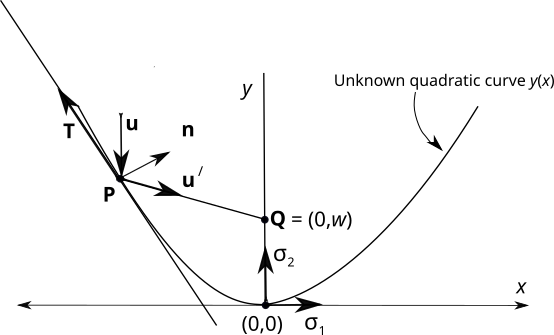
Problem 798 [Not Unipodal: Algebra]
Source: https://www.youtube.com/watch?v=aCGPeRC9RRk
Title: How To Solve A Beautiful Exponential Equation
Presenter: SyberMath
Given the relation \begin{equation} 4^x + 4^{1/x} =18\,, \end{equation} solve for the real values of $x$.
Problem 799 [Not Unipodal: Algebra]
Source: The Ether of Great Mathematical Ideas
Title: Word Problem
Presenter: Patrick
Three different varieties of wheat are to be mixed in proportions
$1:1:2$ to produce a wheat mixture of specified requirements.
If the cost per kilogram of the first two varieties are, respectively,
\$126/Kg and \$135/Kg, and the final mix is \$153/Kg, what is the
cost per kilogram of the third variety?

Solution to the problem.
Link to my write-up on A History of Scheme for solving word problems and stoichiometry problems.
To go to Diversions1 page Link to Diversions1
To go to Diversions2 page Link to Diversions2
To go to Diversions3 page Link to Diversions3
To go to Diversions5 page Link to Diversions5
To go to Diversions6 page Link to Diversions6