Patrick Reany
Abstract: This page presents mathematics diversions, which are basically just
math problems of varying difficulty, which one can try to solve for fun or for
testing one's math skills, or for learning new methods and concepts.
Disclaimer: Many of the following problems were taken from SATs or old
Olympiad tests. My alternative solutions may not follow Olympiad rules, however.
The techniques I use may not be fit for use in Olympiads or entrance exams or the like.
I believe that it's good to see alternative solutions to better fill out one's
mathematical abilities. Four decades ago, I quipped that one cannot truly
understand a theorem until one is able to prove it in essentially two different ways.
It's meant to be a thought-provoking claim, perhaps containing a morsel of truth.
Announcement: If I'm to continue posting on this page, I need to broaden
the scope of the mathematics I cover here. So, I intend to include topics on
groups, rings, matrices, abstract algebra, partial differentiation, word problems,
integration, and others. I also intend to include some theory and proofs.
Note: The comments 'Unipodal' or 'Not Unipodal' placed besides the problems
is there to indicate whether or not the problem solution has incorporated the
Unipodal algebra or not. If it has, the proof will be 'nonstandard', though
(hopefully) still correct.
Note: Here are some short monographs on standard math that I use in my papers:
Link to my write-up on Basic Complex Numbers.
Link to my write-up on Pascal's Triangle.
Link to my write-up on Geometric Series.
Link to my first write-up on Group Theory 1 (very basic).
Link to my write-up on logarithms over the real numbers.
Link to my write-up on Hyperbolic trig functions over the real numbers.
Link to my write-up on Trigonometric functions.
Link to my write-up on the Lambert W function.
Link to my write-up on Word Problem solving.
Link to my write-up on 'A History of Scheme' for solving word problems and stoichiometry problems.
Link to my write-up on Basic Matrix Algebra.
Link to my write-up on Mathematical Induction.
Link to my write-up on GCD & LCM.
Link to my write-up on Virtual Emplacement.
Link to my write-up on the Fibonacci sequence.
Link to my write-up on the Method of Partial Fractions.
Link to my write-up on Set Theory Basics.
Link to my write-up on Basic Ring Theory, 1.
Link to my write-up on Basic Geometric Algebra.
To go to Diversions1 page Link to Diversions1
To go to Diversions2 page Link to Diversions2
To go to Diversions4 page Link to Diversions4
To go to Diversions5 page Link to Diversions5
To go to Diversions6 page Link to Diversions6
Problem 400 [Not Unipodal: Complex Numbers]: Same problem as the last one, 399.
This problem is by
Source: https://www.youtube.com/watch?v=FFC2Ts1GamQ
Title: Solving A Cubic System | Problem 335
Presenter: aplusbi
Given the relations \begin{align} z^2+w^2&= 0\,,\\ z^3+w^3 &= -4\,, \end{align} find the values of $z,w$.
Solution to the problem.
Link to my write-up on Basic Complex Numbers.
Problem 401 [Not Unipodal: Lambert]:
This problem is by
Source: ?
Title: ?
Presenter: ?
Given the relation \begin{equation} x^2 = ( \frac{1}{2})^x\,, \end{equation} find the real values of $x$.
Solution to the problem.
Link to my write-up on the Lambert W function.
Problem 402 [Not Unipodal: Complex Numbers]:
This problem is by
Source: https://www.youtube.com/watch?v=TavEDj8N00g
Title: An Exponent That Triples | Problem 380
Presenter: aplusbi
Given the relation \begin{equation} i^z= 3i\,, \end{equation} find the values for $z$.
Solution to the problem.
Link to my write-up on Basic Complex Numbers.
Problem 403 [Not Unipodal: Complex Numbers]:
This problem is by
Source: https://www.youtube.com/watch?v=TBCeQCkJC4I
Title: An Interesting Equation | Problem 301
Presenter: aplusbi
Given the relation \begin{equation} 2z\cos \theta - z^2 = 1\,, \end{equation} find the values for $z$.
Solution to the problem.
Link to my write-up on Basic Complex Numbers.
Problem 404 [Not Unipodal: Lambert]:
This problem is by
Source: https://www.youtube.com/watch?v=YwElQV393M4
Title: An Interesting Nonstandard Equation
Presenter: SyberMath
Given the relation \begin{equation} x e^{\textstyle\frac{x-1}{x}}= 1\,, \end{equation} find the values of $x$.
Solution to the problem.
Link to my write-up on Lambert $W$ function.
Problem 405 [Not Unipodal: Lambert]:
This problem is by
Source: https://www.youtube.com/watch?v=0IpU9Ly_6lw
Title: An Interesting Homemade Equation
Presenter: SyberMath
Given the relation \begin{equation} e^{1-x}= 1 - \frac{\ln x}{x}\,, \end{equation} find the values of $x$.
Solution to the problem.
Link to my write-up on Lambert $W$ function.
Problem 406 [Not Unipodal: Complex Numbers]:
This problem is by
Source: https://www.youtube.com/watch?v=0IpU9Ly_6lw
Title: An Equation With Absolute Value | Problem 478
Presenter: aplusbi
Given the relation \begin{equation} |z| + iz= z_0 = 4+2i\,, \end{equation} find the values of $z$.
Solution to the problem.
Link to my write-up on Basic Complex Numbers.
Problem 407 [Not Unipodal: Lambert]:
This problem is by
Source: ---
Title: ---
Presenter: Patrick
Given the relation \begin{equation} \ln x =e^{x}\,, \end{equation} find the values of $x$.
Solution to the problem.
Link to my write-up on Lambert $W$ function.
Problem 408 [Not Unipodal: Lambert]:
This problem is by
Source: ---
Title: ---
Presenter: Math-x
Given the relation \begin{equation} 2^b + b= 5\,, \end{equation} find the values of $b$.
Solution to the problem.
Link to my write-up on Lambert $W$ function.
Problem 409 [Not Unipodal: Alpha substitution]: (Same as problem 386.)
This problem is by
Source: https://www.youtube.com/watch?v=wQrM5usqXAQ
Title: A Nice Math Olympiad Exponential Equation X^x^3 = 36
Presenter: MrMath
Given the relation \begin{equation} x^{x^3} = 36 = 6^2\,, \end{equation} find the values of $x$.
Problem 410 [Word Problem]:
This problem is from
Unknown at this time.
Solution by Patrick.
Statement:
A 100 g gold-copper alloy sample has its temperature raised 23.4 $^\circ$C by adding
to it 200 calories of heat. The owner
of the sample was told that the amount of
copper in the sample is less than 50\% by weight. Is this claim true or false?
Solution to the problem.
Link to my write-up on Word Problem solving.
Link to my webpage on solving word problems.
Problem 411 [Not Unipodal: Lambert]:
This problem is by
Source: https://www.youtube.com/watch?v=jS6u-l55QlE
Title: A Nice Math Olympiad Exponential Equation 36^x = 3/x
Presenter: MrMath
Given the relation \begin{equation} 36^x = \frac{3}{x}\,, \end{equation} find the values of $x$.
Solution to the problem.
Link to my write-up on Lambert $W$ function.
Problem 412 [Not Unipodal: Lambert]:
This problem is by
Source: https://www.youtube.com/shorts/V_NQx8uRDqM
Title: 9th grade exponent problem
Presenter: MindSphereYT
Given the relation \begin{equation} x^x = \frac{7^{7^7}}{7^x}\,, \end{equation} find the values of $x$.
Solution to the problem.
Link to my write-up on Lambert $W$ function.
Problem 413 [Not Unipodal: Lambert]:
This problem is by
Source: https://www.youtube.com/watch?v=z_BdVV5MTKg
Title: Solving a 'Harvard' University entrance exams
Presenter: The Map of Mathematics
Given the relation \begin{equation} 27^x = -x\,, \end{equation} find the values of $x$.
Solution to the problem.
Link to my write-up on Lambert $W$ function.
Problem 414 [Not Unipodal: Logarithms]:
This problem is by
Source: https://www.youtube.com/watch?v=tKzQc_I1GLw
Title: Calculate logarithms in your head!
Presenter: The Map of Mathematics
Given the relation \begin{equation} \log_{m+9} 9 = 2\,, \end{equation} find the values of $m$.
Solution to the problem.
Link to my write-up on logarithms over the real numbers.
Problem 415 [Not Unipodal: Solved by Table]:
This problem is by
Source: https://www.youtube.com/watch?v=IJkvllZKhFk
Title: Brazil's Toughest Math Olympiad Challenge
Presenter: Smart math tricks
Given the relation \begin{equation} 9^x - x^4 = 65\,, \end{equation} find the values of $x$.
Problem 416 [Unipodal: Theoretical]:
This problem is by
Source: ---
Title: The Inverse Sinh-to-Natural-Log Identity Proof
Presenter: Patrick
Prove that \begin{equation} \sinh^{-1} y = \ln\,\big[\,y + \sqrt{y^2+1}\,\big]\,. \end{equation}
Problem 417 [Not Unipodal: Lambert]:
This problem is by
Source: https://www.youtube.com/watch?v=grE-NkoMP4M
time stamp 4:29
Title: Top 7 math Olympiad Question
Presenter: MindSphere
Given the relation \begin{equation} 2^x + x = 11\,, \end{equation} find the real values of $x$.
Solution to the problem.
Link to my write-up on Lambert $W$ function.
Problem 418 [Not Unipodal: Lambert]:
This problem is by
Source: https://www.youtube.com/watch?v=_eiiL4r6CHQ
Title: Can you Solve Oxford University Admission Test ?
Presenter: Super Academy
Given the relation \begin{equation} x^2 = (5 - \sqrt{24}\,)^x\,, \end{equation} find the values of $x$.
Solution to the problem.
Link to my write-up on Lambert $W$ function.
Problem 419 [Not Unipodal: Lambert: Theoretical]:
Prove that \begin{equation} W(x^{x+1}\ln x) = x \ln x\,. \end{equation}
Problem 420 [Not Unipodal: Lambert]:
This problem is by
Source: https://www.youtube.com/watch?v=p2zO7g0TeO0
Title: Harvard University Exponential Problem.
Presenter: Super Academy
Given the relation \begin{equation} 4^{ x^2} = x^{128}\,, \end{equation} find the values of $x$.
Solution to the problem.
Link to my write-up on Lambert $W$ function.
Problem 421 [Not Unipodal: Theoretical]:
Prove the relation: Let \begin{equation} f(x) = a^x\,, \end{equation} where $a$ is a constant, then show that \begin{equation} D_x a^x = a^x \ln a\,,\end{equation} where $D_x$ is the derivative with respect to $x$.
Problem 422 [Not Unipodal: Solved by a Table]:
Source: https://www.youtube.com/watch?v=64TBOpB2-7k
Title: Math Olympiad 3^n+2^n=35
Presenter: Super Academy
Given the relation \begin{equation} 3^n + 2^n = 35\,, \end{equation} find the values of $n \in \Integers$.
Problem 423 [Unipodal]:
Source: https://www.youtube.com/watch?v=rEyGlcSdEfk
Title: Brazil Olympiad Simplification Challenge
Presenter: Smart math tricks
Given the relation \begin{equation} \sqrt{x}+\sqrt{2x} = x \,, \end{equation} determine the values of $x$:
Problem 424 [Not Unipodal: Complex: Theoretical]:
Source: https://www.youtube.com/watch?v=2UJtaWCA_xE
Title: Simplify A Trigonometric Expression | Problem 193
Presenter: aplusbi
Simplify \begin{equation} \phi = \sin z\,\cos w + \sin w \,\cos z\,. \end{equation}
Problem 425 [Not Unipodal: Lambert]:
This problem is by
Source: https://www.youtube.com/watch?v=MtVv_FchiG4
Title: Harvard Entrance Exam Question
Presenter: The Map of Mathematics
Given the relation \begin{equation} 2^{c} = 3c+1\,, \end{equation} find the values of $c$.
Solution to the problem.
Link to my write-up on Lambert $W$ function.
Problem 426 [Not Unipodal: Alpha substitution]:
This problem is by
Source: https://www.youtube.com/watch?v=huPSxaz0H2I
Title: Nice Exponential Problem
Presenter: Math Beast
Given the relation \begin{equation} x^{625} = 5^x\,, \end{equation} find the values of $x$.
Problem 427 [Not Unipodal: SD]:
This problem is from
Source: https://www.physicsforums.com/threads/hard-partial-derivatives
-question.646666/
Given the relations:
Taking $k$ and $\omega$ to be constant, [find] $\partial z/\partial \theta$
and $\partial z/\partial \phi$ in terms of $x$ and $t$ for the following function
\begin{equation}
z = \cos\,(kx - \omega t)\,,
\end{equation}
where
\begin{equation}
\theta=t^2-x\quad\mbox{and}\quad\phi = x^2+t\,.
\end{equation}
Solution to the problem.
Link to my write-ups on Structured Differentiation (SD).
Problem 428 [Not Unipodal: Complex Numbers]:
This problem is by
Source: https://www.youtube.com/watch?v=iv900JA6eiU
Title: Solving a Sextic Equation
Presenter: Dr. Barker
Given the relation \begin{equation} (1-x)^6 = 64 x^6\,. \end{equation} find the values of $x$.
Solution to the problem.
Link to my write-up on Basic Complex Numbers.
Problem 429 [Not Unipodal: SD]:
This problem is from
Source: https://www.physicsforums.com/threads/partial-derivatives -using-chain-rule.863640/
Suppose that \begin{equation} \omega = g(u,v)\,, \end{equation} where \begin{equation} u = x/y\quad\mbox{and}\quad v=z/y\,. \end{equation} Using the chain rule, evaluate \begin{equation} x\, \frac{\partial \omega}{\partial x} + y\, \frac{\partial \omega}{\partial x} + z\, \frac{\partial \omega}{\partial z}\,. \end{equation}
Solution to the problem.
Link to my write-ups on Structured Differentiation (SD).
Problem 430 [Not Unipodal: Complex Numbers]:
This problem is by
Source: https://indico.cern.ch/event/726779/contributions
/2991244/attachments/1642552/2727515
/complex_numbers_exercises.pdf
Title: Complex numbers- Exercises with detailed solutions Presenter: CERN
Compute the square root of \begin{equation} z= -1-i\,. \end{equation}
Solution to the problem.
Link to my write-up on Basic Complex Numbers.
Problem 431 [Not Unipodal: Lambert]:
This problem is by
Source: https://www.youtube.com/watch?v=wL-P09_6T1U
Title: An Interesting Equation
| Problem 482
Presenter: aplusbi
Given the relation \begin{equation} z^i = i^z\,, \end{equation} find the values of $z$.
Solution to the problem.
Link to my write-up on Lambert $W$ function.
Problem 432 [Not Unipodal: SD: Calculus]:
This problem is from
Source: The theory of partial differentiation.
Prove Euler's theorem on homogeneous polynomial functions.
Let $f(x_1,x_2,\ldots,x_r)$ be
a homogeneous polynomial function of degree $n$ of $r$ independent variants
$\{x_1,x_2,\ldots,x_r\}$.
Prove that the following relation
holds true:
\begin{equation}
\sum_{i=1}^r x_i\, \frac{\partial f(x_1,x_2,\ldots,x_r)}{\partial x_i} = n\, f(x_1,x_2,\ldots,x_r)\,.
\end{equation}
Solution to the problem.
Link to my write-ups on Structured Differentiation (SD).
Problem 433 [Not Unipodal: Complex Numbers]:
This problem is by
Source: https://www.youtube.com/watch?v=8GXCTh8vg4k
Title: An Absolutely Nice Homemade Equation | Problem 473
Presenter: aplusbi
Given the relation \begin{equation} \frac{1}{z}+ \frac{1}{|z|} =z_0=\frac{9+3i}{25}\,, \end{equation}
Solution to the problem.
Link to my write-up on Basic Complex Numbers.
Problem 434 [Not Unipodal: SD: Series Paper 1]:
This problem is from
Source: The theory of partial differentiation.
This paper is to be my first of a series of papers on so-called
'partial differentiation'. My readers have shown an interest in
downloading the previous problems I worked out in Structured
Differentiation, so I thought I should give this series a try.
Among other things, working with Lagrange multipliers. \begin{equation} \nabla F+\lambda\nabla G=\boldsymbol0\,. \end{equation}
Structured Differentiation Paper One.
Link to my write-ups on Structured Differentiation (SD).
Link to Basic Matrix Algebra
Problem 435 [Unipodal: Calculus]:
This problem is by
Source: https://www.advancedmath.org
Title: An Instructive Unipodal Integral
Presenter: Patrick
perform the integral \begin{equation} I= \int (a\cosh x - \sinh x)\cosh bx\,dx\,. \end{equation}
Problem 436 [Word Problem]:
This problem is from
R. Blitzer, Intermediate Algebra for College Students.
Solution by Patrick.
Statement:
At the north campus of a small liberal arts college, 10% of the students are women.
At the south campus, 50% of the students are women. The campuses are merged
into one east campus, of which 40% of the 1200 students are women. How many
students were in the north and south campuses before the merger?
Solution to the problem.
Link to my write-up on Word Problem solving.
Link to my webpage on solving word problems.
Problem 437 [Not Unipodal: Complex Numbers]:
This problem is by
Source: https://indico.cern.ch/event/726779/contributions
/2991244/attachments/1642552/2727515
/complex_numbers_exercises.pdf
Title: Complex numbers- Exercises with detailed solutions Presenter: CERN
Given the relation \begin{equation} \obz = i(z-1)\,, \end{equation} find the values of $z$.
Solution to the problem.
Link to my write-up on Basic Complex Numbers.
Problem 438 [Word Problem]:
This problem is from
https://www.algebra.com/algebra/homework/Percentage-and-ratio-word-problems
/Advanced-problems-on-percentage.lesson
Solution by Patrick.
Statement:
In a basket full of fruit, 60% are mangoes and remaining 40% are apples.
25% of apples are green and the rest 75% are red. Of the mangoes, 80%
are red and the rest of the mangoes are green. What percentage of the
green fruits are mangoes?
Solution to the problem.
Link to my write-up on Word Problem solving.
Link to my webpage on solving word problems.
Problem 439 [Not Unipodal: Logarithms]:
This problem is by
Source:https://www.youtube.com/watch?v=bU0-PYjyPPQ&t=1s
Title: A Really Cool Exponential Equation
Presenter: SyberMath
Given the relation \begin{equation} (\log x)^{\ln x}= x\,, \end{equation} find the values of $x$.
Solution to the problem.
Link to my write-up on logarithms over the real numbers.
Problem 440 [Not Unipodal: SD]:
This problem is from
https://www.physicsforums.com/threads/partial-derivative
-homework-calculate-f-x.921970/
The problem statement:
The question asks to calculate $\partial f/\partial x$ for
\begin{equation}
f(x,y,t) = 3x^2 + 2xy + y^{1/2}t -5xt
\end{equation}
where
\begin{equation}
x(t) = t^3\quad\mbox{ and }\quad y(t) = 2t^5\,.
\end{equation}
Solution to the problem.
Link to my write-ups on Structured Differentiation (SD).
Link to Basic Matrix Algebra
Problem 441 [Not Unipodal: Complex Numbers]:
This problem is by
Source: https://indico.cern.ch/event/726779/contributions
/2991244/attachments/1642552/2727515
/complex_numbers_exercises.pdf
Title: Complex numbers- Exercises with detailed solutions Presenter: CERN
Given the relation \begin{equation} \Re(z(1 +i))+z\obz = 0\,, \end{equation} find the values of $z$.
Solution to the problem.
Link to my write-up on Basic Complex Numbers.
Problem 442 [Not Unipodal: SD: Series Paper 2]:
This problem is from
Source: The theory of partial differentiation.
This paper is my second of a series of papers on so-called
'partial differentiation'. My readers have shown an interest in
downloading the previous problems I worked out in Structured
Differentiation, so I thought I should give this series a try.
Among other problems solved, a certain thermodynamic state can be
represented by the differential
equation of state
\begin{equation}
\frac{\partial U}{\partial V}-T\frac{\partial P}{\partial T}+P=0\,,
\end{equation}
where $V$ and $T$ are the fundamental variables. What, then, is the appropriate
form that this takes when $U$ and $P$ replace $V$ and $T$ as the fundamental
variables?
Structured Differentiation Paper Two.
Link to my write-ups on Structured Differentiation (SD).
Link to Basic Matrix Algebra
Problem 443 [Not Unipodal: Group Theory]:
This problem is from
Source: Abstract Algebra: A First Course (1992)
Section 2: Problem 2.1 h.
Presenter: Dan Saracino
Given the set $S = \Reals-\{1\}$ with binary operation defined by \begin{equation} a* b = a+b-ab\,, \end{equation} determine if this set forms a group.
Link to download solution.
Link to my first write-up on Group Theory 1 (very basic).
Problem 444 [Not Unipodal: SD: Series Paper 3]:
This problem is from
Source: https://www.physicsforums.com/threads/calculating-the-partial
-derivative-in-polar-coordinates.1014922
This paper is my third of a series of papers on so-called
'partial differentiation'. My readers have shown an interest in
downloading the previous problems I worked out in Structured
Differentiation, so I thought I should give this series a try.
The question asks to calculate the conversion of the Laplacian in 2 dimensions
from rectangular coordinates $x,y$ to polar coordinates, $r,\theta$, where
\begin{align}
x&=r\cos\theta\,,\\
y&=r\sin\theta\,,
\end{align}
and where
\begin{equation}
z = f(x,y)\,,
\end{equation}
to show that
\begin{equation}
\left(\frac{\partial z}{\partial x}\right)^2 + \left(\frac{\partial z}{\partial y}\right)^2
= \left(\frac{\partial z}{\partial r}\right)^2 + \frac{1}{r^2}
\left(\frac{\partial z}{\partial \theta}\right)^2\,.
\end{equation}
Structured Differentiation Paper Three.
Link to my write-ups on Structured Differentiation (SD).
Link to Basic Matrix Algebra
Problem 445 [Not Unipodal: Complex Numbers]:
This problem is by
Source: https://indico.cern.ch/event/726779/contributions
/2991244/attachments/1642552/2727515
/complex_numbers_exercises.pdf
Title: Complex numbers- Exercises with detailed solutions Presenter: CERN
Given the relation \begin{equation} z^2\obz = z\,, \end{equation} find the values of $z$.
Solution to the problem.
Link to my write-up on Basic Complex Numbers.
Problem 446 [Not Unipodal: SD: Series Paper 4]:
This problem is from
Source: Found in: "Mathematical Methods in Elementary Thermodynamics,''
S. M. Blinder, J. of Chem. Ed., Vol. 43, No. 2, 1966, pp 85--88.
Given the relation \begin{equation} z = z(x,y) = \mbox{const}\,, \end{equation} show that \begin{equation} \left(\frac{\partial y}{\partial x}\right)_{\!z} \left(\frac{\partial z}{\partial y}\right)_{\!x} \left(\frac{\partial x}{\partial z}\right)_{\!y} = -1 \,. \end{equation}
Structured Differentiation Paper Four.
Link to my write-ups on Structured Differentiation (SD).
Problem 447 [Not Unipodal: Lambert: Solved by a Table]:
This problem is from
Source: https://www.youtube.com/watch?v=-Cg0niL4whY
Title: Can you Pass Stanford University Admission Test ?
Presenter: Super Academy
Given the relation \begin{equation} 5^{\sqrt{x}+1} + 5\sqrt{x}= 135\,, \end{equation} find the real values of $x$.
Solution to the problem.
Link to my write-up on Lambert $W$ function.
Problem 448 [Unipodal]:
This problem is by
Source: https://www.youtube.com/watch?v=16p5Lxh-H_8
Title: Oxford University Entrance Exam Tricks
Presenter: Super Academy
Given the relation \begin{equation} (\sqrt{10}+3)^x+ (\sqrt{10}-3)^x= 38\,, \end{equation} find the (real) values for $x$.
Problem 449 [Not Unipodal: SD: Series Paper 5]:
This problem is from
Source: Patrick from earlier articles.
Given the relations \begin{equation} \left.\begin{matrix}x=r\sin \theta \cos \phi\\ y=r\sin\theta\sin\phi\\ z=r\cos\theta\hfill\end{matrix}\right\} \end{equation}
Find $\nabla{}r,\ \nabla\theta$, and $\nabla\phi$ where $\nabla=\partial/\partial{\bf x}$. For example, \begin{equation} \nabla r= \left(\frac{\partial r}{\partial x}, \frac{\partial r}{\partial y}, \frac{\partial r}{\partial z} \right)\,. \end{equation}
Structured Differentiation Paper Five.
Link to my write-ups on Structured Differentiation (SD).
Problem 450 [Not Unipodal: Lambert]:
This problem is from
Source: https://www.youtube.com/watch?v=UjlyqwBJZic
Title: An Interesting Transcendental Equation
Presenter: SyberMath
Given the relation \begin{equation} x^{\sqrt{3}} = \sqrt{3}^x\,, \end{equation} find the real values of $x$.
Solution to the problem.
Link to my write-up on Lambert $W$ function.
Problem 451 [Not Unipodal: Lambert]:
This problem is from
Source: ??
Title: ??
Presenter: SyberMath
Given the relation \begin{equation} e^x - 1 = \ln\,(x+1)\,, \end{equation} find the values of $x$.
Solution to the problem.
Link to my write-up on Lambert $W$ function.
Problem 452 [Not Unipodal: Calculus]:
This problem is from
Source: https://www.youtube.com/watch?v=ynIDy0WGwBY
Title: An Interesting Integral
Presenter: SyberMath
Find the indefinite integral \begin{equation} I = \int\! e^x \cos x\, dx\,.\label{eq:TheGiven} \end{equation}
Problem 453 [Not Unipodal: Lambert]:
This problem is by
Source: https://www.youtube.com/watch?v=X5iYlxCwGRo&list
=PLMvuVeOn1Hd_KIT-dsvIVluQQN3pJrlmX&index=46
Title: A Nice Exponential Equation
Presenter: Master T Maths Class
Given the relation \begin{equation} x^{x^{1+x}} = 256 \,, \end{equation} find the values of $x$ over the real numbers.
Problem 454 [Not Unipodal: Mathematical Induction: Fibonacci]:
This problem is by
Source: An induction problem in Fibonacci numbers
The Fibonacci numbers are defined by the recurrence relation \begin{equation} F_{n+2} = F_{n+1} + F_{n}\,, \end{equation} where \begin{equation} F_{0} = 0 \quad\mbox{and}\quad F_{1} = 1\,. \end{equation} The Fibonacci numbers have the proposed closed-form relation of \begin{equation} F_{n} = \frac{a^n - b^n}{a-b}\quad\mbox{where}\quad n \ge 2\,, \end{equation} and where $a$ and $b$ are distinct solutions to the quadratic \begin{equation} x^2 = x+1\,. \end{equation} Prove by mathematical induction that the relation holds.
Solution to this problem.
Link to my write-up on Mathematical Induction.
Link to my write-up on the Fibonacci
sequence.
Problem 455 [Not Unipodal: SD: Series Paper 6]:
This problem is from
Source: Found in: "Mathematical Methods in Elementary Thermodynamics,''
S. M. Blinder, J. of Chem. Ed., Vol. 43, No. 2, 1966, pp 85--88.
Given the Dieterici's Equation of State \begin{equation} P(V-b)\, e^{a/RTV} = RT\,, \end{equation} show that \begin{equation} \left( \frac{\partial V}{\partial T}\right)_{\!P} = \frac{ R+\frac{a}{TV}} {\frac{ RT}{V-b}- \frac{a}{V^2} } \,. \end{equation}
Structured Differentiation Paper Six.
Link to my write-ups on Structured Differentiation (SD).
Problem 456 [Not Unipodal: Alpha Substitution]:
This problem is by
Source: https://www.youtube.com/watch?v=iUK4Ik5I5oQ
Title: Harvard University logarithmic Problem.
Presenter: Super Academy
Given the relation \begin{equation} x^{\log_53} = \sqrt{x} + 4x\,, \end{equation} find the values of $x$.
Solution to the problem.
Link to my write-up on logarithms over the real numbers.
Problem 457 [Not Unipodal: Alpha Substitution]:
This problem is by
Source: https://www.youtube.com/watch?v=JsxpF95w8YQ
Title: Harvard University Admission Interview Tricks
Presenter: Super Academy
Given the relation \begin{equation} x^{x^{x^4}} = 4\,, \end{equation} find the values of $x$.
Problem 458 [Unipodal: Induction]:
This problem is by
Source: https://www.youtube.com/watch?v=gz-j_IiNaX0
Title: Wow! Derivative + Hyperbolic Function + Math Induction!
Presenter: bprp calculus basics
Given the relation \begin{equation} y = e^{2x}\sinh x\,, \end{equation} use induction to show that \begin{equation} \frac{d^ny}{dx^n} = e^{2x}\left[\,\frac{3^n+1}{2}\sinh x + \frac{3^n-1}{2}\cosh x\,\right]\,. \end{equation}
Solution to the problem.
Link to my write-up on Mathematical Induction.
Problem 459 [Not Unipodal: Logarithms]:
This problem is by
Source: https://www.youtube.com/watch?v=5YAurLmKT4o
Title: JEE Mains Complex Logarithm Equation
Presenter: Maths & Olympiad
Given the relation \begin{equation} \log_{3} [7+\log_4\{13+\log_2(x+4)\}] = 2\,, \end{equation} find the values of $x$.
Solution to the problem.
Link to my write-up on Logarithms.
Problem 460 [Unipodal: Logarithms]:
This problem is by
Source: https://www.youtube.com/watch?v=kVQqaYo9DEA
Title: Sample JEE main question from India
Presenter: Prime Newtons
Given the relation \begin{equation} (\sqrt{3}+\sqrt{2})^x+ (\sqrt{3}-\sqrt{2})^x= 10\,, \end{equation} find the (real) values for $x$.
Solution to the problem.
Link to my write-up on Logarithms.
Problem 461 [Not Unipodal: Lambert]:
This problem is from
Source: https://www.youtube.com/watch?v=xuugqqgG6d4
Title: Oxford entrance exam question
Presenter: Math Beast
Given the relation \begin{equation} x^{1/x}=e^{\pi/2}\,, \end{equation} find the values of $x$.
Solution to the problem.
Link to my write-up on Lambert $W$ function.
Problem 462 [Unipodal]:
This problem is by
Source: Patrick
Title: A made up problem
Given the relation \begin{equation} \fourthroot{x+\sqrt{x^2+1}} - \fourthroot{x-\sqrt{x^2+1}}= 2\,, \end{equation} find the values for $x$.
Problem 463 [Not Unipodal: Lambert: Calculus]:
This problem is from
Title: A Lambert $W$ Integral
Presenter: Patrick
Find the indefinite integral \begin{equation} I = \int\! W(x)\, dx\,, \end{equation} where $W$ is the Lambert $W$ function.
Solution to the problem.
Link to my write-up on Lambert $W$ function.
Problem 464 [Not Unipodal: Induction]:
This problem is from
Source: https://www.youtube.com/watch?v=pLbG3Vvpjjk&list
=PLql0qQWQbo6ko_ESCoqvW4dkLMb8eHN9S
Title: Prove that 11^n - 4^n is divisible by 7 for any
natural number
Presenter: Prime Newtons
Use induction to show that 7 divides \begin{equation} 11^n - 4^n\,, \end{equation} for every $n$ a positive integer.
Solution to the problem.
Link to my write-up on Mathematical Induction.
Problem 465 [Not Unipodal: Table Assistence: LCM]:
This problem is from
Source: https://www.youtube.com/watch?v=NfLc-l5ghr0
Title: South Korea - A Nice Radical Equation
Presenter: Maths & Olympiad
Given the relation \begin{equation} x^{1/8} + x^{1/12} = 150\,, \end{equation} find the real values of $x$
Link to my write-up on GCD & LCM.
Problem 466 [Not Unipodal]:
This problem is from
Source: https://www.youtube.com/watch?v=GluuMUWL1GY
Title: Harvard University Exponential Question!
Presenter: Maths & Olympiad
Given the relation \begin{equation} 9^{x-9} - 9^{y-9} = 6560\,, \end{equation} find the integer values of $x,y$.
Problem 467 [Not Unipodal: Induction: VE]:
This problem is from
Source: https://www.youtube.com/watch?v=H6k4jvzIxn4
Title: Prove 3^n + 7^n -2 is divisible by 4
Presenter: Prime Newtons
Use induction to show that 4 divides \begin{equation} 3^n + 7^n - 2\,, \end{equation} for every $n$ a positive integer.
Solution to the problem.
Link to my write-up on Mathematical Induction.
Link to my write-up on Virtual Emplacement.
Problem 468 [Not Unipodal: Complex Numbers: Trigonometry]:
This problem is from
Title: A typical problem in trigonometry
Presenter: Patrick
1) Use complex numbers to show that \begin{align} \cos\,(\theta + \varphi) &= \cos\theta\, \cos\varphi - \sin\theta\, \sin\varphi \,,\\ \sin\,(\theta + \varphi) &= \cos\theta\, \sin\varphi + \sin\theta\, \cos\varphi \,.\end{align} 2) And then use these results to show that \begin{equation} \tan\,(\theta + \varphi) = \frac{\tan \theta + \tan \varphi}{1-\tan \theta\,\tan \varphi}\,. \end{equation}
Solution to the problem.
Link to my write-up on Trigonometric functions.
Link to my write-up on Basic Complex Numbers.
Problem 469 [Not Unipodal: SD: Series Paper 7: Thermodynamics]:
This problem is from
Source: Found in: R.C. Buck. Advanced Calculus, 3ed.
McGraw-Hill Book Co. (1984), problem 18, pg. 146.
A certain thermodynamic state can be represented by the differential
equation
\begin{equation}
\frac{\partial U}{\partial V}-T\frac{\partial P}{\partial T}+P=0\,,
\end{equation}
where $V$ and $T$ are the fundamental variables. What, then, is the appropriate
form that this
thermodynamic equation takes when $U$ and $P$ replace $V$ and $T$ as the
fundamental (independent) variables?
Structured Differentiation Paper Seven.
Link to my write-ups on Structured Differentiation (SD).
Problem 470 [Not Unipodal: Table Assistence: Alpha Substitution: Logarithms]:
This problem is from
Source: https://www.youtube.com/watch?v=hPQpYMXqj3o
Title: JEE Mains Solving Logarithm Equation with Different Bases!
Presenter: Maths & Olympiad
Given the relation \begin{equation} \log_{20}(\fourthroot{x} + \sqrt{x}) = (1/2)\log_{16}x\,, \end{equation} find the values of $x \in \Re^+$.
Solution to the problem.
Link to my write-up on Logarithms.
Problem 471 [Not Unipodal: Induction]:
This problem is from
Title: A typical induction problem
Presenter: Patrick
Use induction to prove Nicomachus's Theorem:
For any $n \ge 1$ \begin{equation} 1^3+2^3+3^3+\cdots+n^3= (1+2+3+\cdots+n)^2 \,. \end{equation}
Solution to the problem.
Link to my write-up on Mathematical Induction.
Problem 472 [Not Unipodal: SD: Series Paper 8: Hamiltonian dynamics]:
This problem is from
Title: A typical problem in Hamiltonian dynamics
Presenter: Patrick
Let $F=F(t,{\bf q}(t),{\bf p}(t))$, then show that \begin{align} \frac{dF}{dt} = \frac{\partial F}{\partial t}+\{F,H\}\,, \end{align} where $\{F,H\}$ is the Poisson bracket of $F$ and $H$, and where Hamilton's equations are \begin{align} \frac{\partial H}{\partial {\bf p}}&=\dot{\bf q}\\ \frac{\partial H}{\partial {\bf q}}&= -\dot{\bf p}\,. \end{align}
Structured Differentiation Paper Eight.
Link to my write-ups on Structured Differentiation (SD).
Link to my write-up on Basic Matrix Algebra.
Problem 473 [Not Unipodal: Trigonometry: Calculus: Partial Fractions: VE]:
This problem is from
Title: An Interesting Trigonometric Integral
Presenter: Patrick
Find the indefinite integral \begin{equation} I = \int\! \frac{dx}{\sin x}\,. \end{equation}
Solution to the problem.
Link to my write-up on Virtual Emplacement.
Link to my write-up on Logarithms.
Link to my write-up on Trigonometric functions.
Link to my write-up on the Method of Partial Fractions.
Problem 474 [Not Unipodal: Table Assistence: Alpha Substitution]:
This problem is from
Source: https://www.youtube.com/watch?v=WpRmwKpGNJc
Title: Solving Harvard's Exponential Problem!
Presenter: Maths & Olympiad
Given the relation \begin{equation} 4^x = (2x)^{32}\,, \end{equation} find the values of $x$.
Solution to the problem.
Link to my write-up on Logarithms.
Problem 475 [Unipodal: The 'Babylonian Quadratic' Problem]:
This problem is from
Source: https://www.youtube.com/watch?v=e1mLmkSFQa8&list
=PLd8BS_A4wDvEilFB9VQNo27V8iSaCzjkQ&index=21
Title: 21 Babylonian Quadratics With a=1
Presenter: Gary Rubinstein
Given the relations \begin{align} a + b&= 18\,,\\ ab &= 77\,, \end{align} find the values of $a,b$.
Problem 476 [Not Unipodal: SD: Series Paper 9: Partial Differentiation]:
This problem is from
Title: An Example from Advanced Calculus
Presenter: Patrick
If $G_1(x_1,x_2,y),\ G_2(x_1,x_2,y)$, and $f(x_1,x_2)$ are given, and if \begin{equation} g_i(x_1,x_2)\equiv{}G_i\bigl(x_1,x_2,f(x_1,x_2)\bigr)\qquad(i=1,2)\,, \end{equation} show that \begin{equation} \left|\frac{\partial(g_1,g_2)}{\partial(x_1,x_2)}\right| = \left|\frac{\partial(G_1,G_2)}{\partial(x_1,x_2)}\right|+\frac{\partial f}{\partial x_1} \left|\frac{\partial(G_1,G_2)}{\partial(y,x_2)}\right| +\frac{\partial f}{\partial x_2} \left|\frac{\partial(G_1,G_2)}{\partial(x_1,y)}\right| \,. \end{equation}
Structured Differentiation Paper Nine.
Link to my write-ups on Structured Differentiation (SD).
Link to my write-up on Basic Matrix Algebra.
Problem 477 [Not Unipodal: Abstract Algebra]:
This problem is from
Title: A typical problem in set theory
Presenter: Patrick
Let $S$ be a set and let $\P(S)$ be the so-called power set of $S$, which is the set of all subsets of $S$, which includes the empty set. Let $A,B,C$ be any subsets of $S$. Let `$\cap$' be the symbol for set intersection.
Show that
1) `$\cap$' is a `binary operator' on $\P(S)$, meaning that for any two elements of $A,B$ of $\P(S)$, \begin{equation} A \cap B \in \P(S) \,; \end{equation} 2) `$\cap$' is a commutative operator on $\P(S)$, meaning that for any two elements $A,B$ of $\P(S)$, \begin{equation} A \cap B = B \cap A \,; \end{equation} and 3) that `$\cap$' is an associative operator on $\P(S)$, meaning that for any three elements $A,B,C$ of $\P(S)$, \begin{equation} A \cap (B \cap C) = (A \cap B) \cap C\,. \end{equation}
Solution to the problem.
Link to my write-up on Set Theory Basics.
Problem 478 [Not Unipodal]:
This problem is from
Source: https://www.youtube.com/watch?v=DAkpGp5Ou5c
Title: Solving the Hardest Algebra Problem
Presenter: Maths & Olympiads
Given the relations \begin{align} a + b&= \frac{50}{8}\,,\\ (1+\sqrt{a})(1+\sqrt{b}) &= \frac{15}{2}\,, \end{align} where $a,b>0$. Find the values of $a,b$.
Problem 479 [Unipodal]:
This problem is from
Source: https://www.youtube.com/watch?v=_quVl1cobqU
Title: How to solve System of Equations - Did you know this?
Presenter: Maths & Olympiad
Given the relations \begin{align} 3^x + 9^y&= 30\,,\\ x + 2y &= 4\,, \end{align} find the solutions for $x,y$.
Problem 480 [Not Unipodal: Mathematical Induction: Fibonacci]:
This problem is by
Source: An induction problem in Fibonacci numbers
The Fibonacci numbers are defined by the recurrence relation \begin{equation} F_{n+2} = F_{n+1} + F_{n}\,, \end{equation} where \begin{equation} F_{1} = 1 \quad\mbox{and}\quad F_{2} = 1\,. \end{equation} Use induction to show that $5\,|\, F_{5n}$ for all $n\ge1$.
Solution to this problem.
Link to my write-up on Mathematical Induction.
Link to my write-up on the Fibonacci
sequence.
Problem 481 [Not Unipodal: SD: Series Paper 10: Partial Differentiation]:
This problem is from
Title: An Example from Advanced Calculus
Presenter: Patrick
Given the system \begin{align} x&=u\cos v,\cr y&=u\sin v\,, \end{align} find $\partial{}u/\partial{}x,\,\partial{}u/\partial{}y,\, \partial{}v/\partial{}x,\,\partial{}v/\partial{}y$.
Structured Differentiation Paper Ten.
Link to my write-ups on Structured Differentiation (SD).
Link to my write-up on Basic Matrix Algebra.
Problem 482 [Not Unipodal: Complex Numbers]:
This problem is by
Source: https://www.youtube.com/watch?v=HrcMBaccYkQ
Title: An Interesting Equation From Russia
| Problem 514
Presenter: aplusbi
Given the relation \begin{equation} z^2+2\obz +1 = 0\,, \end{equation} find the values of $z$.
Solution to the problem.
Link to my write-up on Basic Complex Numbers.
Problem 483 [Unipodal: Complex Numbers]:
This problem is by
Source:https://www.youtube.com/watch?v=PLakuVTrLWM
Title: The Sum Of Two Cube Roots | Problem 511
Presenter: aplusbi
Simplify the expression \begin{equation} \phi = (2+11i)^{1/3} + (2-11i)^{1/3}\,. \end{equation}
Problem 484 [Not Unipodal: Induction]:
This problem is from
Title: A typical induction problem
Presenter: Patrick
Use induction to prove this result.
For any $n \ge 1$ \begin{equation} \sum _{i=1}^n i^2 =\frac{n(n+1)(2n+1)}{6} \,. \end{equation}
Solution to the problem.
Link to my write-up on Mathematical Induction.
Problem 485 [Not Unipodal: Solved by use of table]:
This problem is from
Source: https://www.youtube.com/watch?v=tHU4WUh-CIE
Title: A Nice Diophantine Equation
Presenter: aplusbi
Given the relation \begin{equation} x^4 = 4^x + 17\,, \end{equation} find the integer values of $x$.
Problem 486 [Not Unipodal: Calculus: Integral]:
This problem is from
Title: An Instructive Little Integral
Presenter: Patrick
Find the indefinite integral \begin{equation} I = \int\! \frac{dx}{x \ln x}\,. \end{equation}
Problem 487 [Not Unipodal: Alpha transformation: Table Assistance]:
This problem is from
Source: ???
Title: ???
Presenter: ???
Given the relation \begin{equation} x^{x^{20}} = 256\,, \end{equation} find the real values of $x$.
Problem 488 [Not Unipodal: SD: Series Paper 11: Thermodynamics]:
This problem is from
Source: Benjamin Carroll, J. of Chem. Ed. Vol. 42, No. 4, 1965
Title: "On the Use of Jacobians in Thermodynamics"
Presenter: Patrick
Establish the relation \begin{equation} \frac{\partial(T,S)}{\partial(T,P)} = \frac{\partial(P,V)}{\partial(T,P)}\,. \end{equation}
Structured Differentiation Paper Eleven.
Link to my write-ups on Structured Differentiation (SD).
Link to my write-up on Basic Matrix Algebra.
Problem 489 [Not Unipodal: SD: Series Paper 12: Thermodynamics]:
This problem is from
Source: Benjamin Carroll, J. of Chem. Ed. Vol. 42, No. 4, 1965
Title: "On the Use of Jacobians in Thermodynamics"
Presenter: Patrick
The point of this article is to prove the Joule-Thompson expansion equation
that Carroll proved, but using the SD calculus:
\begin{equation}
\left(\frac{\partial T}{\partial P}\right)_H =
\frac{1}{C_p}\left[\, T\left(\frac{\partial V}{\partial T}\right)_p - V\,\right]\,.
\end{equation}
Structured Differentiation Paper Twelve.
Link to my write-ups on Structured Differentiation (SD).
Link to my write-up on Basic Matrix Algebra.
Problem 490 [Not Unipodal: Diff. Eq.]:
This problem is from
Source: https://www.youtube.com/watch?v=OLRqI7ICN50
Title: A Deceivingly Difficult Differential Equation
Presenter: SyberMath
Find the solution to the differential equation \begin{equation} y'' = 2y^3\,. \end{equation}
Problem 491 [Not Unipodal]:
This problem is from
Source: https://www.youtube.com/watch?v=iINFoFjhtr8
Title: Math Olympiad | Solve for x + y |
Presenter: VIJAY Maths
Given the relations \begin{align} (x^3+y^3)^3&=x^9+y^9\,,\\ xy&=-2\,, \end{align} find the real values of $x+y$.
Problem 492 [Not Unipodal: Complex Numbers]:
This problem is from
Source: https://indico.cern.ch/event/726779/contributions
/2991244/attachments/1642552/2727515
/complex_numbers_exercises.pdf
Title: Complex numbers- Exercises with detailed solutions
Presenter: CERN
Prove that there is no complex number such that \begin{equation} |z| - z = i\,. \end{equation}
Problem 493 [Not Unipodal]:
This problem is from
Source: https://www.youtube.com/watch?v=sGLIBFkwnV4
Title: A Cool Exponential Equation
Presenter: SyberMath
Given the relation \begin{equation} 6^x + 12^x = 24^x\,, \end{equation} find the real values of $x$.
Problem 494 [Not Unipodal: Complex Numbers]:
Source: https://indico.cern.ch/event/726779/contributions
/2991244/attachments/1642552/2727515
/complex_numbers_exercises.pdf
Title: Complex numbers- Exercises with detailed solutions
Presenter: CERN
Given the relation \begin{equation} P(z) = z^3-z^2+z+1+a\,, \end{equation} find the value of $a$ that makes $-i$ a root of $P(z)$.
Problem 495 [Not Unipodal: SD: Series Paper 13: Thermodynamics]:
This problem is from
This is my first of what I hope will be a series of articles explaining and
demonstrating the revisions that physicist E.T. Jaynes made to make
partial derivatives and jacobians easier in thermodynamics.
Found in article: ''Use of Jacobians in Thermodynamics,'' available from
on-line notes at
https://bayes.wustl.edu/etj/thermo/stat.mech.2.pdf
Using SD, justify the following equations concerning the use
of jacobians in thremodynamics:
\begin{align}
[AB] &= -[BA],\qquad [AA] = 0\,,\\
[A\pm B,C] &= [AC] \pm [BC]\,,\\
[AB,C] &= [AC]B + A [BC]\,.
\end{align}
Structured Differentiation Paper Thirteen.
Link to my write-ups on Structured Differentiation (SD).
Link to my write-up on Basic Matrix Algebra.
Problem 496 [Not Unipodal: Complex Numbers]:
This problem is by
Source: https://www.youtube.com/watch?v=wLbcOXdqESU
Title: An Imaginary Cubic Equation | Problem 509
Presenter: aplusbi
Given the relation \begin{equation} z^3+2z = i\,, \end{equation} find the values of $z$.
Solution to the problem.
Link to my write-up on Basic Complex Numbers.
Problem 497 [Not Unipodal: Geometric Algebra]:
This problem is by
Source: https://www.youtube.com/watch?v=33wTO_Lo7wA
Title: What is mathematical elegance?
Presenter: Mathemaniac
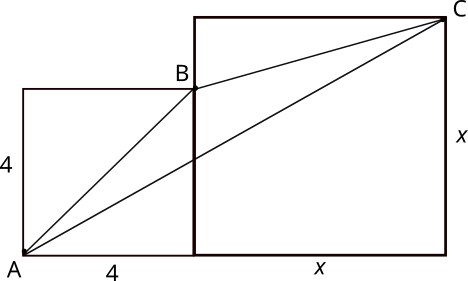
Given are two adjacent squares --- the smaller one of side length 4
and the larger one of side length $x$. Find the area of triangle ABC.
Problem 498 [Not Unipodal: SD paper 14: Jacobians]:
This problem is by
Source: Advanced Calculus (Taylor & Mann)
Title: Jacobians in Advanced Calculus
Presenter: Patrick
Problem 1: Given a surface defined by $F(x,y,z)=0$, we know that if $\partial F/\partial z\not=0$ then, by the Implicit Function Theorem, $z=z(x,y)$. Show that the direction of the normal to the surface is given by the direction ratios \begin{equation} \frac{\partial z}{\partial x}\quad:\frac{\partial z}{\partial y}\quad:\quad-1\,.\end{equation}
Problem 2: Show that, under a change of independent variable to $(u,v)$, the direction ratios of the normal can be given by \begin{equation} j_1\quad:\quad{}j_2\quad:\quad{}j_3 \end{equation} where \begin{equation} j_1=\left|\frac{\partial(y,z)}{\partial(u,v)}\right|\quad:\quad{}j_2=\left|\frac{\partial(z,x)}{\partial(u,v)}\right|\quad:\quad{} j_3=\left|\frac{\partial(x,y)}{\partial(u,v)}\right|\,. \end{equation}
Structured Differentiation Paper Fourteen.
Link to my write-ups on Structured Differentiation (SD).
Link to my write-up on Basic Matrix Algebra.
Problem 499 [Not Unipodal: SD Fifteen: Jacobians: Thermodynamics]:
This problem is by
This is my second of what I hope will be a series of articles explaining and
demonstrating the revisions that physicist E.T. Jaynes made to make
partial derivatives and jacobians easier in thermodynamics.
Found in article: ''Use of Jacobians in Thermodynamics,'' available from
on-line notes at
https://bayes.wustl.edu/etj/thermo/stat.mech.2.pdf
Given $x=x(u,v)$, $y=y(u,v)$, $z=z(u,v)$, show that \begin{equation} \left|\frac{\partial(A,B)}{\partial(u,v)}\right|\,dC + \left|\frac{\partial(B,C)}{\partial(u,v)}\right|\,dA + \left|\frac{\partial(C,A)}{\partial(u,v)}\right|\, dB =0\,. \end{equation} At this point, we can treat $u,v$ as dummy variables, and write \begin{equation} [AB]\,dC + [BC]\,dA + [CA]\, dB =0\,, \end{equation} which is Jaynes's equation (2-9).
Structured Differentiation Paper Fifteen.
Link to my write-ups on Structured Differentiation (SD).
Link to my write-up on Basic Matrix Algebra.
Problem 500 [Not Unipodal: Complex Numbers]:
This problem is by
Title: A Trig Identity
Presenter: Patrick
By use of complex numbers, establish the identity \begin{equation} \cos 5\theta = 16\cos^5\theta - 20\cos^3\theta + 5\cos \theta\,. \end{equation}
Solution to the problem.
Link to my write-up on Basic Complex Numbers.
Link to my write-up on Pascal's Triangle.
Problem 501 [Not Unipodal: Algebra]:
This problem is by
Source: ?
Title: Circle and hyperbola
Presenter: Patrick
Given the relations \begin{align} x^2 + y^2&= r^2\,,\\ x y &= \lambda\,, \end{align} find the values of $x,y$, where $r,\lambda$ are arbitrary positive real numbers.
Problem 502 [Not Unipodal: SD Sixteen: Partial Diff]:
This problem is by
Source: https://www.physicsforums.com/threads/for-this-partial
-derivative-why-are-different-results-obtained.1053100/
Title: For this Partial Derivative --
Why are different results obtained?
Presenter: Silvia2023
Given the relation \begin{equation} F(x,y)= Ax^2y\,, \end{equation} find the derivative \begin{equation} \frac{dF}{d(1/x)}\,. \end{equation}
Structured Differentiation Paper Sixteen.
Link to my write-ups on Structured Differentiation (SD).
Problem 503 [Not Unipodal: Group Theory]:
This problem is by
Source: Abstract Algebra
Title: A group theory problem
Presenter: Patrick
Let
\begin{equation}
G= \mbox{GL}_2(\Reals)\label{eq:GL_2(Reals)}
\end{equation}
be the set of all $2\times2$ matrices with real entries and
nonvanishing determinants. (`GL' stands for general
linear.)
Show that $G$ is a group. The binary operation here is
matrix multiplication.
Solution to the problem.
Link to my first write-up on Group Theory 1 (very basic).
Problem 504 [Not Unipodal: Euclid's Algorithm]:
This problem is by
Title: Applying Euclid's Algorithm
Presenter: Patrick
Given the relation \begin{equation} 18x - 25y = 1\,, \end{equation} solve for integers $x,y$.
Problem 505 [Not Unipodal: Complex Numbers]:
This problem is by
Source: https://www.youtube.com/watch?v=zoytksx8dPE
Title: A Nice Problem With Reciprocals | Problem 466
Presenter: aplusbi
Given the relation \begin{equation} z^2 - z + 1 = 0\,, \end{equation} find the value of \begin{equation} \phi = z^5+z^{-5}\,. \end{equation}
Problem 506 [Not Unipodal: Geometry]:
This problem is by
Source: https://www.youtube.com/watch?v=MCIyh1yVXNo
Title: 98% People Failed To Solve This!
Presenter: MathMinds
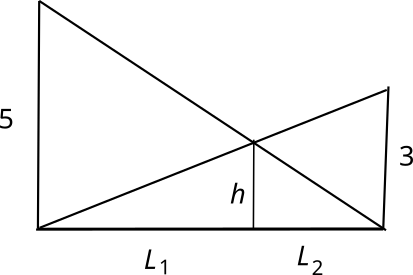
Given the relation presented in the following figure, solve for h.
Problem 507 [Not Unipodal: Logarithms]:
This problem is by
Source: https://www.youtube.com/watch?v=kiX0LOniuHM
Title: Find log_x (y)
Presenter: Prime Newtons
Given the relations \begin{align} x^{\log_y z}&= 2\,,\\ y^{\log_z x}&= 4\,,\\ z^{\log_x y}&= 8\,, \end{align} where $x,y,z>1$, find the value of $\log_x y$.
Problem 508 [Not Unipodal: Combinatorics]:
This problem is by
Source: https://www.youtube.com/watch?v=DVbvcKsmqbs
Title: A factorial exercise
Presenter: Prime Newtons
Prove the relation \begin{equation} \Bigg(\overset{\large n}{k}\Bigg)+ \left(\overset{\large n}{k-1}\right) = \left(\overset{\large n+1}{k}\right)\,. \end{equation}
Problem 509 [Not Unipodal: SD Seventeen: E.T. Jaynes]:
This problem is by
This is my third article explaining and demonstrating the revisions that
physicist E.T. Jaynes made to make partial derivatives and jacobians easier
in thermodynamics.
Found in article: ''Use of Jacobians in Thermodynamics,'' available from
on-line notes at
https://bayes.wustl.edu/etj/thermo/stat.mech.2.pdf
Given the relation \begin{equation} [ST] = [PV]\,, \end{equation} obtain the Maxwell relation \begin{equation} \left(\frac{\partial S}{\partial V}\right)_T = \left(\frac{\partial P}{\partial T}\right)_V \,. \end{equation}
Structured Differentiation Paper Seventeen.
Link to my write-ups on Structured Differentiation (SD).
Problem 510 [Unipodal: The Problem Redone]:
This problem is from
Source: https://www.youtube.com/watch?v=sYL9gc5kvIk
Title: A Nice Algebra Equation |
Math Olympiad Questions
Presenter: Maths Black Board (redone Problem 208)
Given the relations \begin{align} x+y&= 4\,,\\ x^5+y^5 &= 464\,, \end{align} find the values of $x,y$.
Problem 511 [Not Unipodal: Lambert: Integration]:
This problem is from
Title: A Lambert Integration
Presenter: Patrick
Do the following indefinite integral: \begin{equation} I(x) = \int x\, W(x)\, dx\,, \end{equation} where $W(x)$ is the Lambert $W$ function.
Solution to the problem.
Link to my write-up on the Lambert W function.
Problem 512 [Not Unipodal: Lambert]:
This problem is from
Source: https://www.youtube.com/watch?v=HXVlIEnbeLg
Title: How to solve for "x"
Presenter: Math Beast
Given the relation \begin{equation} e^x = x^2\,, \end{equation} find the values of $x$.
Solution to the problem.
Link to my write-up on the Lambert W function.
Problem 513 [Not Unipodal: Lambert]:
This problem is from
Source: https://cs.uwaterloo.ca/research/tr/1993/03/W.pdf
Title: `On the Lambert W Function'
Presenter: Corless, Gonnet, Hare, Jeffrey, Knuth
Given the relation \begin{equation} c = q(1+e^{-cR})\,, \end{equation} find the values of $c$
Solution to the problem.
Link to my write-up on the Lambert W function.
Problem 514 [Not Unipodal: Modern Physics: Lambert]:
This problem is from
Source: https://www.youtube.com/watch?v=B-EIkGzedhE
Title: Deriving Wien's law
Presenter: Physics and Math Lectures
Derive Wien's law from Planck's wavelength distribution of black body radiation: \begin{equation} u_\lambda(\lambda,T) = \frac{2hc^2}{\lambda^5}\frac{1}{\strut e^{hc/\lambda kT} - 1}\,. \end{equation}
Solution to the problem.
Link to my write-up on the Lambert W function.
Problem 515 [Not Unipodal: Lambert]:
This problem is from
Title: A Lambert problem
Presenter: Patrick
Given the relation \begin{equation} x e^{x^2} = y\,, \end{equation} find the real values of $x$.
Solution to the problem.
Link to my write-up on the Lambert W function.
Problem 516 [Not Unipodal: SD Eighteen: E.T. Jaynes]:
This problem is by
This is my fourth article explaining and demonstrating the revisions that
physicist E.T. Jaynes made to make partial derivatives and jacobians easier
in thermodynamics.
Found in article: ''Use of Jacobians in Thermodynamics,'' available from
on-line notes at
https://bayes.wustl.edu/etj/thermo/stat.mech.2.pdf
This time we have two equations to establish: Jaynes's (2-22) and (2-23): \begin{align} TdS &= C_PdT - T\left(\frac{\partial V}{\partial T}\right)_P dP\,,\\ \left(\frac{\partial U}{\partial V}\right)_T &=T \left(\frac{\partial P}{\partial T}\right)_V - P\,. \end{align}
Structured Differentiation Paper Eighteen.
Link to my write-ups on Structured Differentiation (SD).
Problem 517 [Not Unipodal: Logarithms: Lambert]:
This problem is by
Source: 3 years ago
Title: My Favorite Silly Identity (Members only)
[I am not a member.]
Presenter: BriTheMathGuy
Prove the relation \begin{equation} \sqrt{2}^{ \sqrt{2}} = 2^{1/ \sqrt{2}}\,. \end{equation}
Solution to the Problem..
Link to my write-up on the Lambert W function.
Link to my write-up on logarithms over the real numbers.
Problem 518 [Not Unipodal: Real Numbers]:
This problem is by
Title: Is it irrational?
Presenter: Patrick
Given that $\sqrt{2}$ is irrational, is \begin{equation} \phi = \sqrt{3+ \sqrt{2}} \end{equation} irrational?
Problem 519 [Not Unipodal: Mathematical Induction: finite products]:
This problem is by
Source: A typical induction problem
Use induction to prove this result.
Let $P(n)$ be the proposition that \begin{equation} \left(1-\frac{1}{2^2}\right)\left(1-\frac{1}{3^2}\right)\left(1- \frac{1}{4^2}\right)\cdots\left(1-\frac{1}{n^2}\right)=\frac{n+1}{2n} \end{equation} for all integers $n\ge2$.
Solution to this problem.
Link to my write-up on Mathematical Induction.
Problem 520 [Not Unipodal: Geometry: Trigonometry]:
This problem is by
Source: https://www.youtube.com/watch?v=Gh-pw1iMXiY
Title: Sweden Math Olympiad
Presenter: Math Booster
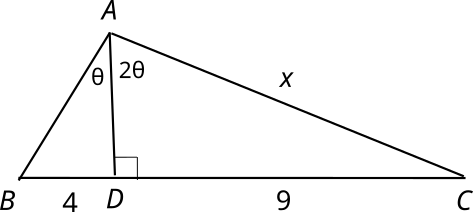
Determine the value of $x$ from the given information.
Problem 521 [Not Unipodal: Complex Numbers: Trigonometry]:
This problem is by
Title: A complex numbers problem
1) Use complex numbers to show that \begin{align} \cos 3\theta &= \cos^3\theta - 3\cos\theta \sin^2\theta \,,\\ \sin 3\theta &= 3\cos^2\theta \sin\theta- \sin^3\theta \,. \end{align} 2) And then use these results to show that \begin{equation} \tan 3\theta = \frac{3\tan \theta -\tan^3\theta}{1- 3\tan^2\theta}\,. \end{equation}
Problem 522 [Unipodal]:
This problem is by
Source: https://www.youtube.com/watch?v=aPdJpfEx_oo
Title: Italy | a nice Math Olympiad Question
Presenter: Math-X
Given the relation \begin{equation} \sqrt{1+\sqrt{1+x}} = x^{1/3}\,, \end{equation} find the real values of $x>0$.
Problem 523 [Not Unipodal: Basic Algebra]:
This problem is by
Source: https://www.youtube.com/shorts/et7_N2S79xU
Title: How fast can you crack this ricky SAT question?
Presenter: Your SAT Coach
Given the relation \begin{equation} 2 = p^{3}\,, \end{equation} find the value of $8p$. Choices:
A) $p^6$
B) $p^8$
C) $p^{10}$
D) $8\sqrt{2}$
Problem 524 [Not Unipodal: Basic Algebra]:
This problem is by
Source: https://www.youtube.com/watch?v=UWD7Z5iMyYk
Title:A Nice Algebra Problem | Math Olympiad |
Presenter: SALogic
Given the relation \begin{equation} \left( \frac{\sqrt{x}}{x}\right)^{x-1} = \left( \frac{x}{\sqrt{x}}\right)^{x-3} \,, \end{equation} find the positive real values of $x$.
Problem 525 [Not Unipodal: Ring Theory: Polynomials]:
This problem is by
Source: https://www.youtube.com/watch?v=WwqW-fSj_jA
Title: The sum of a nilpotent and a unit is a unit
Presenter: Coconut Math
Let $R$ be a commutative ring with unity element 1. If $u$ is a unit
in $R$ and $x$ is nilpotent in $R$, show that $x+u$ is also a unit in $R$.
Solution to this problem.
Link to my write-up on Basic Ring Theory, 1.
Problem 526 [Not Unipodal: Complex Numbers]:
This problem is by
Source: https://www.youtube.com/watch?v=MFxh4JSy0fg
Title: A Nice Cubic Equation | Problem 525
Presenter: aplusbi
Given the relation \begin{equation} z^3 + (2-i)z^2= 2iz \,, \end{equation} find the values of $z$.
Solution to this problem.
Link to my write-up on Basic Complex Numbers.
Problem 527 [Not Unipodal: Simple Algebra]:
This problem is by
Source: https://www.youtube.com/watch?v=Y8ob91CrCQc
Title: I got this asked as a Harvard interview question
Presenter: Higher Mathematics
Given the relation \begin{equation} \phi = \sqrt{3} - 1\,, \end{equation} find the value of $\phi^{10}$.
Note: The Presenter's version used the 8th power; I'm
using the 10th power.
Solution to this problem.
Link to my write-up on Basic Complex Numbers.
Problem 528 [Not Unipodal: Lambert: Complex Numbers]:
This problem is by
Source: https://www.youtube.com/watch?v=rLgZw5SNbXI
Title: Solving a 'Harvard' University entrance exam
Presenter: The Map of Mathematics
Given the relation \begin{equation} x^{625} = 5^x\,, \end{equation} find the values of $x$.
Note: I already solved this in Problem 426 using an
alpha subsitution.
Solution to this problem.
Link to my write-up on Basic Complex Numbers.
Link to my write-up on the Lambert W function.
Problem 529 [Not Unipodal: Complex Numbers]:
This problem is by
Source: https://www.youtube.com/watch?v=wxq60oaPjc0
Title: An Exponential Equation | Too Radical?
Presenter: SyberMath
Given the relation \begin{equation} (2+\sqrt{3})^x= \fourthroot{2-\sqrt{3}} \,, \end{equation} find the complex values of $x$.
Solution to this problem.
Link to my write-up on Basic Complex Numbers.
Problem 530 [Unipodal: Numerical Analysis]:
This problem is by
Source: https://www.youtube.com/watch?v=WVWePTHo8HI
Title: German Olympiad Question
Presenter: Higher Mathematics
Given the relation \begin{equation} 3^a + 2^a = 35\,, \end{equation} find the integer values of $a$.
After that, do similarly for the relation \begin{equation} 3^a + 2^a = 36\,, \end{equation} to find its real value solutions, which WolframAlpha claims is \begin{equation} a \approx 3.02799\,. \end{equation}
Problem 531 [Not Unipodal: Logarithms]:
This problem is by
Source: https://www.youtube.com/watch?v=Tu6W6QRV9pc
Title: China | Can you solve this?
Presenter: MathMinds
Given the relation \begin{equation} 2^a=3^b=5^c \,, \end{equation} find the values of \begin{equation} \phi = \frac{c}{a} + \frac{c}{b} \,. \end{equation} And for fun, find the values of $a,b,c$.
Solution to this problem.
Link to my write-up on logarithms over the real numbers.
Problem 532 [Not Unipodal: Lambert $W$ function]:
This problem is by
Source: https://www.youtube.com/watch?v=vtTU3JBCpns
Title: A Nice Algebra Problem
Presenter: SALogic
Given the relation \begin{equation} e^{x^2-1}=x\,, \end{equation} find the values of $x$.
Solution to this problem.
Link to my write-up on logarithms over the real numbers.
Problem 533 [Not Unipodal: Assisted by Table]:
This problem is by
Source: https://www.youtube.com/watch?v=_avyzbyAD9E
Title: A Nice Algebra Problem
Presenter: SALogic
Given the relation \begin{equation} x^{1/3} + x^{1/2} = 12 \,, \end{equation} find the real values of $x$.
Problem 534 [Not Unipodal: SD Nineteen: E.T. Jaynes]:
This problem is by
This is my fifth article explaining and demonstrating the revisions that
physicist E.T. Jaynes made to make partial derivatives and jacobians easier
in thermodynamics.
Found in article: ''Use of Jacobians in Thermodynamics,'' available from
on-line notes at
https://bayes.wustl.edu/etj/thermo/stat.mech.2.pdf
Among other things, establish the Joule-Thomson coefficient $ \left(\frac{\partial T}{\partial P}\right)_H=\mu$, \begin{equation} \mu = \frac{V}{C_P}\left(\beta T - 1\right)\,.\label{eq:Joule-Thompson} \end{equation}
Problem 535 [Not Unipodal: Logarithms]:
This problem is by
Source: https://www.youtube.com/watch?v=-Hxaz4SkgSs
Title: International Math Competition Problem:
Presenter: New Track Mathematics Video
Given the relation \begin{equation} 3^y+3^{2y} = 3^{3y}\,, \end{equation} find the values of $y$.
Solution to this problem.
Link to my write-up on logarithms over the real numbers.
Problem 536 [Not Unipodal: Geometry: Poor-Man's 'Butterfly Lemma']:
This problem is by
Source: https://www.youtube.com/shorts/IbLfCe0S7ZQ
Title: The Weirdest Question on the SAT
Presenter: Your SAT Coach
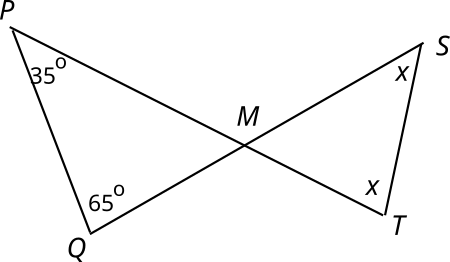
Determine the value of $x$ from the given information.
Problem 537 [Not Unipodal: Group Theory]:
This problem is by
Source: A common problem in group theory.
Let $G$ be a group, and let $f$ be a mapping of $G$ to $G$, such that \begin{equation} f(g) = g^{-1}\,. \end{equation} Show that $f$ is a one-to-one map.
Problem 538 [Not Unipodal: Logarithms]:
This problem is by
Source: https://www.youtube.com/watch?v=KnayG-Zi1Y0
Title: Solving a Nice Olympiad Mathematics Exponential Equation
Presenter: New Track Mathematics Video
Given the relation \begin{equation} (1+i)^x = 16\,, \end{equation} find all values of $x$.
Solution to this problem.
Link to my write-up on Basic Complex Numbers.
Problem 539 [Not Unipodal: Lambert]:
This problem is by
Source: https://www.youtube.com/watch?v=r35c9UBMxuI
Title: A Nice Algebra Problem
Presenter: SALogic
Given the relation \begin{equation} (1/2)^x=x/8\,, \end{equation} find the values of $x$.
Solution to this problem.
Link to my write-up on the Lambert W function.
Problem 540 [Not Unipodal: Group Theory]:
This problem is by
Source: A common problem in group theory.
Let $G$ be a group, and let $H,K$ be subgroups of $G$.
Show that $H \cap K$ (that is,
the intersection of $H$ and $K$) is a subgroup of $G$, expressed as:
\begin{equation}
H \cap K \le G\,.
\end{equation}
The Humor Corner (An essay):
Because I have no colleagues to present my material to for proofreading before I publish
it on the Web, I sometimes ask an LLM to review it for accuracy. And that's what I did
for my proof of this little problem. I asked Copilot to review it for accuracy, and after it
had, it gave me this report (in so many words): Well, it's correct and logical --- but would
you like me to write a better presentation of it for you?!
That reply shocked me because it was a first. I chuckled and I had to think carefully about it.
At first thought, I had to wonder if perhaps Copilot had been recently dating Grammarly. (Ha, ha!)
But, seriously, I had to stop and think if my presentation could be better than Copilot's,
or if any human's presentation could be better than Copilot's.
Just for the record, I did
not ask Copilot to present its improved version of my proof. First, because I was satisfied
with it. And, second, because I have a bad feeling about turning over mathematical proofs
to LLMs for noob expositions. (Though I might change my mind on this if I wanted Copilot
to translate my proof into some language that I'm not familiar with.)
But if I did get nontrivial assistance from Copilot, I would state that I got help from Copilot.
People often receive outside help with their papers, and then acknowledge that help with a
formal written thanks for their assistance, either for exposition, logic, or accuracy. So, I see
no problem with doing the same for help from an LLM.
But what are some negatives to blindly accepting an LLM to rewrite my proofs wholesale?
- On principle, some people might already have a strong bias against that.
- Could this make me lazy in my proofs and lead me to rely on LLMs
to complete them for me? - Will the LLM have the same emphasis and insight on how to present
proofs to noobs? I remember what I had trouble understanding when
I was a noob. - What will be lost to the reader if I submit my personal style of
presentation to an LLM? For example, I'm not against injecting a bit
of humor into my proofs, just to keep them from being boring or tedius.
Perhaps some people read what I write because they just like my style. - I write for a specific audience (often noobs) and I have to do so on the
basis of my own experience and intuition. Can an LLM do that?
On the other hand, I have often witnessed both ChatGPT and Copilot write a better
exposition of some material than I had when I presented it to them. They are quite
capable. But what are their limitations?
When I'm learning a subject new to me, I like to view or read the presentations of many
people, to get a variety of viewpoints on it. But if everyone passes their expositions
through some 'homogenizing' LLM referee, what would be left of the subjective views,
perspectives, wisdom, and styles of the original authors? So, I have to ask if an LLM
can remove all that subjective stuff and still create a 'better' version of the exposition
than the human did?
Now, if I were to present this essay of mine to Copilot to improve its presentation,
could it do so? Ironically, I think it probably could. But this is not a math theorem;
it's just a pros-vs-cons essay, and LLMs have shown themselves to be masters of that,
at least to my satisfaction.
Problem 541 [Not Unipodal: Lambert]:
This problem is by
Source: https://www.youtube.com/watch?v=vLvURYicuLc
Title: Structured Differentiation for Advanced Calculus
Presenter: SyberMath
Given the relation \begin{equation} \sqrt{x+a}=e^x\quad(a>0)\,, \end{equation} find the values of $x$.
Solution to this problem.
Link to my write-up on the Lambert W function.
Problem 542 [Not Unipodal: Lambert]:
This problem is by
Source: https://www.youtube.com/watch?v=ZyH3FBzquQ0
Title: YOU Must-Know ... to Prepare for International Math Olympiad
Presenter: Math-X
Given the relation \begin{equation} x^{x^2}= 2\,, \end{equation} find the real values of $x$.
Solution to this problem.
Link to my write-up on the Lambert W function.
Problem 543 [Not Unipodal: SD: Twenty]:
This problem is by
Source: One of my older papers.
Title: Structured Differentiation for Advanced Calculus, 1
Presenter: Patrick
Taylor & Mann have their problems trying to present a consistent
notation and vocabulary too. On page 271 we find: Consider the
function $G(x,y)$ as a function of $u$ and $y$, with $x=f(u,y)$. The
partial derivative with respect to $y$ is
\begin{equation}
\frac{\partial G}{\partial x} \frac{\partial f}{\partial y}+ \frac{\partial G}{\partial y}
=\frac{\displaystyle\left|\frac{\partial (F,G)}{\partial (x,y)}\right|}{\displaystyle\frac{\partial F}{\partial x}}=0\,,
\end{equation}
where I have inserted the determinant symbols to conform to SD.
Solution to this problem.
Link to my write-ups on Structured Differentiation (SD).
Problem 544 [Not Unipodal: Logarithms]:
This problem is by
Source: https://www.youtube.com/watch?v=aTaEBktzFsE
Title: A Nice Algebra Problem | Math Olympiad
Presenter: SALogic
Given the relation \begin{equation} 9^{x+1} - 9^{x-1}= 20\,, \end{equation} find the real values of $x$.
Solution to this problem.
Link to my write-up on logarithms over the real numbers.
Problem 545 [Not Unipodal: Algebra]
This problem is by
Source: https://www.youtube.com/watch?v=7VOwC35DFZw
Title: Math Olympiad | A Nice Algebra Problem
Presenter: MathMinds
Given the relations \begin{align} 2^a \cdot 5^b &= 50\,,\\ 2^b \cdot 5^a &= 20\,, \end{align} find the integer values of $a,b$.
Problem 546 [Not Unipodal: Logarithms]:
This problem is by
Source: https://www.youtube.com/watch?v=Dm-iKG3hpo0
Title: A MIT Math Test Logarithm Problem
Presenter: MyMathProgress
Given the relations \begin{align} a\cdot 2^b &=8 \,,\\ a^b &=2 \,, \end{align} find the real values of \begin{equation} \phi=a^{\log_2a}\ 2^{b^2} \,. \end{equation}
Solution to this problem.
Link to my write-up on logarithms over the real numbers.
Problem 547 [Not Unipodal: Physics: Infinite Continued Fraction: Self-similarity]:
This problem is by
Source: University Physics (Sears & Zemansky, Addison Wesley 4th ed).
Title: A Neat Physics Problem (resistance network)
Presenter: Patrick
Prove that the resistance of the following network is equal to $(1+\sqrt{3})r$.
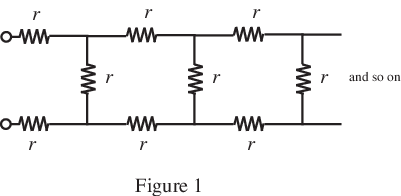
Problem 548 [Not Unipodal: Logarithms]:
This problem is by
Source: https://www.youtube.com/watch?v=hquxO73_Ytc
Title: Harvard Entrance Exam Question
Presenter: Math Beast
Given the relation \begin{equation} \log_4\,(\log_3 x)^3= 4.5\,, \end{equation} find the real values of $x$.
Solution to this problem.
Link to my write-up on logarithms over the real numbers.
Problem 549 [Not Unipodal: SD: Twenty-one]:
This problem is by
Source: One of my older papers.
Title: Structured Differentiation for Advanced Calculus, 2
Presenter: Patrick
From page 191 , problem 4 reads: $u=f(x,y,z)$, $v=g(x,y,z)$ are solutions of
$F(x,y,z,u,v)=0$, $G(x,y,z,u,v)=0$. Let $K(x,y,z)=H(x,y,z,f(x,y,z),g(x,y,z))$.
Show that (under suitable conditions)
\begin{equation}
\frac{\partial K}{\partial z}
=\frac{\displaystyle\left|\frac{\partial(F,G,H)}{\partial(z,u,v)}\right|}{\displaystyle\left|\frac{\partial(F,G)}{\partial(u,v)}\right|}\,.
\end{equation}
Solution to this problem.
Link to my write-ups on Structured Differentiation (SD).
Link to my write-up on Basic Matrix Algebra.
Problem 550 [Not Unipodal: Self-similarity: Golden Ratio: Infinite Continued Fraction]:
This problem is by
Source: The ether of mathematics
Title: A Neat continued fraction Problem
Presenter: Patrick
What's the value of $x$ defined in the continued fraction \begin{equation} x=1+\cfrac{1}{1+\cfrac{1}{1+\cfrac{1}{ 1+\cfrac{1}{1+\cfrac{1} {1+\cfrac{1}{1+\cfrac{1}{1+\cdots}}}}}}}\quad? \end{equation}
Problem 551 [Unipodal]:
This problem is by
Source: https://www.youtube.com/watch?v=R_ouo5iekqw
Title: A Nice Algebra Problem | Math Olympiad
Presenter: SALogic
Given the relation \begin{equation} (x+2)^4+x^4 = 80\,, \end{equation} find the real values for $x$.
Note: I inadvertantly solved a slightly different problem.
Problem 552 [Not Unipodal: Lambert]:
This problem is by
Source: https://www.youtube.com/watch?v=kOPR-V2-ggc
Title: A nice algebra question
Presenter: mathmasteryminds
Given the relation \begin{equation} 4^{-x}= x\,, \end{equation} find the real values of $x$.
Solution to this problem.
Link to my write-up on the Lambert W function.
Problem 553 [Not Unipodal: Geometry: Trigonometry]:
This problem is by
Source: https://www.youtube.com/watch?v=GJcHkq7HzgM
Title: SAT Geometry Problem
Presenter: Brain Station
Determine the value of $x$ from the information in the figure.
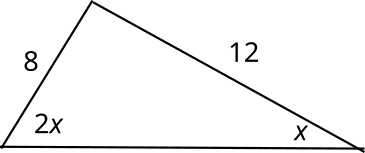
Problem 554 [Not Unipodal: Discrete Mathematics]:
This problem is by
Source: https://www.youtube.com/watch?v=e4iXxNNaj00
Title: This Simple Trick Solves Math Problem in Seconds!
Presenter: Magna Math
What's the value of the following sum? \begin{equation} \phi = \sum_{n=5}^{100}(3n-2)\,. \end{equation}
Problem 555 [Not Unipodal: Lambert]:
This problem is by
Source: https://www.youtube.com/watch?v=VKp2j9qD8ts
Title: United kingdom l how to solve this nice math Olympiad problem
Presenter: J Educational Tutorials
Given the relation \begin{equation} 6^{x}= 6x + 24\,, \end{equation} find all values of $x$ and specify the two real values of $x$.
Solution to this problem.
Link to my write-up on the Lambert W function.
Problem 556 [Not Unipodal: Assisted by Table]:
This problem is by
Source: https://www.youtube.com/watch?v=1vWDG0TibB4
Title: Germany | can you solve this ?
Presenter: MathMastery_Minds
Given the relation \begin{equation} 4^{n} + 3^{n} = 91 \,, \end{equation} find the real values of $n$.
Problem 557 [Not Unipodal]:
This problem is by
Source: https://www.youtube.com/watch?v=KhT6IT2viDg
Title: Final Result Will Blow Your Mind!
Presenter: Brain Station Videos
Given the relation \begin{equation} \phi = \cuberoot{7+\sqrt{50}} + \cuberoot{7-\sqrt{50}} \,, \end{equation} find the real values of $\phi$.
Solution to this problem.
Link to my write-up on Pascal's Triangle.
Problem 558 [Not Unipodal: Geometric Algebra]:
This problem is by
Source: New Foundation for Classical Mechanics (textbook)
Title: Vector dual to bivector.
Presenter: Patrick
On page 63 of NFCM (New Foundation for Classical Mechanics), we find Problem (3.8):
Let $\bB = \half B_{\ell p}\,\bsigma_\ell\wedge\bsigma_p$ (sum on
repeated indices)
be a bivector and $\bb = b_k\bsigma_k$
(sum on
repeated indices) be a vector and they are related by the equation
\begin{equation}
\bB = i\bb\,.
\end{equation}
Prove that $B_{ij} = \epsilon_{ijk}b_k$, where $ \epsilon_{ijk} \definedas i^\dagger\bsigma_i\wedge \bsigma_j\wedge\bsigma_k$.
Problem 559 [Not Unipodal: Assisted by Table]:
This problem is by
Source: https://www.youtube.com/watch?v=IxO6lM2Vwo0
Title: Math Olympiad
Presenter: Learncommunolizer
Given the relation \begin{equation} \frac{(x+6)!}{(x+2)!} = 1680 \,, \end{equation} find the integer values of $x$.
Problem 560 [Not Unipodal: Word Problem]
This problem is by
Source: https://www.youtube.com/watch?v=wQrM5usqXAQ
Title: Tea Price Doubled
Presenter: TableClass Math
The cost of your favorite tea doubled, with 7% tax
you now pay $12.50. What was the original price?
Problem 561 [Not Unipodal: Number Theory: Euler Totient Function]:
This problem is by
Source: A common lemma in number theory.
Let $\varphi(n)$ be the number of positive integers less than
$n$ that are relatively prime
to $n$. Let $p$ be a prime and $k$ a positive
integer. Show that
\begin{equation}
\varphi(p^k) = p^k - p^{k-1}\,.
\end{equation}
Problem 562 [Not Unipodal: Trigonometry]:
This problem is by
Source: https://www.youtube.com/watch?v=ursa591tldU
Title: An Interesting Trigonometric Equation
Presenter: SyberMath
Given the relation \begin{equation} \tan x\ \tan (x+1) = 1\,, \end{equation} solve for $x$.
Problem 563 [Not Unipodal: Logarithms]:
This problem is by
Source: https://www.youtube.com/watch?v=AAn_ZTsExiM
Title: A very Difficult Logarithm & Exponents Question
Presenter: Maths & Olympiad
Given the relation \begin{equation} 5^{\log_2 \cuberoot{x}}\cdot \sqrt{x}^{\ \log_{2\sqrt{2}}3}= 15^{2}\,, \end{equation} find the real values of $x$.
Solution to this problem.
Link to my write-up on logarithms over the real numbers.
Problem 564 [Not Unipodal: Finite Continued Fraction]:
This problem is by
Source: https://www.youtube.com/watch?v=HM1KagtoRuk
Title: A Harder Math Question from China Elementary School
Presenter: Math Beast
Given the relation \begin{equation} 1+\cfrac{1}{a+\cfrac{1}{b+\cfrac{1}{ c}}}= \frac{17}{10}\,, \end{equation} where $a,b,c$ are integers, solve for $a,b,c$.
Problem 565 [Not Unipodal: Algebra: Complex Numbers]:
This problem is by
Source: The Ether of Mathematical Ideas
Title: How to eliminate the first-order term
Presenter: Patrick
Given the relation \begin{equation} \frac{1}{x^2}+ \frac{1}{(x+1)^2} = 1\,, \end{equation} find the complex values of $x$.
Problem 566 [Not Unipodal: Assisted with a Table]:
This problem is by
Source: https://www.youtube.com/watch?v=Bm88kuDqcpk
Title: Harvard University Interview Math Tips & Tricks
Presenter: Smart Math Tricks
Given the relation \begin{equation} x^y - y^x = 17 \,, \end{equation} find the integer values of $x,y$.
Problem 567 [Not Unipodal: Alpha Substitution: Lambert]:
This problem is by
Source: https://www.youtube.com/watch?v=tblj-TPkOfU
Title:A tricky question from old math book (1955 year)
Presenter: Higher Mathematics
Given the relation \begin{equation} x^{x}= 2^{2048}\,, \end{equation} find all real values of $x$.
Solution to this problem.
Link to my write-up on the Lambert W function.
Problem 568 [Not Unipodal: Logarithms] RB, JB
This problem is by
Source: https://www.youtube.com/watch?v=8825HXv3ADs
Title: Logarithm - System of Equations
Presenter: Maths & Olympiad
Given the relations \begin{align} \log_x y + \log_y x &= \frac{26}{5}\,,\\ xy &= 64\,, \end{align} find the values of $x,y$.
Solution to this problem.
Link to my write-up on logarithms over the real numbers.
Problem 569 [Not Unipodal: SD: Twenty-two]:
This problem is by
Source: One of my older papers.
Title: Structured Differentiation for Advanced Calculus, 3
Presenter: Patrick
Let $w(\bx)=w(r(\bx),\phi(\bx))$ be given by $\bx=(x,y)^t$ and \begin{equation} \begin{cases} x=r\cosh\phi\\ y=r\sinh\phi \end{cases}\,. \end{equation} Find the derivatives of $w$ with respect to $x,y$ in terms of derivatives of $r,\phi$.
Solution to this problem.
Link to my write-ups on Structured Differentiation (SD).
Link to my write-up on Basic Matrix Algebra.
Problem 570 [Not Unipodal: Alpha Substitution: Lambert]:
This problem is by
Source: https://www.youtube.com/watch?v=WBpxl44Egzk
Title: Can you solve this Tricky Exponential Algebra Question?
Presenter: Maths & Olympiad
Given the relation \begin{equation} x^{5x^{95}}= 1444\,, \end{equation} find all real values of $x$.
Solution to this problem.
Link to my write-up on the Lambert W function.
Problem 571 [Not Unipodal: Logarithms]:
This problem is by
Source: https://www.youtube.com/watch?v=bLKECNiNiF8
Title: Solving log values with different bases
Presenter: Math Beast
Given the relation \begin{equation} \log_4 x + \log_{16}x + \log_2 x = 7\,, \end{equation} find the real values of $x$.
Solution to this problem.
Link to my write-up on logarithms over the real numbers.
Problem 572 [Not Unipodal: Trigonometry]:
This problem is by
Source: https://www.youtube.com/watch?v=1Sx3Fn-MRQw
Title: THE DERIVATIVE OF THE ARCOTANGENT.
Presenter: Matematicas con Juan
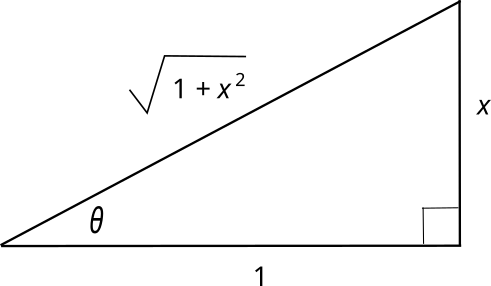
Problem 573 [Not Unipodal: SD: Twenty-three]:
This problem is by
Source: One of my older papers.
Title: Structured Differentiation for Advanced Calculus, 4
Presenter: Patrick
Let $\bx=\bx(\bu)$ where $\bx$ is the new fundamental, $\bu$ is the old fundamental, $\bx=(x,y,z)^t$, $\bu=(u,v,w)^t$, show that \begin{equation} \frac{\partial x}{\partial u} =\abspartial{v}{w}{y}{z}\left|\frac{\partial(x,y,z)}{\partial(u,v,w)}\right|\,.\end{equation}
Solution to this problem.
Link to my write-ups on Structured Differentiation (SD).
Link to my write-up on Basic Matrix Algebra.
Problem 574 [Not Unipodal: Logarithms: Geometric Series]: E.N.
This problem is by
Source: https://www.youtube.com/watch?v=skK2GefAgg8
Title: Logarithm & Algebra
Presenter: Maths & Olympiad
Given the relation \begin{equation} x = 4^{\log_{8}\sqrt{18\sqrt{5}-17}}\,, \end{equation} simplify $x$ and then find \begin{equation} \phi = \frac{1}{x} + \frac{1}{x^2} + \frac{1}{x^3} + \cdots\,. \end{equation}
Solution to this problem.
Link to my write-up on logarithms over the real numbers.
Problem 575 [Not Unipodal: Alpha Substitution: Lambert]:
This problem is by
Source: https://www.youtube.com/watch?v=I8X2pMJlD9Q
Title: Unleashing Your Math Skills:
Presenter: Numbers & Numbers
Given the relation \begin{equation} x^{x}= 7^{x+49}\,, \end{equation} find all real values of $x$.
Solution to this problem.
Link to my write-up on the Lambert W function.
Problem 576 [Not Unipodal: SD: Twenty-four]:
This problem is by
Source: One of my older papers.
Title: Structured Differentiation for Advanced Calculus, 4
Presenter: Patrick
Given \begin{equation} \begin{cases}xy+x^2u-vu^2=5\,,\cr x+4uy-v^2u=20\,,\cr\end{cases} \end{equation} find $\partial u/\partial x$, $\partial u/\partial y$, $\partial v/\partial x$, $\partial v/\partial x$.
Solution to this problem.
Link to my write-ups on Structured Differentiation (SD).
Link to my write-up on Basic Matrix Algebra.
Problem 577 [Not Unipodal: Lambert]
This problem is by
Source: https://www.youtube.com/watch?v=xuugqqgG6d4
Title: Oxford entrance exam question
Presenter: Math Beast
Given the relation \begin{equation} x^{1/x}= e^{\pi/2}\,, \end{equation} find all values of $x$.
Solution to this problem.
Link to my write-up on the Lambert W function.
Problem 578 [Unipodal]
This problem is by
Source: https://www.youtube.com/watch?v=U0F7CqXZ0IA
Title: A very interesting algebra math simplification
Presenter: Math Beast
Given the relations \begin{align} m + n&= 2\,,\\ m^4 + n^4 &= 272\,, \end{align} find the values of $\phi = mn$.
Problem 579 [Not Unipodal: Exponential]
This problem is by
Source: https://www.youtube.com/watch?v=O8rdQyUzhgU
Title: Harvard University Admission Interview Tricks
Presenter: Super Academy
Given the relation \begin{equation} 6 = 216^{8^{3x^{-1}}}\,, \end{equation} find all real values of $x$.
Problem 580 [Not Unipodal: Word Problem]
This problem is brought to you by the Ether of Mathemtical Ideas
In what ratio should water be added to a liquid costing \$12
per liter so as to make a profit of 25% by selling the
diluted liquid at \$13.75 per liter?
Problem 581 [Not Unipodal: Trigonometry]
This problem is by
Source: https://www.youtube.com/watch?v=JmyfgUglUzA
Title: Unlocking Trigonometric Secrets
Presenter: Numbers & Numbers
Given the relation \begin{equation} \phi_+ = \sin \theta +\cos\theta = \frac{7}{5}\,, \end{equation} find all real values of \begin{equation} \phi_- = \sin \theta - \cos\theta\,. \end{equation}
Problem 582 [Unipodal]
This problem is by
Source: https://www.youtube.com/watch?v=sV3u3F7ABzw
Title: Cambridge University Interview Trick
Presenter: Higher Mathematics
Given the relations \begin{align} a + b&= 1\,,\\ a^2 + b^2 &= 2\,, \end{align} find the values of \begin{equation} \phi = a^8 + b^8\,. \end{equation}
Problem 583 [Not Unipodal: Table Assistance]
This problem is by
Source: https://www.youtube.com/watch?v=EZO2Eqoew2A
Title: Can You Solve This?
Presenter: Brain Station
Given the relations \begin{align} x^2 + y^2 &= 7\,,\\ x^3 + y^3 &= 10\,, \end{align} find the values \begin{equation} \phi =x+y\,, \end{equation} over the reals.
Problem 584 [Not Unipodal: Lambert]
This problem is by
Source: https://www.youtube.com/watch?v=2JJOd4ZgeEU
Title: Can You Dare To Touch This?
Presenter: Brain Station Advanced
Given the relation \begin{equation} F(x,y) = x^{y}\,, \end{equation} which satisfies constraint \begin{equation} x + y = 6\,, \end{equation} find all values of $x$ which maximize $F$.
Solution to this problem.
Link to my write-up on the Lambert W function.
Problem 585 [Not Unipodal: Word Problem: Geometry]:
This problem is by
Source: https://www.youtube.com/watch?v=OF_MA2bRTMI
Title: Can You Solve This?
Presenter: Brain Station Advanced
In the graphic below, we are given enough information to solve for $x$,
which
is the side length of a square. What is the area of the square?
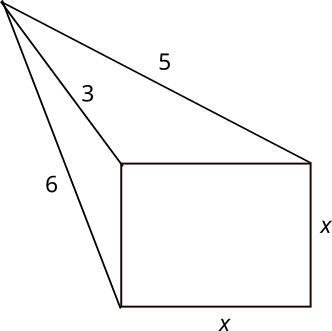
Problem 586 [Not Unipodal: Word Problem: Percentages]:
This problem is by
Source: https://www.youtube.com/watch?v=p86xIM03aXk
Title: Why is it NOT 1?
Presenter: Brain Station
In a room of 100 people, 99% are left-handed. How many left-handed
have to leave the room to bring that percentage down to 98%?
Problem 587 [Not Unipodal: Word Problem: Creativity in Mathematics]:
This problem is by
Source: https://www.youtube.com/watch?v=agOetV8b87U
Title: Is there creativity in Maths? The History
of Mathematics with Luc de Brabandere
Presenter: What Makes It Tick?
Consider the following 12 numbers.
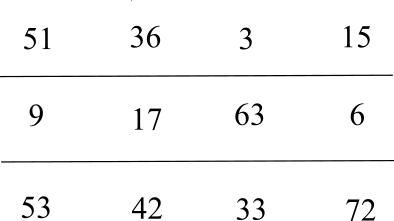
A subset of these twelve numbers add to 100.
Can you find them?
Problem 588 [Not Unipodal: Logarithms]:
This problem is by
Source: https://www.youtube.com/watch?v=pMGz4fVXqGE
Title: Are YOU smart enough to get into Cambridge?
Presenter: Math Queen
Given the relation \begin{equation} 3^x - (\sqrt{3})^{x+4} + 20 = 0 \,, \end{equation} find the sum of the real solutions to $x$.
Solution to this problem.
Link to my write-up on logarithms over the real numbers.
Problem 589 [Not Unipodal: Algebra]:
This problem is by
Source: https://www.youtube.com/watch?v=LK-9oM_BQh4
Title: Can You Solve This Math Olympiad?
Presenter: Brain Station Advanced
Given the relation \begin{equation} 2^a + 2^b +2^c = 148 \,, \end{equation} find the positive integer values of $a,b,c$, subject to the constraint: $a>b>c$.
Problem 590 [Not Unipodal: Word Problem: Scheme: Chemistry]
(My pedagogic discussion of this problem I had with Copilot can be found at
Acetate Bodies as the conserved quantity. Copilot calls on chemists to extend
the methodology, if possible.)
So, in one of my chemistry textbooks cite{Hein&Arena}, I found this problem
(presented here somewhat paraphrased):
( M. Hein and S. Arena, Foundations of College Chemistry, alternate 12th ed,
John Wiley & Sons (2007), 421--422.)
What is the [H$^+$] in 0.50 $M$ HC$_2$H$_3$O$_2$ solution? The
ionization constant $K_a$ for HC$_2$H$_3$O$_2$ is $1.8\times 10^{-5}$.
Given the equilibrium state of the ionization reaction (for acetic acid) \begin{equation} \text{HC$_2$H$_3$O$_2$} \rightleftharpoons \text{ H$^+$ + C$_2$H$_3$O$_2{}^-$}\,, \end{equation} the ionization constant given to us as \begin{equation} K_a = \frac{\text{ [H$^+$] [C$_2$H$_3$O$_2{}^-$]}}{\text{[HC$_2$H$_3$O$_2$]}} = 1.8 \times 10^{-5}\,. \end{equation}
Solution to this problem.
Link to my write-up on Word Problem solving.
Link to my home page on Word Problem solving.
Problem 591 [Not Unipodal: SD: Twenty-five]:
This problem is by
https://www.physicsforums.com/threads/partial-differentiation
-problem-multiple-variables-chain-rule.753651/
Given the relations \begin{align} z &= x^2 + 2y^2\,,\\ x &= r \cos \theta\,,\\ y &= r \sin \theta\,, \end{align} find the partial derivative $\displaystyle\left(\frac{\partial z}{\partial \theta}\right)_x$.
Solution to this problem.
Link to my write-ups on Structured Differentiation (SD).
Link to my write-up on Basic Matrix Algebra.
Problem 592 [Not Unipodal: Geometric Algebra]:
This problem is by
Source: New Foundation for Classical Mechanics (textbook)
Title: Vector dual to bivector.
Presenter: Patrick
On page 93 of NFCM \cite{HestenesNFCM}, we find problem (6.6): Find the point
of intersection of the line defined by the set of all $\bx$ satisfying the equation
\begin{equation}
(\bx - \ba)\wedge \bu = 0 \,,
\end{equation}
and the plane defined by the set of all points $\by$ defined by
\begin{equation}
(\by - \bb)\wedge \bB = 0 \,,
\end{equation}
where $\bu\wedge\bB \ne 0$.
Solution to the problem.
Link to my write-up on Basic Geometric Algebra.
Problem 593 [Not Unipodal: Integration]
This problem is by
Source: https://www.youtube.com/watch?v=OTGiyXfCu5Q
Title: Can you solve this Integration Problem
Presenter: Ankit Physics Gurukul
Integrate the following integral: \begin{equation} I = \int \frac{x}{3-2x}\, dx\,. \end{equation}
Problem 594 [Not Unipodal: Logarithms]
This problem is by
Source: https://www.youtube.com/watch?v=OTGiyXfCu5Q
Title: Exercício de Potenciacao e Radiciacao
Presenter: @matematicaempauta
Given the relation: \begin{equation} t^{\sqrt{t}} = \sqrt{t^t}\,, \end{equation} solve for the values of $t$.
Solution to this problem.
Link to my write-up on logarithms over the real numbers.
Problem 595 [Not Unipodal: Integration]
This problem is by
Source: https://www.youtube.com/watch?v=MqVACSgL1HQ
Title: Austrailia Can you solve this partial fraction integral
Presenter: Ankit Physics Gurukul
Integrate the following integral: \begin{equation} I = \int \frac{3x^2}{1+3x^2}\, dx\,.\end{equation}
Problem 596 [Not Unipodal: Use of Differential Forms in Thermodynamics, Part 1]:
This is my first (and maybe last) article explaining and demonstrating the use
of differential forms in thermodynamics. My source for this article is: ''Beginner's
guide to differential forms in thermodynamics,'' available on-line,
by V. Tymchyshyn (2016).
The physical content of this paper centers on the equation: \begin{equation} dU = TdS - PdV\,. \end{equation} Use differential forms to prove the result: \begin{equation} \left(\frac{\partial U}{\partial V}\right)_T = T\, \left(\frac{\partial P}{\partial T}\right)_V - P\,. \end{equation}
Differential Forms in Thermodynamics, Part 1.
Problem 597 [Not Unipodal: Word Problem: Percentages]:
A merchant has 100 lbs of sugar, part of which ($x$ lbs) he sells at 7%
profit and the rest ($y$ lbs) at 17% profit. The division of the whole into
two parts is to be made so that the net profit is the same as 10% on each
original quantity of sugar. How much is each part?
Problem 598 [Not Unipodal: Practice with Logarithms]:
Source: The ether of mathematical ideasProve the identity: \begin{equation} \log_{n^k} a^k =\log_{n} a \end{equation}
Title: Practice with Logarithms
Presenter: Patrick
Problem 599 [Not Unipodal: alpha substitution: Assisted with table]:
Source: https://www.youtube.com/shorts/swZmfHgE_UUGiven the relation \begin{equation} x^{x} = 2^{2048}\,, \end{equation} find the real values of $x$.
Title: The trickiest problem on the SAT
Presenter: YourSATCoach (shorts)
To go to Diversions1 page Link to Diversions1
To go to Diversions2 page Link to Diversions2
To go to Diversions4 page Link to Diversions4
To go to Diversions5 page Link to Diversions5
To go to Diversions6 page Link to Diversions6